Creating Antimatter On The Desktop — One Day

If you watch Star Trek, you will know one way to get rid of pesky aliens is to vent antimatter. The truth is, antimatter is a little less exotic than it appears on TV, but for a variety of reasons there hasn’t been nearly as much practical research done with it. There are well over 200 electron accelerators in labs around the world, but only a handful that work with positrons, the electron’s anti-counterpart. [Dr. Aakash Sahai] would like to change that. He’s got a new design that could bring antimatter beams out of the lab and onto the desktop. He hasn’t built a prototype, but he did publish some proof-of-concept simulation work in Physical Review Accelerators and Beams.

Today, generating high-energy positron beams requires an RF accelerator — miles of track with powerful electromagnets, klystrons, and microwave cavities. Not something you are going to build in your garage this year. [Sahai] is borrowing ideas from electron laser-plasma accelerators (ELPA) — a technology that has allowed electron accelerators to shrink to mere inches — and turned it around to create positrons instead.

Continue reading “Creating Antimatter On The Desktop — One Day”

Raspberry Shake Detects Quakes

The Raspberry Pi’s goal, at least while it was being designed and built, was to promote computer science education by making it easier to access a working computer. What its low price tag also enabled was a revolution in distributed computing projects (among other things). One of those projects is the Raspberry Shake, a seismograph tool which can record nearby earthquakes.

Of course, the project just uses the Pi as a cost-effective computing solution. It runs custom software, but if you want to set up your own seismograph then you’ll also need some additional hardware. There are different versions of the Raspberry Shake, the simplest using a single Geophone which is a coil and magnet. Vibrations are detected by sensing the electric signal generated by the magnet moving within the coil of wire. Other models increase the count to three Geophones, or add in MEMS accelerometers, you can easily whip one of these up on your own bench.

The entire setup will fit nicely on a coffee table as well, making it much smaller (and cheaper) than a comparable professional seismograph. Once all of the Raspberry Shakes around the world were networked together, it gives an accurate, real-time view of seismic activity anywhere you can imagine. If you’ve ever been interested in geology or just want to see where the latest earthquake was, check out their projects. But you don’t need even a Raspberry Pi to see where the earthquakes are, thanks to a Hackaday Prize entry all you need is a Twitter account.

Thanks to [Rich Cochran] aka [AG6QR] for the tip!

Electrostatically Accelerated Ping-Pong Ball Travels The Circuit

There is a special breed of hardware hacker whose playground lies in the high voltage arena. Their bench sizzles with the ozone and plasma of Tesla coils, and perhaps it’s best not to approach it without a handy fluorescent light tube to sniff for unseen hazards. There are many amazing things that can come of these experiments, and fortunately for those of us who lack the means or courage to experiment with them there are many YouTube videos to satisfy our curiosity.

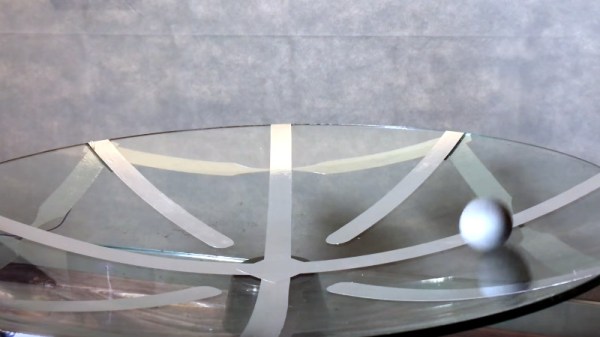
One such comes from [Plasma channel], in the form of a table-top ping-pong ball accelerator. It lacks impressive sparks  but makes up for it in scientific edification, because it uses static electricity to send a conductive-paint-coated ping-pong ball spinning round the inside of a curved glass bowl. It does this using alternate positive and negatively charged strips of aluminium tape on the inside of the bowl, each of which charges the ball as it rolls over it, then giving it a bit of repulsive force to keep it spinning. His power comes from a couple of small Wimshurst machines, but no doubt other similar generators could be used instead.

The whole is an entertaining if a little hazardous talking point, and a fun weekend build. The parts are easy enough to find that you might even have them to hand. If continued electrostatic diversion floats your boat, you might like to read our recent excursion into the subject.

Continue reading “Electrostatically Accelerated Ping-Pong Ball Travels The Circuit”

Scanning Tunneling Microscope Packs The Bits

We don’t usually think of a microscope as an active instrument, but researchers in Canada have used a scanning tunneling microscope to remove or replace single hydrogen atoms from the surface of a hydrogen-passivated silicon wafer. If the scientific paper is too much to wade through, there’s an IEEE Spectrum article and a video that might run on the 6 o’clock news below.

As usual with these research projects, there is good news and there is bad news. The good news is that — in theory — a memory device made using hydrogen lithography could store 138 terabytes per square inch. That’s enough, apparently, to store the entire iTunes catalog on a quarter. The bad news? Well, right now this takes exotic lab equipment at very low temperatures and pressures.

Continue reading “Scanning Tunneling Microscope Packs The Bits”

Junk Bin Spin Coater Uses Modded Case Fan

We’ve all been there: you need a specific tool or gadget to complete a project, but it’s not the kind of thing you necessarily want to fork over normal retail price for. It could be something you’re only going to use once or twice, or maybe you’re not even sure the idea is going to work and don’t want to invest too much money into it. You cast a skeptical towards the ever-growing pile of salvaged parts and wonder…

Inspiration and a dig through the junk bin is precisely how [Nixie] built this very impressive spin coater for use in his ongoing homemade semiconductor project. If you’ve never had first hand experience with a spin coater, don’t worry, not many people have. Put simply, it’s a machine that allows the user to deposit a thin layer of material on a disc by way of centrifugal force. Just place a few drops in the center of the disc, then spin it up fast enough and let physics do the rest.

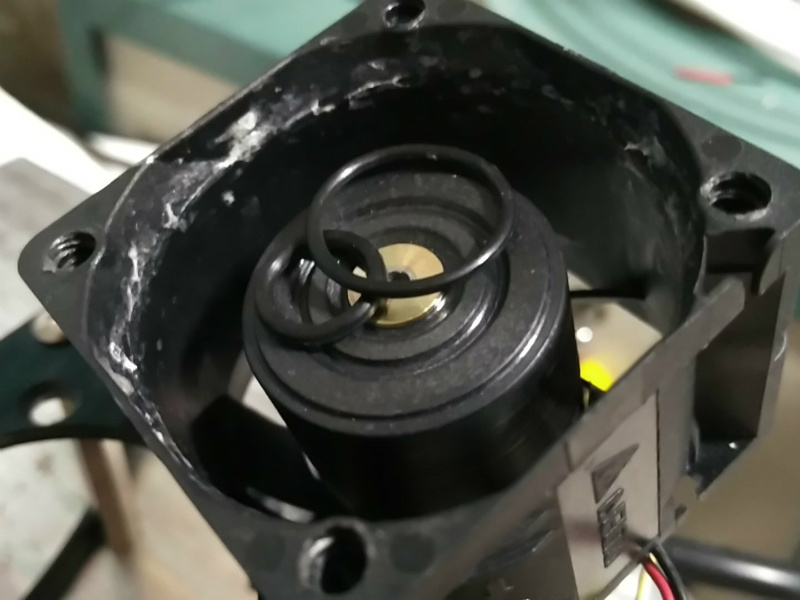
[Nixie] only needs to spin up a fairly tiny disc, and realized the hub of a 40x40mm brushless case fan was just about the perfect size. A quick pass through the lathe stripped the hub of its blades and faced off the front. Once he found a tube that was the exact same diameter of the fan’s axle, he realized he could even use a small vacuum pump to hold his disc in place. A proper seal is provided by 10 and 16 mm OD o-rings, installed into concentric grooves he machined into the face of the hub.

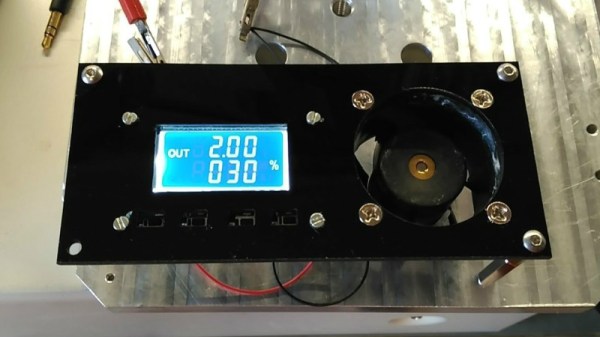
With a way to draw a vacuum through the hub of the spinner he just needed the pump. As luck would have it, he didn’t have to wait for one to make the journey from China, as he had one of those kicking around his junk bin from a previous project. The only thing he ended up having to buy was the cheap PWM fan controller which he mounted along with the modified fan to a piece of black acrylic; producing a fairly professional looking little piece of lab equipment. Check out the video after the break for a brief demonstration of it in action.

This isn’t the first specialized piece of gear [Nixie] has produced in his quest for DIY chips. We’ve previously covered his DIY tube oven as well as his vacuum chamber complete with magnetically controlled manipulator arm.

Continue reading “Junk Bin Spin Coater Uses Modded Case Fan”

Frozen Rat Kidney Shipping Container

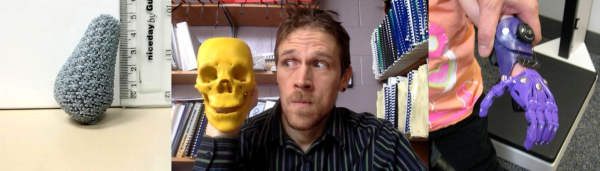
The biggest allure of 3D printing, to us at least, is the ability to make hyper-personalized objects that would otherwise fall through the cracks of our mass-market economy. Take, for instance, the Frozen Rat Kidney Shipping Container, or maybe some of the less bizarro applications in the US National Institute of Health’s 3D Print Exchange.

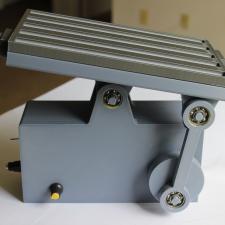
The Exchange is dominated, at least in terms of sheer numbers, by 3D models of proteins and other biochemical structures. But there are two sections that will appeal to the hacker in you: prosthetics and lab equipment. Indeed, we were sent there after finding a nice model of a tray-agitator that we wanted to use for PCB etching. We haven’t printed one yet, but check out this flexible micropositioner.

While it’s nowhere near as comprehensive a resource as some other 3D printing model sites, the focus on 3D printing for science labs should really help those who have that particular itch to find exactly the right scratcher. Or a tailor-made flexible container for slicing frozen rat kidneys. Whatever you’re into. We don’t judge.

Man with skull image: [jaqtikkun]

Changing Color Under Pressure

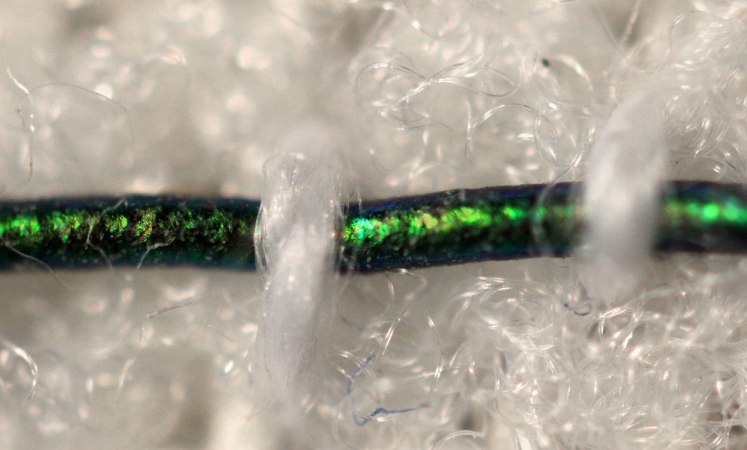
When you saw the picture for this article, did you think of a peacock’s feather? These fibers are not harvested from birds, and in fact, the colors come from transparent rubber. As with peacock feathers, they come from the way light reflects off layers of differing materials, this is known as optical interference, and it is the same effect seen on oil slicks. The benefit to using transparent rubber is that the final product is flexible and when drawn, the interference shifts. In short, they change color when stretched.

Most of the sensors we see and feature are electromechanical, which has the drawback that we cannot read them without some form of interface. Something like a microcontroller, gauge, or a slew of 555 timers. Reading a single strain gauge on a torque wrench is not too tricky, but simultaneously reading a dozen gauges spread across a more complex machine such as a quadcopter will probably require graphing software to generate a heat map. With this innovation it could now be done with an on-board camera in real-time. Couple that with machine learning and perhaps you could launch Skynet. Or build a better copter.

The current proof-of-concept weaves the fibers into next-generation bandages to give an intuitive sense of how tightly a dressing should be applied. For the average first-aid responder, the rule is being able to slide a finger between the fabric and skin. That’s an easy indicator, but it only works after the fact whereas saying that the dressing should be orange while wrapping gives constant feedback.