Growing Up With Computers

My son is growing up with computers. He’s in first grade, and had to list all of the things that he knows how to do with them. The list included things like mousing around, drawing ghosts with the paint program, and — sign of the times — muting and unmuting the microphone when he’s in teleconferences. Oh yeah, and typing emojis. He loves emojis.

When I was just about his age, I was also getting into computers. But home computers back then were in their early years as well. And if I look back, I’ve been getting more sophisticated about computers at just about the same pace that they’ve been getting more sophisticated themselves. I was grade school during the prime of the BASIC computers — the age of the Apple II and the C64. I was in high school for the dawn of the first Macs and the Amiga. By college, the Pentiums’ insane computational abilities just started to match my needs for them to solve numerical differential equations. And in grad school, the rise of the overclockable multi-cores and GPUs powered me right on through a simulation-heavy dissertation.
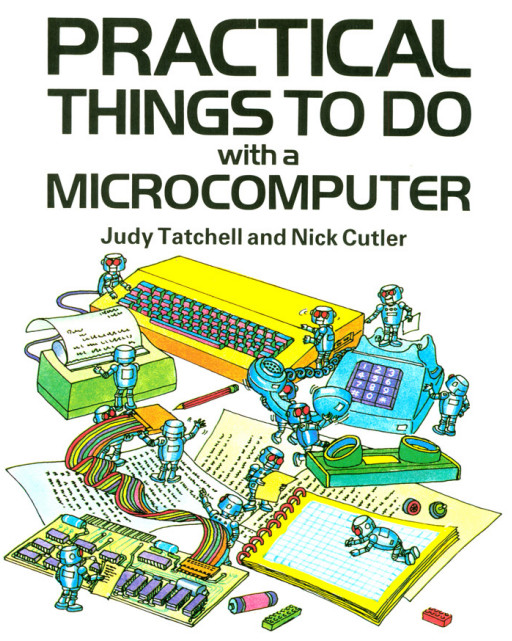
We were both so much younger then.

When I was a kid, they were playthings, and as a grownup, they’re powerful tools. Because of this, computers have never been intimidating. I grew up with computers.

But back to my son. I don’t know if it’s desirable, or even possible, to pretend that computers aren’t immensely complex for the sake of a first grader — he’d see right through the lie anyway. But when is the right age to teach kids about voice recognition and artificial neural networks? It’s a given that we’ll have to teach him some kind of “social media competence” but that’s not really about computers any more than learning how to use Word was about computers back in my day. Consuming versus creating, tweeting versus hacking. Y’know?

Of course every generation has its own path. Hackers older than me were already in high-school or college when it became possible to build your own computer, and they did. Younger hackers grew up with the Internet, which obviously has its advantages. Those older than me made the computers, and those younger have always lived in a world where the computer is mature and taken for granted. But folks about my age, we grew up with computers.


Hackaday Podcast 123: Radioactive Rhinos, Wile E. Coyote Jetpack, Radio Hacks 3-Ways, And Battery Welders On The Spot

Hackaday’s Mike Szczys is taking a bit of vacation this week, so Elliot is joined by Staff Writer Dan Maloney to talk about all the cool hacks and great articles that turned up this week. Things were busy, so there was plenty to choose from, but how would we not pick one that centers around strapping a jet engine to your back to rollerskate without all that pesky exercise? And what about a light bulb that plays Doom – with a little help, of course. We’ll check out decals you can make yourself and why the custom keyboard crowd might want to learn that skill, learn about the other “first computer”, and learn how a little radiation might be just what it takes to save an endangered species.

Take a look at the links below if you want to follow along, and as always, tell us what you think about this episode in the comments!

Direct download (55 MB or so.)

Places to follow Hackaday podcasts:

Continue reading “Hackaday Podcast 123: Radioactive Rhinos, Wile E. Coyote Jetpack, Radio Hacks 3-Ways, And Battery Welders On The Spot”

This Week In Security: Updates, Leaks, Hacking Old Hardware, And Making New

First off, Apple has issued an update for some very old devices. Well, vintage 2013, but that’s a long time in cell-phone years. Fixed are a trio of vulnerabilities, two of which are reported to be exploited in the wild. CVE-2021-30761 and CVE-2021-30762 are both flaws in Webkit, allowing for arbitrary code execution upon visiting a malicious website.

The third bug fixed is a very interesting one, CVE-2021-30737, memory corruption in the ASN.1 decoder. ASN.1 is a serialization format, used in a bunch of different crypto and telecom protocols, like the PKCS key exchange protocols. This bug was reported by [xerub], who showed off an attack against locked iPhone immediately after boot. Need to break into an old iPhone? Looks like there’s an exploit for that now. Continue reading “This Week In Security: Updates, Leaks, Hacking Old Hardware, And Making New”

How To Get Into Cars: Land Speed Racing

Land speed racing is one of the oldest forms of motorsport, and quite literally consists of going very, very fast in (ideally) a straight line. The higher the speed your car can attain, the better! It’s about the pure pursuit of top speed above all else, and building a car to compete is a calling for a dedicated few. If you’d like to join them, here’s how to go about it.

Faster, Faster, Faster!

A great example of the “36HP” Volkswagen class, which challenges competitors to set land speed records using only classic VW engines, with categories for various levels of modification. Note the aero wheels and raked stance. Credit: Utah Salt Flats Racing Association

While taking the outright land speed record typically requires a jet-engined sled of singular design, there is plenty of land speed competition to be had in various classes for competitors fielding their own entries. There are vintage classes for older technology engines, still popular from the dawn of hotrodding, like Ford Flathead V8s and other contemporary motors. There are also classes split by engine displacement, number of cylinders, aerodynamic modifications, or the type of fuel used.

Racers often pick a record or set of records they wish to beat – for example, wanting to set the the fastest speed for a gasoline-powered, naturally-aspirated four cylinder – and build their car to that end. Alternatively, a racer might build a car with a large V8 engine, for example, to compete in one class, and then disable several cylinders on a later run to try and snatch records in lower classes as well. Continue reading “How To Get Into Cars: Land Speed Racing”

Where Are All The Cheap X86 Single Board PCs?

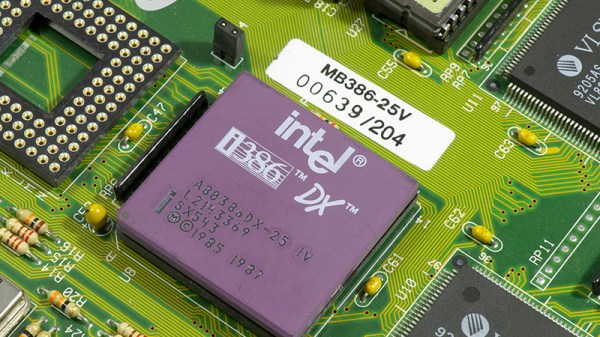
If we were to think of a retrocomputer, the chances are we might have something from the classic 8-bit days or maybe a game console spring to mind. It’s almost a shock to see mundane desktop PCs of the DOS and Pentium era join them, but those machines now form an important way to play DOS and Windows 95 games which are unsuited to more modern operating systems. For those who wish to play the games on appropriate hardware without a grubby beige mini-tower and a huge CRT monitor, there’s even the option to buy one of these machines new: in the form of a much more svelte Pentium-based PC104 industrial PC.

Continue reading “Where Are All The Cheap X86 Single Board PCs?”

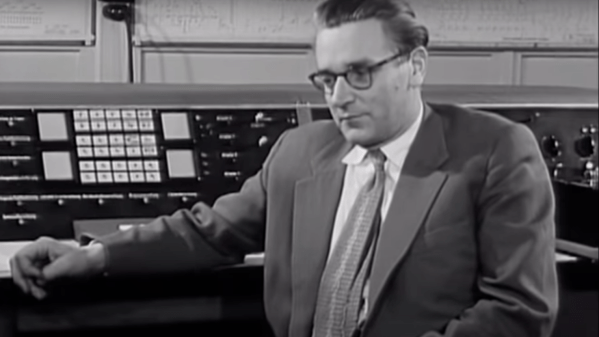
The Other First Computer: Konrad Zuse And The Z3

Bavarian Alps, Dec. 1945:

Since 1935, Berlin engineer Konrad Zuse has spent his entire career developing a series of automatic calculators, the first of their kind in the world: the Z1, Z2, Z3, S1, S2, and Z4. He accomplished this with a motley group of engineers, technicians, and mathematicians who were operating against all odds. With all the hardships and shortages of war and the indifference of their peers, the fact that they succeeded at all is a testament to their dedication and resourcefulness. And with the end of the war, more hardships have been piling on.

Two years ago, during the Battle of Berlin, bombers completely destroyed the Zuse family home and adjacent workshops on the Methfesselstraße, where they performed research and fabrication. All of the calculators, engineering drawings, and notes were lost in the rubble, save for the new Z4 nearing completion across the canal in another workshop on Oranienstraße. In the midst of all this, Zuse married in January of this year, but was immediately plunged into another crisis when the largest Allied air raid of the war destroyed the Oranienstraße workshop in February. They managed to rescue the Z4 from the basement, and miraculously arranged for it to be shipped out of the Berlin. Zuse, his family, and colleagues followed soon thereafter. Here and there along the escape route, they managed to complete the final assembly and testing of the Z4 — even giving a demonstration to the Aerodynamics Research Institute in Göttingen.

On arrival here in the Bavarian Alps, Zuse found a ragtag collection of refugees, including Dr Werner Von Braun and a team of 100 rocket scientists from Peenemünde. While everyone here is struggling just to stay alive and find food and shelter, Zuse is further worried with keeping his invention safe from prying eyes. Tensions have risen further upon circulation of a rumor that an SS leader, after three bottles of Cognac, let slip that his troops aren’t here to protect the scientists but to kill them all if the Americans or French approach.

In the midst of all this madness, Zuse and his wife Gisela welcomed a baby boy, and have taken up residence in a Hinterstein farmhouse. Zuse spends his time working on something called a Plankalkül, explaining that it is a mathematical language to allow people to communicate with these new machines. His other hobby is making woodblocks of the local scenery, and he plans to start a company to sell his devices once the economy recovers. There is no doubt that Konrad Zuse will soon be famous and known around the world as the father of automatic computers. Continue reading “The Other First Computer: Konrad Zuse And The Z3”

Your 1958 Punch Card Machine Tested Tubes

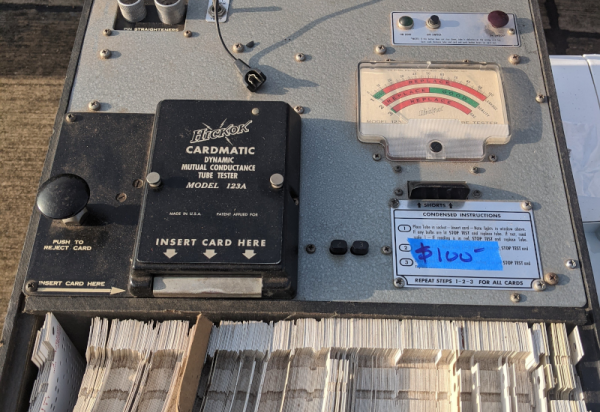
We think of punched cards as old-fashioned, but still squarely part of the computer age. Turns out, cards were in use way before they got conscripted by computers. Jacquard looms are one famous example. The U.S. Census famously used punched cards for tabulating the census without anything we’d consider a computer. But in the 1950s, you might have had a punched card machine on your electronics workbench. The Hickok Cardmatic was a tube tester with a difference.

About Tube Testers

While you, as a Hackaday reader, might tear into a busted TV at your house and try to fix it, most people today will either scrap a bad set or pay someone to fix it. That’s fine today. TVs are cheap and rarely break, anyway. But this hasn’t always been the case.

In the “good old days” your expensive TV broke down all the time. Most of the parts were reliable, but the tubes would wear out. If you were the kind of person who would change your own oil, you’d probably look to see if you could spot a burned out tube and try replacing it. If you couldn’t spot it, you’d pull all the tubes out. If you were lucky, there was a diagram glued inside the cover that showed where they all went back. Then you took them to the drugstore.

Continue reading “Your 1958 Punch Card Machine Tested Tubes”