
Fun With Negative Resistance II: Unobtanium Russian Tunnel Diodes

In the first part of this series, we took a look at a “toy” negative-differential-resistance circuit made from two ordinary transistors. Although this circuit allows experimentation with negative-resistance devices without the need to source rare parts, its performance is severely limited. This is not the case for actual tunnel diodes, which exploit quantum tunneling effects to create a negative differential resistance characteristic. While these two-terminal devices once ruled the fastest electronic designs, their use has fallen off dramatically with the rise of other technologies. As a result, the average electronics hacker probably has never encountered one. That ends today.
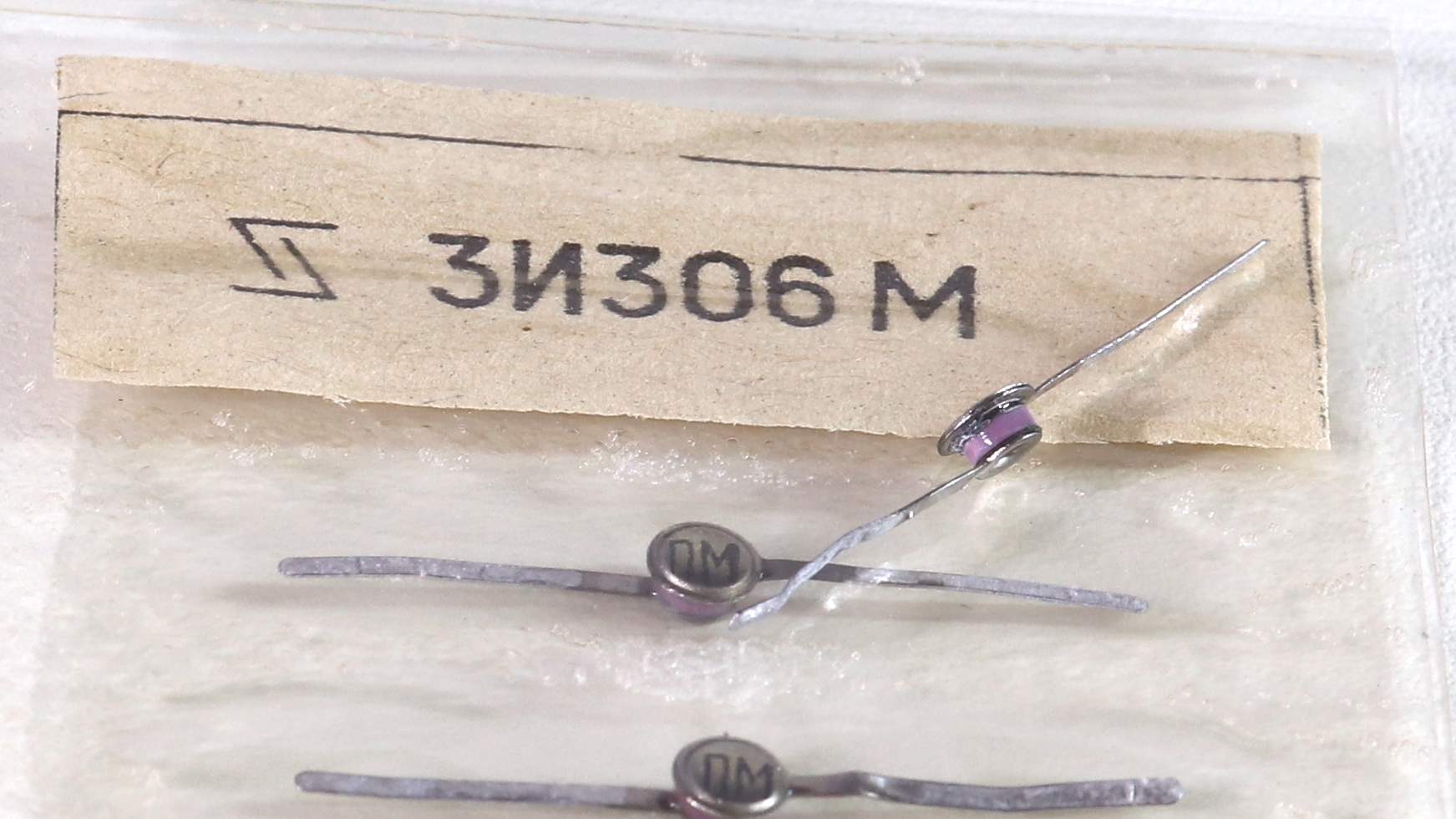
Due to the efficiencies of the modern on-line marketplace, these rare beasts of the diode world are not completely unobtainable. Although new-production diodes are difficult for individuals to get their hands on, a wide range of surplus tunnel diodes can still be found on eBay for as little as $1 each in lots of ten. While you’d be better off with any number of modern technologies for new designs, exploring the properties of these odd devices can be an interesting learning experience.

For this installment, I dug deep into my collection of semiconductor exotica for some Russian 3И306M gallium arsenide tunnel diodes that I purchased a few years ago. Let’s have a look at what you can do with just a diode — if it’s the right kind, that is.

[Note: the images are all small in the article; click them to get a full-sized version]

Continue reading “Fun With Negative Resistance II: Unobtanium Russian Tunnel Diodes” →

It Is ‘Quite Possible’ This Could Be The Last Bay Area Maker Faire

The Bay Area Maker Faire is this weekend, and this might be the last one. This report comes from the San Francisco Chronicle, and covers the continuing problems of funding and organizing what has been called The Greatest Show and Tell on Earth. According to Maker Media CEO Dale Dougherty, “it is ‘quite possible’ that the event could be the Bay Area’s last Maker Faire.”

Maker Faire has been drawing artists, craftspeople, inventors, and engineers for more than a decade. In one weekend you can see risque needlepoint, art cars meant for the playa, custom racing drones, science experiments, homebrew computers, gigantic 3D printers, interactive LED art, and so much more. This is a festival built around a subculture defined by an act of creation; if you do something with your hands, if you build something, or if you make something, Maker Faire has something for you. However you define it, this is the Maker Movement and since 2006, there has been a Maker Faire, a festival to celebrate these creators.

It’s sad to learn the future of this event is in peril. Let’s take a look at how we got here and what the future might hold.

Continue reading “It Is ‘Quite Possible’ This Could Be The Last Bay Area Maker Faire” →

The Great Ohio Key Fob Mystery, Or “Honey, I Jammed The Neighborhood!”

Hack long enough and hard enough, and it’s a pretty safe bet that you’ll eventually cause unintentional RF emissions. Most of us will likely have our regulatory transgression go unnoticed. But for one unlucky hacker in Ohio, a simple project ended up with a knock at the door by local authorities and pointed questions to determine why key fobs and garage door remotes in his neighborhood and beyond had suddenly been rendered useless, and why his house seemed to be at the center of the disturbance.

Few of us want this level of scrutiny for our projects, so let’s take a more in-depth look at the Great Ohio Key Fob Mystery, along with a look at the Federal Communications Commission regulations that govern what you can and cannot do on the airwaves. As it turns out, it’s easy to break the law, and it’s easy to get caught.

Continue reading “The Great Ohio Key Fob Mystery, Or “Honey, I Jammed The Neighborhood!”” →

The Amazing New World Of Gallium Nitride

From the heart of Silicon Valley comes a new buzzword. Gallium nitride is the future of power technology. Tech blogs are touting gallium nitride as the silicon of the future, and you are savvy enough to get in on the ground floor. Knowing how important gallium nitride is makes you a smarter, better consumer. You are at the forefront of your peer group because you know of an up and coming technology, and this one goes by the name of gallium nitride.

OK, gallium nitride is more than just a buzzword. It is, indeed, important materials science. Gallium nitride is a semiconductor that allows for smaller electronics, more powerful electric cars, better solar cells, and is the foundation of all LED lighting solutions today. Time will tell, but it may well mark a revolution in semiconductors. Here’s what you need to know about it now.

Continue reading “The Amazing New World Of Gallium Nitride” →

This Week In Security: Backdoors In Cisco Switches, PGP Spoofing In Emails, Git Ransomware

Some switches in Cisco’s 9000 series are susceptible to a remote vulnerability, numbered CVE-2019-1804 . It’s a bit odd to call it a vulnerability, actually, because the software is operating as intended. Cisco shipped out these switches with the same private key hardcoded in software for all root SSH logins. Anyone with the key can log in as root on any of these switches.

Cisco makes a strange claim in their advisory, that this is only exploitable over IPv6. This seems very odd, as there is nothing about SSH or the key authentication process that is IPv6 specific. This suggests that there is possibly another blunder, that they accidentally left the SSH port open to the world on IPv6. Another possibility is that they are assuming that all these switches are safely behind NAT routers, and therefore inaccessible through IPv4. One of the advantages/disadvantages of IPv6 is that there is no NAT, and all the network devices are accessible from the outside network. (Accessible in the sense that a route exists. Firewalling is still possible, of course.)

It’s staggering how many devices, even high end commercial devices, are shipped with unintentional yet effective backdoors, just like this one. Continue reading “This Week In Security: Backdoors In Cisco Switches, PGP Spoofing In Emails, Git Ransomware” →

Hacking The Ionosphere, For Science

Imagine what it must have been like for the first human to witness an aurora. It took a while for our species to migrate from its equatorial birthplace to latitudes where auroras are common, so it was a fairly recent event geologically speaking. Still, that first time seeing the shimmers and ribbons playing across a sky yet to be marred by light pollution must have been terrifying and thrilling, and like other displays of nature’s power, it probably fueled stories of gods and demons. The myths and legends born from ignorance of what an aurora actually represents seem quaint to most of us, but it was as good a model as our ancestors needed to explain the world around them.

Our understanding of auroras needs to be a lot deeper, though, because we now know that they are not only a beautiful atmospheric phenomenon but also a critical component in the colossal electromagnetic system formed by our planet and our star. Understanding how it works is key to everything from long-distance communication to keeping satellites in orbit to long-term weather predictions.

But how exactly does one study an aurora? Something that’s so out of reach and so evanescent seems like it would be hard to study. While it’s not exactly easy science to do, it is possible to directly study auroras, and it involves some interesting technology that actually changes them, somehow making the nocturnal light show even more beautiful.

Continue reading “Hacking The Ionosphere, For Science” →