Fast 3D Printing With Raspberry Pi — But Not How You Think

Although we tend to think of 3D printers as high-tech toys, most of them are not especially powerful in the brain department. There are some exceptions, but most 3D printers run on either an 8-bit Arduino or some Arduino variant with a lot of I/O. There are a few 32-bit boards, but if you grab a random 3D printer, its brain is going to be an 8-bit AVR running something like Marlin or Repetier. It isn’t uncommon to see a Raspberry Pi connected to a printer, too, but — again, in general — it is a network interface that handles sending G-code to the 8-bit controller that runs the stepper motors. Would it make more sense to do things like parse G-code, map out curves, and set accelerations in the relatively powerful Raspberry Pi and relegate the 8-bit AVR to just commanding motors and heaters? [KevinOConnor] thinks so, and he wrote Klipper to prove it.

Klipper is mostly written in Python and it does most of the functions of traditional 3D printing firmware. It communicates with the onboard microprocessor by providing a schedule of when to do what tasks. The microprocessor then handles the timing and things like motion control for the axes and extruder. Klipper can control multiple microprocessors with no trouble and keeps them in synchronization, so you could have a processor for your extruder and one for each stepper, for example. You can use Klipper with a Cartesian machine, a delta, or a Core XY-style printer.

Continue reading “Fast 3D Printing With Raspberry Pi — But Not How You Think”
The WiFi Repeater You Probably Have On Your Bench

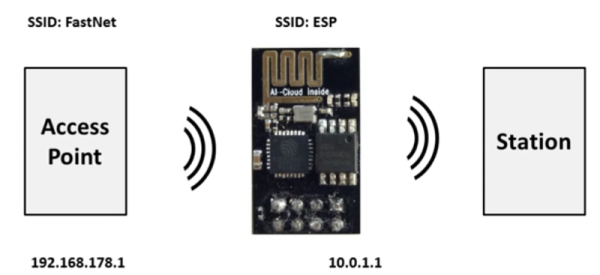
Few things are as frustrating as a WiFi signal that drops in and out. On a public network it is bad enough but at home? Even if you can live with it, your cohabitants will certainly impune your technical abilities if they don’t have solid WiFi.  One solution is a WiFi repeater. You can buy one, of course. But you can also make one out of an ESP8266 and some code from GitHub. There is also a video about the project, below.

[Martin Ger’s] code implements NAT, so it isn’t a true WiFi repeater, but more of a bridge or router. Of course, that means performance isn’t stellar, but tests show it can sustain about 5 Mbps, which isn’t bad for a little board that costs a couple of bucks. There is a limit of 8 clients, but that’s more than enough for a lot of cases. Even if you don’t want to use it as a router, it has a mesh mode that could be a basis for some interesting projects all by itself.

Continue reading “The WiFi Repeater You Probably Have On Your Bench”

How Much Of A Battery Pack Does Your Electric Car Need?

[Elon Musk] recently staged one of his characteristic high-profile product launches, at which he unveiled a new Tesla electric semi-truck. It was long on promise and short on battery pack weight figures, so of course [Real Engineering] smelled a rat. His video investigating the issue is below the break, but it’s not the link that caught our eye for this article. As part of the investigation he also created an online calculator to estimate the battery size required for a given performance on any electric vehicle.

It’s not perfectly intuitive, for example it uses SI units rather than real-world ones so for comparison with usual automotive figures a little mental conversion is needed from kilometres and hours to metres and seconds if you’re a metric user, and miles if you use Imperial-derived units. But still it’s a fascinating tool to play with if you have an interest in designing electric cars or conversions, as you can tweak the figures for your chosen vehicle indefinitely to find the bad news for your battery pack cost.

It’s very interesting from a technical standpoint to see a credible attempt at an electric truck, and we hope that the existing truck manufacturers will show us more realistic prototypes of their own. But we can’t help thinking that the overall efficiency of electric long-distance trucking could be improved hugely were they to make a truck capable of hauling more than one trailer at once. Any safety issues could be offset by giving these super-trucks their own highways, and with such dedicated infrastructure the power could be supplied from roadside cables rather than heavy batteries. In such circumstances these long trains of electrically hauled containers could be rather successful, perhaps we might call them railroads.

Continue reading “How Much Of A Battery Pack Does Your Electric Car Need?”

Low-Power Motor Can Run For Years On A Coin Cell

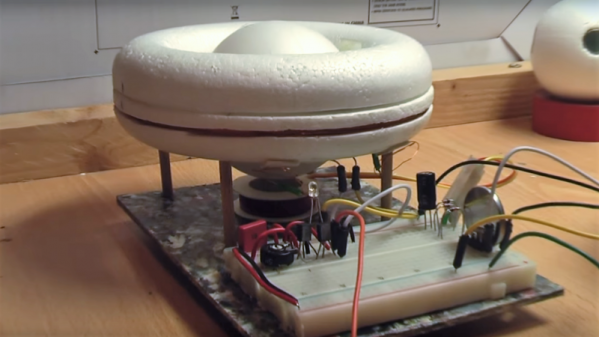
Can you run an electric motor for two years on a single lithium coin cell? [IamWe] figured out how to do it, and even though his donut motor doesn’t look like any motor we’ve ever seen before, it’s a pretty solid lesson in low-current design.

The donut motor is really just a brushless DC motor with a sign-pole stator and a multi-pole rotor. The frame of the motor is built from a styrofoam donut, hence the motor’s name. The rotor is a styrofoam sphere with neodymium magnets embedded around its equator. A sharpened bicycle spoke serves as an axle, and clever magnetic bearings provide near-zero friction rotation. The stator coil comes from an old solenoid and is driven by a very simple two-transistor oscillator. [IamWe]’s calculations show that the single CR2032 coin cell should power this motor for over two years. This one looks easy enough to whip up that it might make a nice project for a long winter’s night. Watch it spin in the video below.

This one seems like a perfect entry for the Coin Cell Challenge contest. Sure, it may not be a coin cell jump starter for your car, but our guess is this motor will still be spinning in 2020, and that’s no mean feat.

Continue reading “Low-Power Motor Can Run For Years On A Coin Cell”

Watch Video On A Oscilloscope With An ESP32

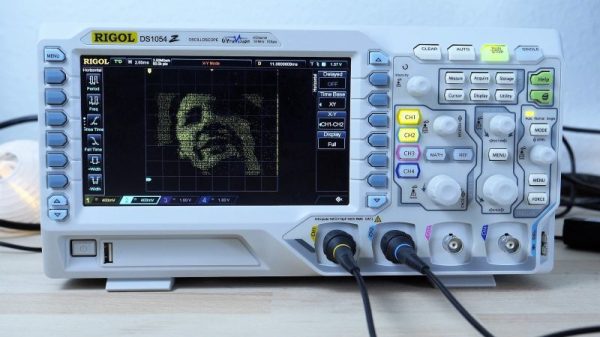
[bitluni] got a brand new scope, and he couldn’t be happier. No, really — check the video below; he’s really happy. And to celebrate, he turned his scope into a vector display using an ESP32.

Using a scope in X-Y mode is nothing new, of course. The technique is used to display everything from Lissajous patterns from an SDR to bouncing balls from an analog computer. Taken on as more of an exercise to learn how to use his new tool than a practical project, [bitluni]’s project starts by using two DACs on an ESP32 to create simple Lissajous patterns to learn about the scope’s controls. Next he built some code to display 3D point clouds, but learned that the native DAC code wasn’t up to the job. A little hacking improved the speed 27-fold, which was enough for great 3D images and live video from an I²S camera module. The latter was accomplished by grabbing frames from the camera and rendering them pixel by pixel, CRT style. The results are pretty clean, and there’s a lot to be learned about both using scopes as X-Y displays and tweaking the ESP32 for maximum performance.

Need more background on the ESP32? Start by checking out these ESP32 tutorials.


Continue reading “Watch Video On A Oscilloscope With An ESP32”

16-Cylinder Stirling Engine Gets A Tune Up

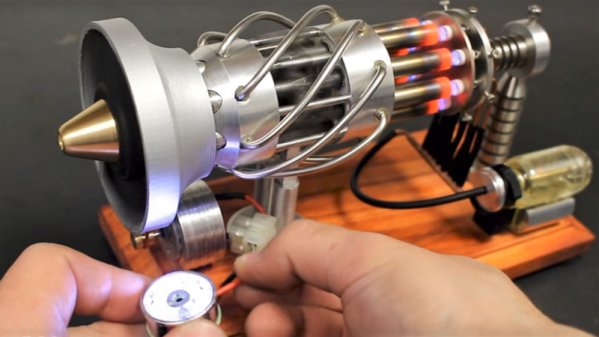
Tiny catapults, kinetic sculptures, a Newton’s Cradle — all kinds of nifty toys can adorn the desk of the executive in your life. On the high end of the scale, a 16-cylinder butane-powered Stirling engine makes a nice statement, but when it comes equipped with a propeller that looks ready for finger-chopping, some mods might be in order before bestowing the gift.

We don’t knock [JohnnyQ90] for buying a rotary Stirling engine from one of the usual sources rather than building, of course. With his micro Tesla turbine and various nitro-powered tools, he’s proven that he has the machining chops to scratch-build one of these engines. And it wasn’t just the digit dicing potential of the OEM engine that inspired him. There was a little too much slop in the bearings for his liking, so he machined a new bearing block and shaft extension. With a 3D-printed shroud, a small computer fan, and snappy brass nose cone, the engine started looking more like a small jet engine. And the addition of a pulley and a small generator gave the engine something interesting to do. What’s more, the increased airflow over the cold end of the engine boosted performance.

Need the basics of Stirling engines? Here’s a quick look at the 200-year history of these remarkable devices.

Continue reading “16-Cylinder Stirling Engine Gets A Tune Up”

Ask Hackaday: Preserving Electronic Devices

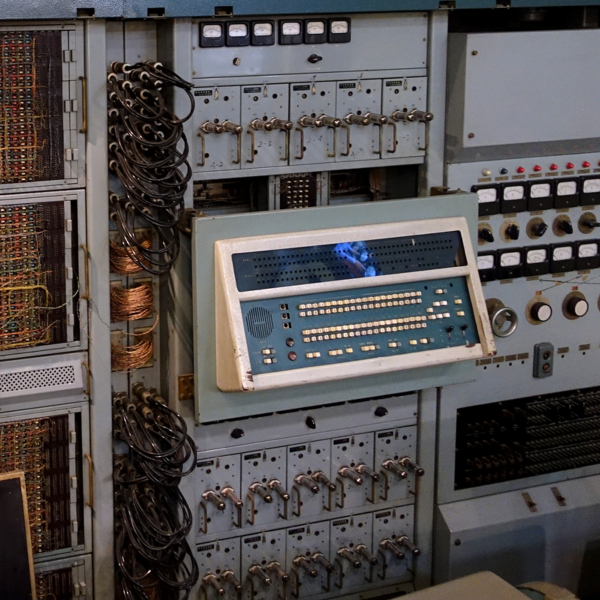
Conventional wisdom holds that we no longer make things to last for the long haul, and that we live in a disposable world. It’s understandable — after all, most of us have a cell phone in our pocket that’s no more than a year or two old, and it’s often cheaper to buy a new printer than replace the ink cartridges. But most of that disposability is driven by market forces, like new software that makes a device obsolete long before it breaks down, or the razor and blades model that makes you pay through the nose for ink. It turns out that most electronic devices are actually pretty well engineered, and as long as they’re not abused can still be operating decades down the road.

But what happens when you want to put an electromechanical device away and preserve it for a rainy day? What can you do to make sure the device will operate again a few years down the road? Are there steps one can take beyond the typical “keep it in a cool, dry place” advice? In short, how do you preserve electronic devices?

Continue reading “Ask Hackaday: Preserving Electronic Devices”