Make Cars Safer By Making Them Softer

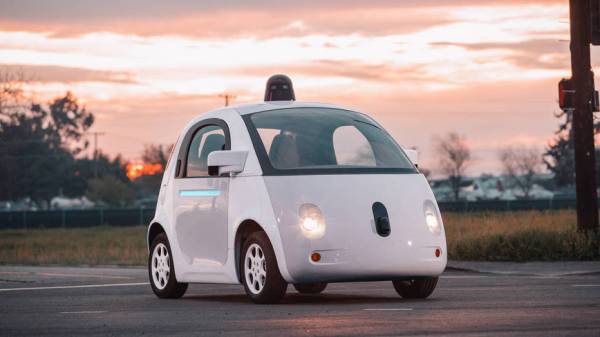
Would making autonomous vehicles softer make them safer?

Alphabet’s self-driving car offshoot, Waymo, feels that may be the case as they were recently granted a patent for vehicles that soften on impact. Sensors would identify an impending collision and adjust ‘tension members’ on the vehicle’s exterior to cushion the blow. These ‘members’ would be corrugated sections or moving panels that absorb the impact alongside the crumpling effect of the vehicle, making adjustments based on the type of obstacle the vehicle is about to strike.

Continue reading “Make Cars Safer By Making Them Softer”

Stunning Fake Polaroid Camera Performs Magic

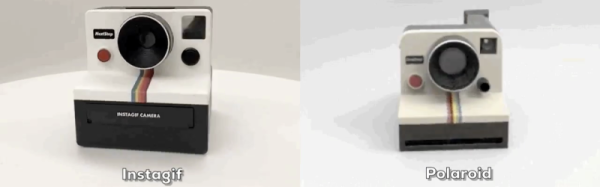
It’s high time us Muggles got our hands on the hardware used to take Magical Photographs as seen in The Daily Prophet. The first pioneering step in that direction has been taken by [Abhishek] who built this moving picture taking polaroid-ish camera, which he’s calling the “Instagif NextStep”. It’s a camera that records a short, three second video, converts it to GIF and ejects a little cartridge which displays the animated photo.

This amazing piece of hardware has been painstakingly built, and the finished product looks great. The nice thing about building such projects, in [Abhishek]’s own words, is that “it involves a bunch of different skill sets and disciplines – hardware, software, 3D modeling, 3D printing, circuit design, mechanical/electrical engineering, design, fabrication etc that need to be integrated for it to work seamlessly.”
Continue reading “Stunning Fake Polaroid Camera Performs Magic”

Way To Go, Einstein; His Time Spent Being Wrong

When you hear someone say “Einstein”, what’s the first thing that pops into your head? Is it high IQ… genius… or maybe E=MC2? Do you picture his wild grey hair shooting in all directions as he peacefully folds the pages back from his favorite book?  You might even think of nuclear bombs, clocks and the Nobel Prize. It will come as a surprise to many that these accomplishments were a very small part of his life. Indeed, Einstein turned the world of classical physics upside down with his general theory of relativity. But he was only in his early twenties when he did so.

What about the rest of his life? Was Einstein a “one-hit-wonder”? What else did he put his remarkable mind to? Surely he tackled other dilemmas that plagued the scientific world during his moment in history. He was a genius after all… arguably one of the smartest people to have ever walked the earth. His very name has become synonymous with genius. He pulled the rug out from under Isaac Newton, whose theories had held the universe together for over 300 years. He talked about enigmatic concepts like space and time with an elegance that laid bare the beauty hidden within their simplicity. Statues have been made of him. His name and face are recognizable across the globe.

But when you hear someone say “Einstein”, do you think of a man who spent the better half of his life… being wrong?  You should.

Continue reading “Way To Go, Einstein; His Time Spent Being Wrong”

Detecting Dire Diseases – With A Selfie?

They say the eyes are the windows to the soul. But with a new smartphone app, the eyes may be a diagnostic window into the body that might be used to prevent a horrible disease — pancreatic cancer. A research team at the University of Washington led by [Alex Mariakakis] recently described what they call “BiliScreen,” a smartphone app to detect pancreatic disease by imaging a patient’s eyes.

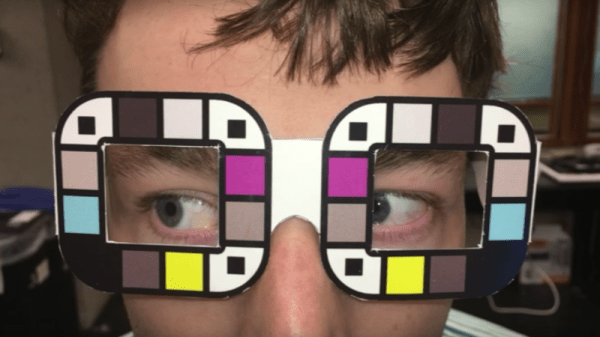
Pancreatic cancer is particularly deadly because it remains asymptomatic until it’s too late. One early symptom is jaundice, a yellow-green discoloration of the skin and the whites of the eyes as the blood pigment bilirubin accumulates in the body. By the time enough bilirubin accumulates to be visible to the naked eye, things have generally progressed to the inoperable stage. BiliScreen captures images of the eyes and uses image analysis techniques to detect jaundice long before anyone would notice. To control lighting conditions, a 3D-printed mask similar to Google’s Cardboard can be used; there’s also a pair of glasses that look like something from [Sir Elton John]’s collection that can be used to correct for ambient lighting. Results look promising so far, with BiliScreen correctly identifying elevated bilirubin levels 90% of the time, as compared to later blood tests. Their research paper has all the details (PDF link).

Tools like BiliScreen could really make a difference in the early diagnosis and prevention of diseases. For an even less intrusive way to intervene in disease processes early, we might also be able to use WiFi to passively detect Parkinson’s.

Continue reading “Detecting Dire Diseases – With A Selfie?”

Lu Ban’s Axe And Working With Your Chinese Suppliers

It is nearly impossible to build any kind of hardware these days without at some point in the process dealing with China — Chinese suppliers, and so by extension Chinese culture. Difficulties can be as simple as the usual inconvenience of everything stopping for weeks up to and after Chinese New Year, or engineers that you know to be otherwise reasonably competent simply choosing not to bring up glaring and obvious problems. Having encountered my share of Western hardware entrepreneurs on the verge of a breakdown, and just as many flummoxed Chinese bosses completely unable to see exactly why they’re so upset, I thought I’d try to offer at least a little insight into one of the many issues that comes up.

Nearly any school child in the world will be able to tell you whom they were taught invented the lightbulb, the telephone, the radio transmitter. Those same children will usually be able to tell you of at least a few Chinese inventions as well — gunpowder, paper, the compass etc. But with one key difference, even the Chinese children are unlikely to be able to credit even a group of people for their invention let alone a single (usually misattributed) individual.

China does not really have an Edison, or Tesla, or Bell — oh we’ve had people as brilliant, but they are not celebrated in quite the same way for cultural reasons. If you were to do an alternate history of China where we went through the Industrial Revolution first, you’d want to split the timeline around Mozi (墨子). The Mohists (followers of Mozi) had advanced siege engine design, schools of logic, mathematics and theory for the physical sciences. much of the same foundation that set the West on its particular trajectory. In the end, Confucian ideals won out and China became a culture that celebrated scholarship over ingenuity (to vastly oversimplify things).

Even our respective terms for engineer reflect this. The word engineer (Latin ingeniator) is derived from the Latin words ingeniare (“to contrive, devise”) and ingenium (“cleverness”). Yet in Chinese 工程师, the first character for engineer in Chinese is the carpenters square 工. He or she is a simple worker (工人 literally “Work Person”). Even now, engineers are not held in anywhere near the same regard in China as they are in the West.

Continue reading “Lu Ban’s Axe And Working With Your Chinese Suppliers”

A Functioning 3D Printer For 10€

There was a time when crowdfunding websites were full of 3D printers at impossibly low prices. You knew that it would turn out to be either blatant vaporware or its delivery date would slip into the 2020s, but still there seemed always to be an eager queue ready to sign up. Even though there were promised models for under $200, $150, and then $100, there had to be a lower limit to the prices they were prepared to claim for their products. A $10 printer on Kickstarter for example would have been just a step too far.

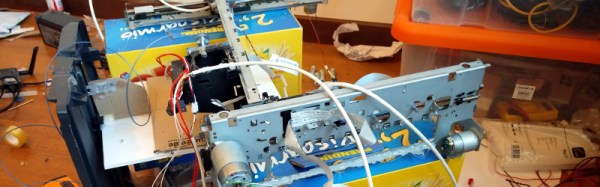
There is a project that’s come close to that mark though, even though the magic figure is 10 euros rather than 10 dollars, so just short of 12 dollars at today’s exchange rate. [Michele Lizzit] has built a functioning 3D printer for himself, and claims that magic 10€ build price. How on earth has he done it? The answer lies in extensive use of scrap components, in this case from broken inkjet printers and an image scanner. These provide all the mechanical parts for the printer, leaving him only having to spend his 10€ on some hot end parts and the printer’s electronics. In an unusual move, the frame of the machine appears to come from a set of cardboard biscuit boxes, a master stroke of junk box construction.

The claimed resolution is 33µm, and using the position encoders from the inkjet printers he is able to make it a closed loop device. We salute his ingenuity in building such an impressive printer from so little, and were we ever locked by the bad guys in a room full of IT junk and lacked a handy escape device, we’d wish to be incarcerated with [Michele] any day over [Angus MacGyver] or [Sgt. Bosco BA Baracus].

You can see the printer in action in the video below the break.

Continue reading “A Functioning 3D Printer For 10€”

Raspberry Pi automated greenhouse

Raspberry Pi Is The Brains Behind Automated Greenhouse

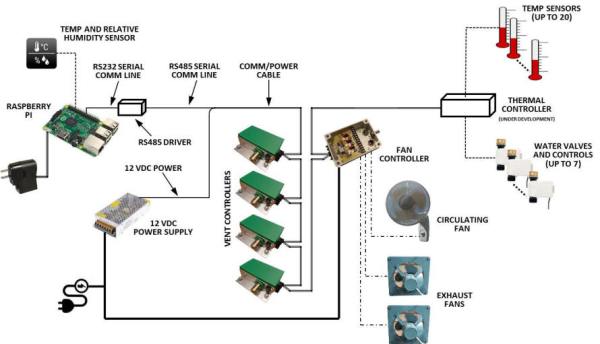
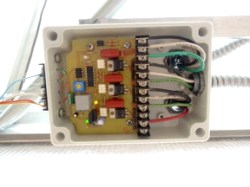
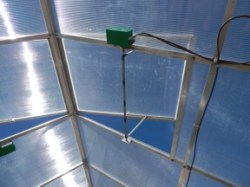
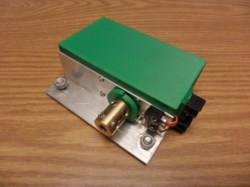
[Asa Wilson] and his wife picked up a 10’x12′ greenhouse from Harbor Freight that for their location required some serious changes, understandable since they’re in Colorado on the western slope of Pike’s Peak where the winds are strong and the normal growing season is short. After assembling it on a concrete footing and adding some steel bracing, they got to work on adding an environment management system based around a Raspberry Pi. Read on for a look at the modifications they made.

Continue reading “Raspberry Pi Is The Brains Behind Automated Greenhouse”