While most people who make the trek to the path of totality for the Great American Eclipse next week will fix their gazes skyward as the heavenly spectacle unfolds, we suspect many will attempt to post a duck-face selfie with the eclipsed sun in the background. But at least one man will be feverishly tending to an experiment.
On a lonely hilltop in Wyoming, Dr. Don Bruns will be attempting to replicate a famous experiment. If he succeeds, not only will he have pulled off something that’s only been done twice before, he’ll provide yet more evidence that Einstein was right.
As ever, I am fighting a marginally winning battle against my 1991 Mazda MX-5, and this is the story of how I came to install a wideband oxygen sensor in my Japanese thoroughbred. It came about as part of my ongoing project to build myself a viable racecar, and to figure out why my 1990s Japanese economy car engine runs more like a late 1970s Malaise-era boat anchor.
I’ve always considered myself unlucky. My taste for early 90s metal has meant I’ve never known the loving embrace of OBD-2 diagnostics, and I’ve had to make to do with whatever hokey system was implemented by manufacturers who were just starting to produce reliable fuel injection systems.
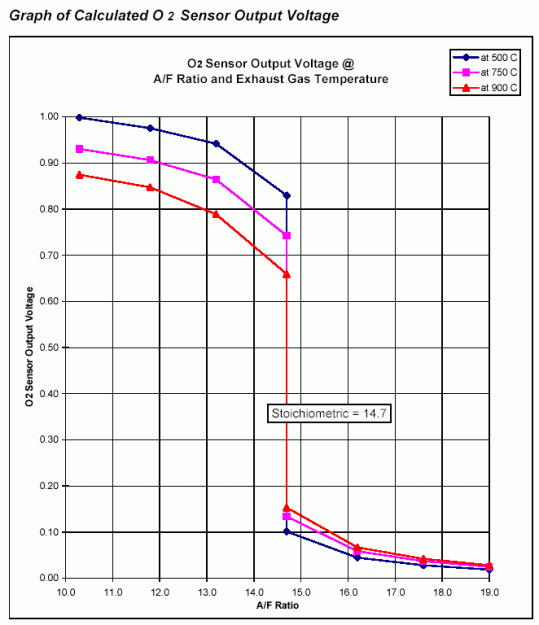
Narrowband oxygen sensor voltage output. The output is heavily dependent on sensor temperature and highly non-linear, making these sensors unsuitable for delivering a true AFR reading.
This generally involves putting in a wire jumper somewhere, attaching an LED, and watching it flash out the trouble codes. My Mazda was no exception, and after putting up with a car that was running rich enough to leave soot all over the rear bumper, I had to run the diagnostic.
It turned up three codes – one for the cam angle sensor, and two for the oxygen sensor. Now, a cam angle sensor (CAS) fault will normally prevent the car running at all, so it’s safe to assume that was an intermittent fault to keep an eye on.
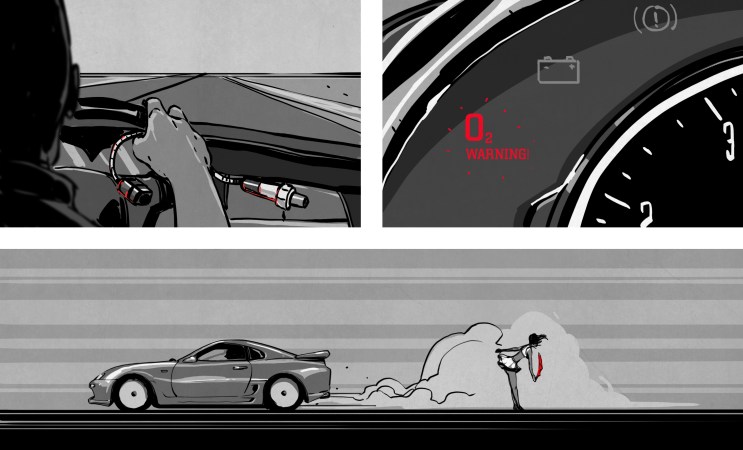
The oxygen sensor, however, was clearly in need of attention. Its job is to allow the engine control unit (ECU) to monitor the fuel mixture in the exhaust, and make sure it’s not too rich or too lean. As my car was very obviously running too rich, and the diagnostic codes indicated an oxygen sensor failure, a repair was in order.
I priced up replacement sensors, and a new oxygen sensor could be had for under $100. However, it wasn’t exactly what I wanted, as not all oxygen sensors are created equal. Cars in the 80s and 90s typically shipped from the OEM fitted with what’s called a narrowband oxygen sensor. These almost always consist of a zirconia dioxide cell that outputs a voltage depending on the difference in oxygen concentration between the exhaust gas and the free air. These sensors generally sit at 0.45 V when the fuel mixture is stoichiometric, but rapidly change to 0.1 V in a lean condition and 0.9 V in a rich condition. The response is highly non-linear, and changes greatly with respect to temperature, and thus is only good for telling the ECU if it’s rich or lean, but not by how much. ECUs with narrowband sensors tend to hunt a lot when running in closed loop O2 control – you’ll see an engine at idle hunt either side of the magical 14.7 stoichiometric air fuel ratio, never able to quite dial in on the correct number.
As I intend to switch to an aftermarket ECU in the future, I’ll need to tune the car. This involves making sure the air/fuel ratios (AFRs) are correct, and for that I need to be able to properly measure them. Just knowing whether you’re rich or lean isn’t enough, as often it’s desirable to run the engine intentionally rich or lean at certain engine loads. To get a true AFR reading requires fitting a wideband oxygen sensor. These are a little more complicated.
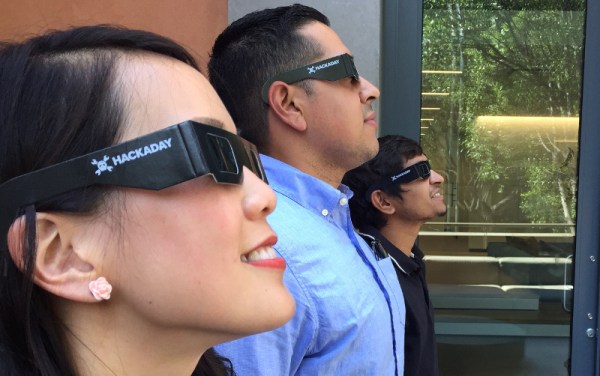
We’re getting ready to stare at the Sun for a few hours when a total solar eclipse is visible across the United States on August 21st. You could protect your eyes with some welding goggles, but why not wear a pair of Hackaday eclipse glasses instead?
UPDATE: And They’re Gone. We had a huge response to this with over 200 event pages made in just a few hours (and more coming since then; thank you, you’re awesome!). We had 500 glasses to give away and are sending them out in envelopes of 4. We would still love it if you made an event page but unfortunately we’ve run out of glasses to send out.
Let us know where you’ll be watching the eclipse and we’ll mail you some custom-printed Hackaday eclipse glasses (sorry, they’re all gone). Head over to the Eclipse Meetups page, click the “Host a Meetup” button and tell us where you’ll be. We’ll add you to the map and contact you for the shipping address and the number of glasses you’ll need.
Whether you want others to join you or not is your choice, but we want to see a map full of pins where the Hackaday community is taking part in this momentous event.
As you can see, there are already a number of meetups watch the partial eclipse and that’s fine with us. No matter where you are, if you can see the eclipse we’re ready to send you some glasses. Hurry up though, they need to arrive before Monday!
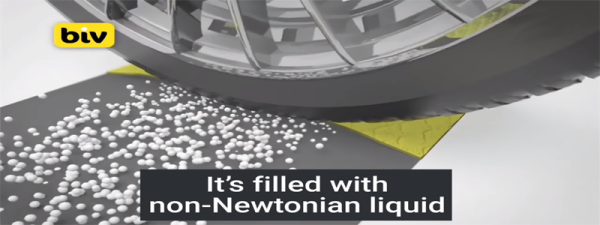
Like it or not speed bumps are an essential part of our road infrastructure especially in built-up places like near schools [Business Insider UK] reports non-Newtonian liquid filled speed bumps are being tested in Spain, Israel and Germany.
Traditional speed bumps do have their drawbacks; damage to the underside of low vehicles is common. While they should be uniform in dimensions, in practice they can vary significantly, making driving over unfamiliar bumps a bit unpredictable. This is all set to change with non-Newtonian bumps which are soft to drive over at slow speeds but for speeding drivers they harden up and act more like traditional bumps. This gives drivers following the letter of the law a better driving experience whilst still deterring speeding drivers..
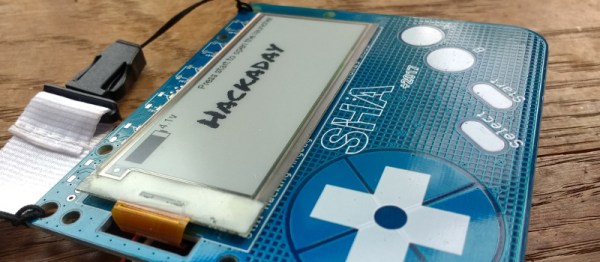
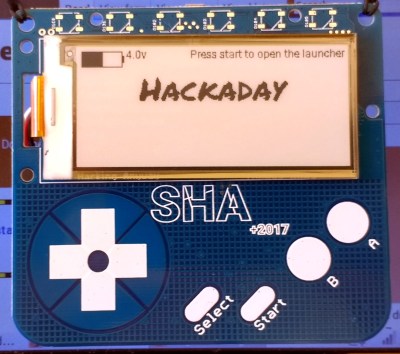
The badge has become one of the defining features of a modern hacker camp, a wearable electronic device that serves as both event computer and platform for some mild software and hardware hacking. Some events have had astoundingly sophisticated badges while others are more simple affairs, and the phenomenon has even spawned an ecosystem of unofficial badges which have nothing to do with the event in question.
The SHACamp 2017 badge is the latest to come the way of a Hackaday writer, and certainly contains enough to be taken as representative of the state of hacker camp badges in 2017. It doesn’t have a star turn like CCCCamp 2015’s software defined radio, instead it’s an extremely handy little computer in its own right.
When it comes to microcontroller development boards, we have a plethora of choices at our disposal. Each has its strengths and weaknesses, be they associated with its support and community, its interface capabilities, or its choice of processor family. Most boards you’ll find in our communities come from niche manufacturers, or at least from manufacturers who started as such. Just occasionally though along comes one whose manufacturer you will have heard of, even whose manufacturer the Man in the Street will have heard of.
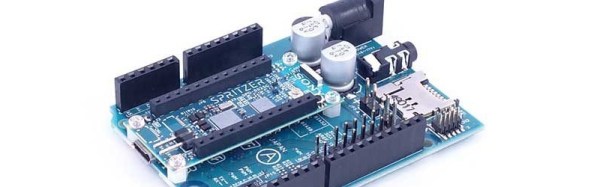
Which brings us neatly to today’s story, the quiet announcement from Sony, of a new microcontroller development board called the Spritzer. This is Arduino compatible in both physical footprint and IDE, is intended for IoT applications, and packs GPS, an audio codec, and an ARMCortexM4 at 156 MHz. There is a Japanese page with a little more detail (Google Translate link), on which they talk about applications including audio beam forming with up to eight microphones, and a camera interface.
The board is due to be available sometime early next year, and while it looks as though it will be an interesting device we’d sound a note of caution to Sony. It is not good enough to have an amazing piece of hardware; the software and community support must be more than just make-believe. If they can crack that then they might just have a winner on their hands, if they fail to make any effort then they will inevitably follow Intel into the graveyard of also-ran boards.
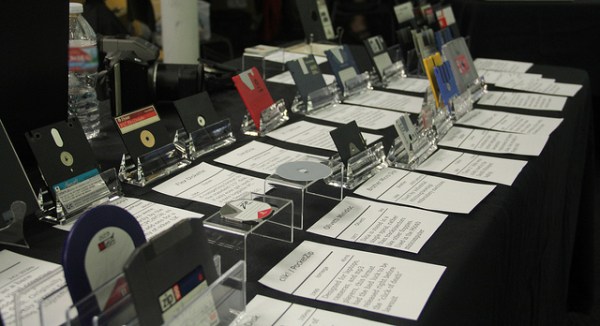
This past weekend, another smashing round of the Vintage Computer Festival was held at the Computer History Museum in Mountainview. As always, VCF West gathers the sages and lords of vintage computers onto a common ground to talk old-school hardware. It also draws in a collection of unique artifacts, many of which either still work, have been brought back to life, or have otherwise been reincarnated through a modern means. [Bil Herd] and I dropped in to join the crowd, and I snagged a few pics of some new faces and pieces that have been added to the experience since last year.
[Foone’s] Digital Media Archiving
Up first on our bucket list was [Foone], a librarian of digital media archiving. Outside of VCF, he runs a digital media backup gig to help folks backup their niche, often-failing, disk formats into something more modern. His drive for doing this backup features a special “reread” capability, where the file is actually reread dozens of time to validate that the right information was pulled from it.


 The badge has become one of the defining features of a modern hacker camp, a wearable electronic device that serves as both event computer and platform for some mild software and hardware hacking. Some events have had astoundingly sophisticated badges while others are more simple affairs, and the phenomenon has even spawned an ecosystem of unofficial badges which have nothing to do with the event in question.