Little Bobby Tables Just Registered A Company…

Sometimes along comes a tech story that diverges from our usual hardware subject matter yet which just begs to be shared with you because we think you will find it interesting and entertaining.

XKCD 327, Exploits of a Mom (CC BY-NC 2.5).

You will no doubt be familiar with the XKCD cartoon number 327, entitled “Exploits of a Mom”, but familiarly referred to as “[Bobby Tables]”. In it a teacher is ringing the mother of little [Robert’); DROP TABLE Students; –], whose name has caused the loss of a year’s student records due to a badly sanitized database input. We’ve all raised a chuckle at it, and the joke has appeared in other places such as an improbably long car license plate designed to erase speeding tickets.

It's nice to see that Companies House sanitise their database inputs.
It’s nice to see that Companies House sanitise their database inputs.

Today we have a new twist on the Bobby Tables gag, for someone has registered a British company with the name  “; DROP TABLE “COMPANIES”;– LTD“. Amusingly the people at Companies House have allowed the registration to proceed, so either they get the joke too or they are unaware of the nuances of a basic SQL exploit. It’s likely that if this name leaves Her Majesty’s civil servants with egg on their faces it’ll be swiftly withdrawn, so if that turns out to be the case then at least we’ve preserved it with a screenshot.

Of course, the chances of such a simple and well-known exploit having any effect is minimal. There will always be poor software out there somewhere  that contains badly sanitized inputs, but we would hope that a vulnerability more suited to 1996 would be vanishingly rare in 2016.

If by some chance you haven’t encountered it before we’d recommend you read about database input sanitization, someday it may save you from an embarrassing bit of code. Meanwhile we salute the owner and creator of this new company for giving us a laugh, and wish them every success in their venture.

Improving Raspberry Pi Disk Performance

Usually, you think of solid state storage as faster than a rotating hard drive. However, in the case of the Raspberry Pi, the solid state “disk drive” is a memory card that uses a serial interface. So while a 7200 RPM SATA drive might get speeds in excess of 100MB/s, the Pi’s performance is significantly less.

[Rusher] uses the Gluster distributed file system and Docker on his Raspberry Pi. He measured write performance to be a sluggish 1MB/s (and the root file system was clocking in at just over 40MB/s).

There are an endless number of settings you could tweak, but [Rusher] heuristically picked a few he thought would have an impact. After some experimentation, he managed 5MB/s on Gluster and increased the normal file system to 46 MB/s.

Continue reading “Improving Raspberry Pi Disk Performance”

Police Want Alexa Data; People Begin To Realize It’s Listening

It is interesting to see the wide coverage of a police investigation looking to harvest data from the Amazon Echo, the always-listening home automation device you may know as Alexa. A murder investigation has led them to issue Amazon a warrant to fork over any recordings made during the time of a crime, and Amazon has so far refused.

Not too long ago, this is the sort of news would have been discussed on Hackaday but the rest of my family would have never heard about it. Now we just need to get everyone to think one step beyond this and we’ll be getting somewhere.

What isn’t being discussed here is more of concern to me. How many of you have a piece of tape over your webcam right now? Why did you do that? It’s because we know there are compromised systems that allow attackers to turn on the camera remotely. Don’t we have to assume that this will eventually happen with the Echo as well? Police warrants likely to affect far less users than account breaches like the massive ones we’ve seen with password data.

All of the major voice activated technologies assert that their products are only listening for the trigger words. In this case, police aren’t just looking for a recording of someone saying “Alexa, help I’m being attacked by…” but for any question to Alexa that would put the suspect at the scene of the crime at a specific time. Put yourself in the mind of a black hat. If you could design malware to trigger on the word “Visa” you can probably catch a user giving their credit card number over the phone. This is, of course, a big step beyond the data already stored from normal use of the system.

It’s not surprising that Amazon would be served a warrant for this data. You would expect phone records (although not recordings of the calls) to be reviewed in any murder case. Already disclosed in this case is that a smart water meter from the home reported a rather large water usage during the time of the murder — a piece of evidence that may be used to indicate a crime scene clean-up effort.

What’s newsworthy here is that people who don’t normally think about device security are now wondering what their voice-controlled tech actually hears them say. And this is a step in the right direction.

Extracting Sounds With Acid And UV

Toaplan was a Japanese video game developer in the 80s and early 90s, most famous for Zero Wing, the source of the ancient ‘All Your Base’ meme. Memeology has come a long way since the Something Awful forums and a pre-Google Internet, but MAME hasn’t. Despite the completionist nature of MAME aficionados, there are still four Toaplan games with no sound in the current version of MAME.

The sound files for these games is something of a holy grail for connoisseurs of old arcade games, and efforts to extract these sounds have been fruitless for three decades. Now, finally, these sounds have been released with the help of sulfuric acid and microscopes.

The sounds for Fire SharkVimanaTeki Paki, and Ghox were stored on their respective arcade boards inside the ROM for a microcontroller, separate from the actual game ROM. Since the fuse bits of this microcontroller were set, the only way to extract the data was decapsulation. This messy and precise work was done by CAPS0ff, who melted away the epoxy coating of the chip, revealing the microcontroller core.

Even without a microscope, the quarry of this hunt was plainly visible, but there was still no way to read out the data. The built-in read prevention bit was set, and the only way to clear that was to un-set a fuse. This was done by masking everything on the chip except the suspected fuse, putting it under UV, and checking if the fuse switched itself to an unburnt state.

The data extraction worked, and now the MAME project has the sound data for games that would have otherwise been forgotten to time. A great success, even if the games are generic top-down shooters.

Ken Shirriff Takes Us Inside The IC, For Fun

[Ken Shirriff] has seen the insides of more integrated circuits than most people have seen bellybuttons. (This is an exaggeration.) But the point is, where we see a crazy jumble of circuitry, [Ken] sees a riddle to be solved, and he’s got a method that guides him through the madness.

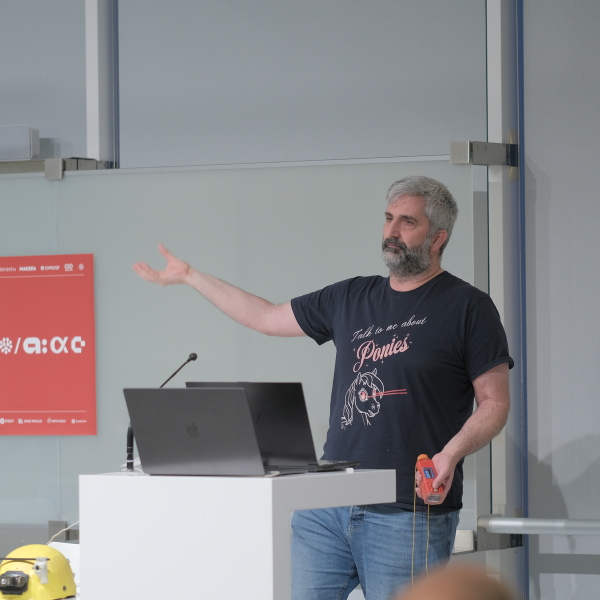
In his talk at the 2016 Hackaday SuperConference, [Ken] stepped the audience through a number of famous chips, showing how he approaches them and how you could do the same if you wanted to, or needed to. Reading an IC from a photo is not for the faint of heart, but with a little perseverance, it can give you the keys to the kingdom. We’re stoked that [Ken] shared his methods with us, and gave us some deeper insight into a handful of classic silicon, from the Z80 processor to the 555 timer and LM7805 voltage regulator, and beyond.

Continue reading “Ken Shirriff Takes Us Inside The IC, For Fun”

200 Years Of The Stirling Engine

In the early years of the nineteenth century, steam engines were at work in a variety of practical uses. However, they were still imperfect in many ways. One particular problem were the boilers, that had a tendency to explode, causing injuries and fatalities. Reverend Dr. Robert Stirling, a Scottish clergyman, was concerned about the death toll from exploding boilers. Based on previous work by George Cayley (known for his pioneering work on aeronautics), Stirling filed his patent for a safer engine in 1816. That makes this year the bicentenary of this engine. The Stirling engine has the highest theoretical efficiency of any thermal engine. It is also a relatively simple machine. Unlike other types of engines, there are no valves, and that makes the mechanical design much simpler.

Continue reading “200 Years Of The Stirling Engine”

33C3 Starts Tomorrow: We Won’t Be Sleeping For Four Days

Possibly the greatest hacker show on Earth, the 33rd annual Chaos Communication Congress (33C3) begins Tuesday morning in Hamburg, Germany. And Hackaday will be there! Contributing Editor [Elliot Williams] is taking the night train up and will be trying to take it all in for you. The schedule looks tremendous.

If you can’t make it, don’t fret. There will be live streaming, and the talks are usually available in preliminary edit for viewing or download just a few minutes after they finish. It’s even cooler to watch the talks with friends, though. Every hackerspace with a video projector could be playing along, live or after the fact. Pick some cool talks and have a “movie night”.

elliot_williams_head_2_square_fuzzIf you’re going to be in Hamburg, and you want to show us something cool, tell us that something is NOTAHACK!1!! in person, or even just say “Hi”, we’ll be wandering around from talk to talk and session to session just like you, only with a backpack full of Hackaday stickers.

If there’s anything you think we should see, post up in the comments. If there’s enough call for it, we’ll have a Hackaday meetup once we can figure out a good time and location. Bring us a cool hack, and we’ll document it on the spot! Our DECT phone number is 2475.