A Ridiculous Way To Light An LED: Candle-power

If you have ever entertained yourself by reading comprehensive electronic-theory textbooks you’ll have seen references to technologies that sound really interesting but which you will rarely hold in your hand. They may be dead-ends that have been superseded by more recent innovations, or they may be technologies that have found uses but in other fields from those in which they originally showed promise. What if you could take these crazy parts and actually build something?

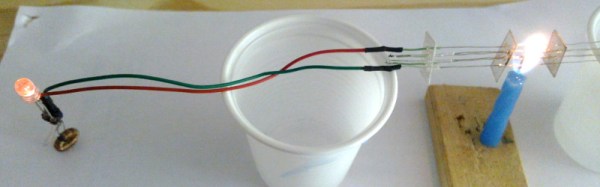
[Fedetft] has an interesting project that combines two of those intriguing textbook references, he’s created a thermopile that lights an LED through an inverter whose oscillator is a tunnel diode. Dig out the textbook.

If you’ve used a thermocouple thermometer or a semiconductor thermoelectric generator then you’ll have encountered the thermoelectric effect. Perhaps you’ve even operated a Peltier cooling element in this mode. When a circuit is made with two junctions between different types of conductor with a temperature difference between the two junctions, a current will flow in the circuit which is dependent on both the scale of the temperature difference and the properties of the conductors.

A thermopile is a collection of these thermoelectric junction circuits between metal conductors, arranged in series to increase the voltage. [Fedetft]’s thermopile uses chromel and alumel wires taken from a K-type thermocouple. He’s made six sets of junctions, and supported them with small pieces of mica sheet. Using the heat from a candle he found he could generate about 200mV with it, at about 3.7mW.
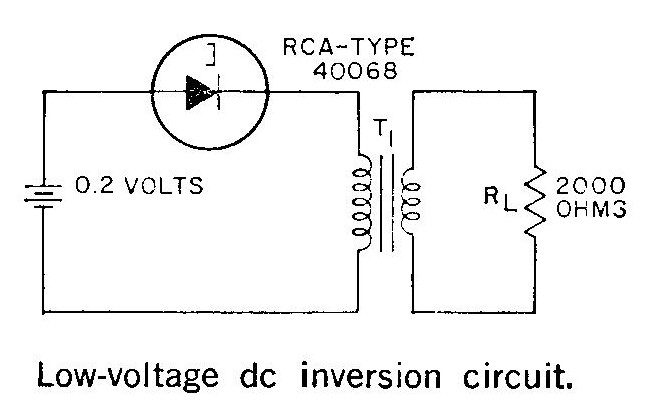
The RCA tunnel diode inverter circuit

Such a tiny source of electricity would be of little use to light an LED directly, so he needed to build an inverter. And that’s where the tunnel diode comes in. Tunnel diodes have a negative-resistance region that can be used to amplify and oscillate at extremely high frequencies in extremely simple circuits, yet they’re not exactly a device you’d encounter very often in 2016. [Fedetft] has a Russian tunnel diode, and he’s used it with a toroidal transformer in an inverter circuit he found in an RCA tunnel diode manual from 1963. It’s a two-component Joule Thief. The RCA manual is a good read in itself for those curious about tunnel diodes.

The resulting circuit produces a 15kHz oscillation with 4.5v peaks, and has just enough power to light an LED.

While it might seem pointless to barely light an LED from a brightly lit candle, the important part of [Fedetft]’s project is to gain some understanding of two of those technological backwaters from the textbooks. And we applaud that.

It’s the mark of a truly esoteric technology that it features rarely on Hackaday, and neither of these two disappoint. We’ve only mentioned tunnel diode in passing when looking at diodes in general, and we’ve tended to use “thermopile” in another sense to refer to thermal imaging cameras.


Windows And Ubuntu: “Cygwin Can Suck It”

For the last ten years or so, computing has been divided into two camps: Windows, and everything else with a *nix suffix. Want a computing paradigm where everything is a file? That’s Linux. Want easy shell scripting that makes the command line easy? Linux. Want a baroque registry with random percent signs and dollar symbols? That would be Windows. Want to run the most professional productivity apps for design and engineering? Sadly, that’s Windows as well.

*nix runs nearly the entire Internet, the top 500 supercomputers in the world, and is the build environment for every non-Windows developer. Yet Windows is the most popular operating system. The divide between Windows and *nix isn’t so much a rivalry, as much as people who still spell Microsoft with a dollar sign would tell you. It’s just the way personal computing evolved by way of legacy apps and IT directors.

Now, this great divide in the world of computing is slowly closing. At Microsoft’s Build 2016 developer’s conference, Microsoft and Canonical, Ubuntu’s parent company, announced a partnership that will allow Ubuntu to run using native Windows libraries.

In short, this announcement means bash and the Linux command line is coming to Windows 10. The command line is great, but userland is where it’s at, and here this partnership really shines. Unlike Cygwin, the current way to get *nix stuff running in a Windows environment, Windows’ bash will allow unmodified Linux programs to run unmodified on Windows 10.

It is not an understatement to say this is the most important development in operating systems in the last 10 years. For the last decade, every developer who is not purely a Windows developer has picked up a MacBook for the sole reason of having BSD under the hood. If you’re looking for a reason Apple is popular with devs, it’s *nix under the hood. This announcement changes all of that.

FBI Vs Apple: A Postmortem

By now you’ve doubtless heard that the FBI has broken the encryption on Syed Farook — the suicide terrorist who killed fourteen and then himself in San Bernardino. Consequently, they won’t be requiring Apple’s (compelled) services any more.

A number of people have written in and asked what we knew about the hack, and the frank answer is “not a heck of a lot”. And it’s not just us, because the FBI has classified the technique. What we do know is that they paid Cellebrite, an Israeli security firm, at least $218,004.85 to get the job done for them. Why would we want to know more? Because, broadly, it matters a lot if it was a hardware attack or a software attack.

Continue reading “FBI Vs Apple: A Postmortem”

Rotary Subwoofer Combines A Speaker Coil W/ A Fan

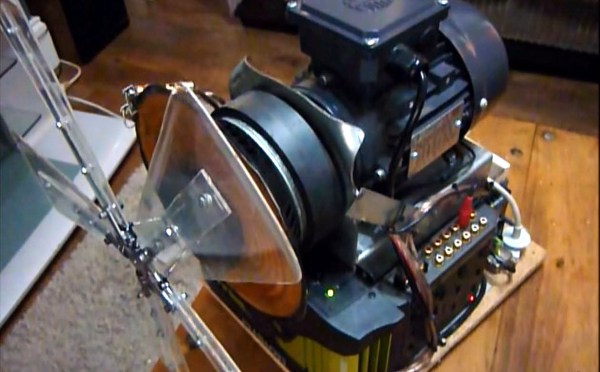
What happens when you combine a fan with a sub-woofer? Apparently, you get a high-efficiency ultra low hertz (3-5hz) rotary subwoofer!

First thing’s first, believe it or not, these things really do exist. [Chris] got the idea to build his own after seeing the TRW-17, a commercial offering of a rotary subwoofer.

The concept is pretty simple. If you use a giant subwoofer, you can get low frequency response, but it uses an immense amount of power to move a giant speaker coil. So what if you put something on a smaller speaker coil to increase airflow? Like, a fan or something?

Continue reading “Rotary Subwoofer Combines A Speaker Coil W/ A Fan”

Remote Sensing Bombs Could Stem Terrorism

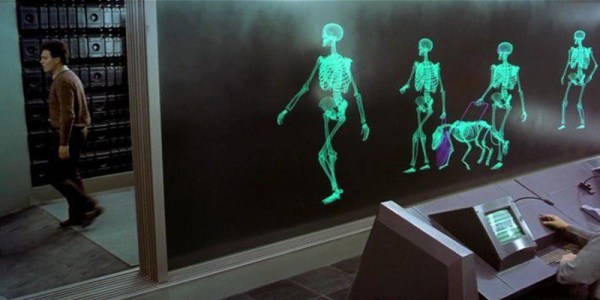
If you understand technology, there were a lot of things hard to explain on Star Trek. Transporters, doors that were smart enough to open unless you hit them during a fight, and the universal translator all defy easy explanation. But one of the hardest things to explain were Mr. Spock’s sensors. From the ship or with a tricorder, Spock could sense at a distance just about anything from chemical compositions, to energy, and even the presence of life (which, today, at least, is difficult to determine even what that means).

Remote sensing would have a very distinct use in today’s world: finding terrorist bombs earlier. A recent article published on New Scientist by [Debora MacKenzie] points out that stopping attacks like the recent one in Brussels is difficult without increasing congestion. For example, putting checkpoints at doors instead of inside transit stations is common in Asia, but causes lines and delays.

detecThe United States has used ion mobility spectrometry (IMS) to detect explosive traces on swabs (using machines like the one on the left). However in the early 2000’s they experimented with a version of the device that used puffs of air to determine if people had explosives while they passed by the machine. By 2010, officials decided the machines broke down too often and stopped using them.

Remote Sensing in Practice

According to an expert at Rand Corporation, remote sensing is likely to employ imaging or sniffers. However, imaging solutions are easy to fool since a bomb can take the shape of an ordinary object. Sniffers, including biological sniffers (known as dogs), are harder to fool. The problem is that deploying thousands of dogs to cover the world’s airports is difficult.

Continue reading “Remote Sensing Bombs Could Stem Terrorism”

Dirt-Cheap USB Arduino Hack From The Past

Mass production is a wonderful thing. Prices fall, and hobby hackers get cheap gear. The mind then wanders towards what can be done with it. So it’s little wonder that someone like [Aaron Christophel] would try to repurpose those sub-$3 AVR programmers that are all over eBay (translated poorly out of German here, but demonstrated in the video embedded below).

[Aaron] didn’t have to do much, really. The only trick is that you’ll first need to re-flash the existing ISP firmware with one that lets you upload code to the device itself over USB. If you don’t have an Arduino on hand to re-flash, buy at least two of the cheap programmers — one to program the other ones. Once you’ve done that, you have essentially an Arduino with limited pinout and two onboard LEDs, but in a nice small form-factor and with built-in USB. [Aaron] even provides an Arduino boards.txt file to make it all work smoothly within the IDE.

Continue reading “Dirt-Cheap USB Arduino Hack From The Past”

Improving The RTL-SDR

The RTL-SDR dongle is a real workhorse for radio hacking. However, the 28.8 MHz oscillator onboard isn’t as stable as you might wish. It is fine for a lot of applications and, considering the price, you shouldn’t complain. However, there are some cases where you need a more stable reference frequency.

[Craig] wanted a stable solution and immediately thought of a TCXO (Temperature Compensated “Xtal” Oscillator). The problem is, finding these at 28.8 MHz is difficult and, if you can find them, they are relatively expensive. He decided to make an alternate oscillator using an easier-to-find 19.2 MHz crystal.

Continue reading “Improving The RTL-SDR”