DIY Cast AR-15 Receivers Are More Interesting Than Expected

For some reason the US News media decided on the AR-15 as the poster child of guns that should not be allowed to be made for, or sold to, the consumer. The words still out on the regulation, but, in a very American response, a whole market sprang up around people saying, “Well, then we’ll just make our own AR-15.”

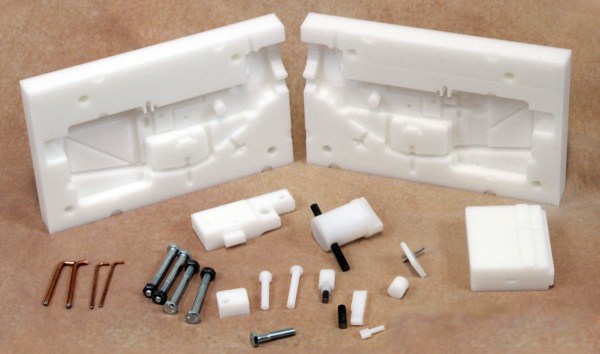
Ordinarily, we wouldn’t cover this sort of thing, but the work [AR-15Mold] is doing is just so dang interesting. They sell a product that enables the home user to cast an AR-15 receiver out of high performance resin. In the process they made a really informative three part video on the casting process.

A lot of people are interested in the product, and having fun with it. In this two part video series, [Liberty Marksman] cast their receivers and test them to destruction. In one video they see how many rounds they can fire out of the gun before it breaks. When it breaks, they excitedly tear down the gun to see where it failed.

It’s quite a bit of fun to watch. Videos after the break.

Continue reading “DIY Cast AR-15 Receivers Are More Interesting Than Expected”

Smallest MIDI Synth, Again!

Not content with fitting a tiny square-wave MIDI synthesizer into a MIDI plug, [Mitxela] went on to cram a similar noisemaker into a USB plug itself.

Besides being physically small, the code is small too, as well as the budget. It uses V-USB for the USB library running on an ATtiny85, and a couple of passive parts. His firmware (apparently) takes in MIDI notes and spits out square waves.
Continue reading “Smallest MIDI Synth, Again!”

Tiling Your TV Remote

The Tile is a small Bluetooth chip, speaker, and enough battery for a year in a keychain format. If you lose your keys in the morning, simply use the app on your phone to find the keychain. If you lose your phone simply get out your second phone.

This planned obsolescence didn’t jive with [JM] when his Tile stopped being discoverable. He didn’t want to toss a gadget that had served him so well into the landfill. So, like any good hacker, he cracked its plastic case open.

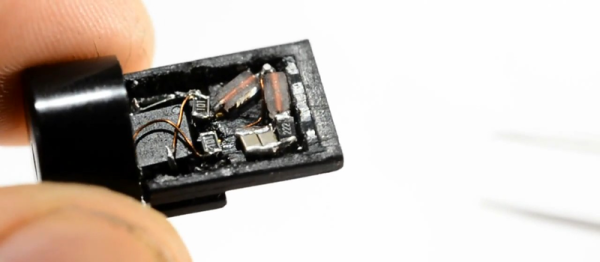
The Tile itself is a really interesting product. The largest component is the battery which has tabs spot-welded to its surface. Attached to those is a well laid out board. [JM] points out the clever use of spring contacts to engage the piezo element for the speaker as a nice example of good design for manufacture.

The hack itself was pretty easy to complete. Some electrical tape and soldering was all it took to embed the tile into the remote. Now he can take out his phone and press a button to hear a forlorn beep coming from under the couch cushions.

Super Massive Musical Instrument

Performing music in open spaces can be a real challenge. The acoustics of the space can play spoil-sport. Now imagine trying to play an instrument spread out over tens of kilometres. The folks at [LimbicMedia] wrote in to tell us about the project they worked on to build the The World’s Largest Musical Instrument.

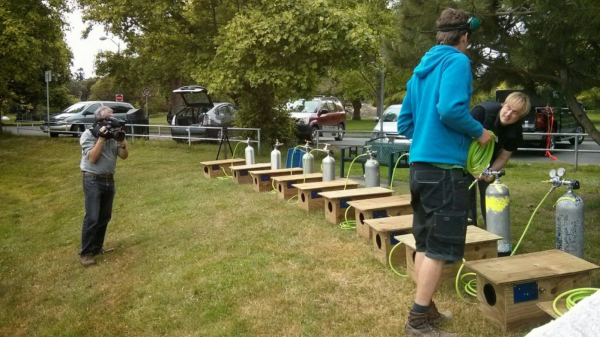
The system consists of wirelessly controlled air horns deployed at remote locations. Each air horn is self contained, driven by a supply of compressed air from a scuba diving tank and battery powered electronics. The wireless link allows the air horns to be placed up to 10kms away from the base station. Each air horn is tuned to a specific note of the piano keyboard which, in turn, is configured to transmit its note data to the air horns.

HornsBeaconHill_02Currently, they have built 12 air horns, enough to let them play the Canadian and British anthems. The horns are built out of PVC piping and other off-the-shelf plastics with the dimensions of the horn determining its note. The setup was installed and performed at the Music by the Sea festival recently, by mounting the air horns on 12 boats which were stationed out at Sea in the Bamfield Inlet in Eastern Western Canada. But that was just a small trial. The eventual plan is to set up air horns all around Canada, and possibly other places around the world, and synchronise them to play music simultaneously, to commemorate the 150th Canada Day celebrations in 2017.

There aren’t many details shared about the hardware, but it’s not too difficult to make some guesses. A micro-controller to operate the air solenoid, long range radio link to connect all the air horns to the base station, and another controller to detect the key strokes on the Piano. The limiting issue to consider with this arrangement is the spatial separation between the individual air horns. Sound needs about 2.9 seconds to travel over a kilometer. As long as all the air horns are at approximately the same distance from the audience, this shouldn’t be a problem. See how they did in the video after the break. We do know of another project which handled that problem brilliantly, but we’ll leave the details for a future blog post.

This isn’t the first time [LimbicMedia] was commissioned to create audio-visual public installations. A couple of years back they built this Sound Reactive Christmas Tree in Victoria, British Columbia.

Continue reading “Super Massive Musical Instrument”

Software Defined Radio App Store

Software defined radios (SDRs) can–in theory–do almost anything you need a radio to do. Voice? Data? Frequency hopping? Trunking? No problem, you just write the correct software, and you are in.

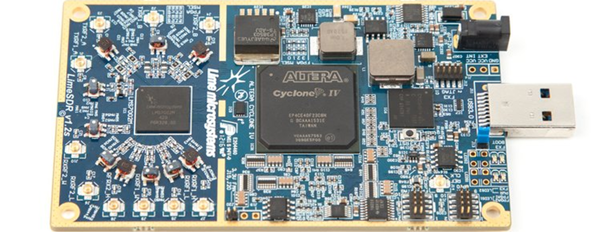
That’s the problem, though. You need to know how to write the software. LimeSDR is an open source SDR with a crowdfunding campaign. By itself, that’s not anything special. There are plenty of SDR devices available. What makes LimeSDR interesting is that it is using Snappy Ubuntu Core as a sort of app store. Developers can make code available, and end-users can easily download and install that code.

Continue reading “Software Defined Radio App Store”

Hackaday Dictionary: Transformers

Funny stuff, electricity. It’s all about the volts and the amps, and controlling these two factors. Most of the time, the electricity coming into your device is at a higher voltage than you need, so you have to convert it down to something more usable. The easiest way to do this is with a transformer.

The transformer in your power supply takes a high voltage from the mains and converts it down into a lower voltage to power your gadgets. You’ll find one in all power supplies, from the miniature USB version that powers your cell phone to the big ones hanging on a telephone pole that drive your home’s mains electricity. Although these transformers are different sizes, they share the same fundamental design.

Continue reading “Hackaday Dictionary: Transformers”

Up Your CAD Game With Good Reference Photos

I’ve taken lots of reference photos for various projects. The first time, I remember suffering a lot and having to redo a model a few times before I got a picture that worked. Just like measuring parts badly, refining your reference photo skills will save you a lot of time and effort when trying to reproduce objects in CAD. Once you have a model of an object, it’s easy to design mating parts, to reproduce the original, or even for milling the original for precise alterations.

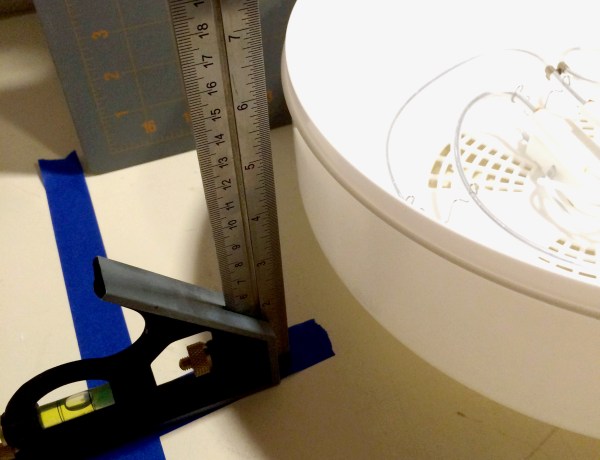
I’m adding some parts onto a cheap food dehydrator from the local import store. I’m not certain if my project will succeed, but it’s a good project to talk about taking reference photos. The object is white, indistinct, and awkward, which makes it a difficult object to take a good photo for reference use in a CAD program. I looked around for a decent tutorial on the subject, and only found one. Maybe my Google-fu wasn’t the best that day. Either way, It was mostly for taking good orthogonal shots, and not how to optimize the picture to get dimensions out of it later.

There are a few things to note when taking a reference photo. The first is the distortion and the setup of your equipment to combat it. The second is including reference scales and surfaces to assist in producing a final model from which geometry and dimensions can be accurately taken. The last is post-processing the picture to try to fight the distortion, and also to prepare it for use in cad and modeling software.

Continue reading “Up Your CAD Game With Good Reference Photos”