Lunar Ark Boldly Goes

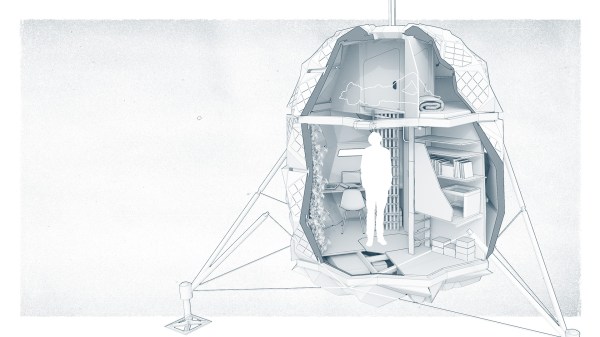
[Sebastian and Karl-Johan] are two award-winning Danish Space Architects who are subjecting themselves to harsh, seemingly uninhabitable conditions, for science. The pair set out to build a lunar base that could land with the manned Moon missions in 2024. Like any good engineering problem, what good is a solution without testing? So the pair have placed their habitat in a Moon Analogue habitat and are staying in their habitat for two months. They want to really feel the remoteness, the bitter cold, and the fatigue of actually being on the moon. So far they are about halfway through their journey and expect to return home in December 2020.

When asking themselves where on Earth is it most like the Moon, they came up with Moriusaq, Greenland. It’s cold, remote, in constant sunlight this time of year, and it is a vast white monochrome landscape just like the moon. The first moon settlement missions are expected to be at the South Pole of the Moon, as known as the Peak of Eternal Light.
The habitat itself is a testament to the duo’s ingenuity. The whole structure folds to fit the tight space and weight requirements of rockets. Taking 2.9m3 (102 ft3) when stored, it expands 560% in volume to 17.2m3 (607 ft3). In Greenland, the structure needs to withstand -30ºC (-22ºF) and 90 km/h winds.



Because the South Pole is in constant sunlight, the temperature varies much less there than on the rest of the Moon, which makes Greenland a very good analogue temperature-wise. The foldable skin is covered in solar panels, both on the top of the bottom. The highly reflective nature of the Moon’s surface makes it easy to capture the light bouncing up onto the bottom of the habitat.

Several other bits of technology have been included onboard, like a 3D printer, a circadian light stimulation system, an algae reactor, and a weather simulation. Since both the Moon and Greenland are in constant sunlight, the pod helps regulate the circadian rhythms of the occupants by changing the hue and brightness throughout the day. The weather simulation tries to break up the monotony of space by introducing weather like a stormy day or rainbow colours.

Their expedition is still ongoing and they post daily mission updates. While some might call their foray into the unknown madness, we call it bold. Currently, NASA is planning its Artemis mission in 2024 and we hope that the lessons learning from the Lunark and other experiments culminate in a better experience for all astronauts.

Crowd Funded Jumping Cubes

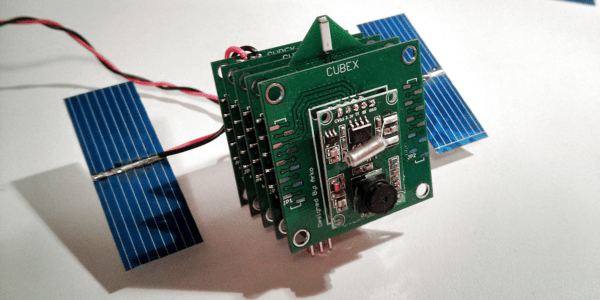
The Japan Aerospace Exploration Agency (JAXA) recently contributed their Int-Ball  technology to a Kickstarter campaign operated by the Japanese electronics manufacturer / distributor Bit Trade One (Japanese site). This technology is based on the Cubli project out of the Swiss Federal Institute of Technology in Zurich (ETH Zurich), which we covered back in 2013. The Cubli-based technology has been appearing in various projects since then, including the Nonlinear Mechatronic Cube in 2016.  Alas, the current JAXA-based “3-Axis Attitude Control Module” project doesn’t have a catchy name — yet.

One interesting application of these jumping cubes, presumably how JAXA got involved with these devices, is a floating video camera that was put to use on board the International Space Station (ISS) in 2017.  The version being offered by the Kickstarter campaign doesn’t include the cameras, and you will need to provide your own a gravity-free environment to duplicate that application.  Instead, they seem to be marketing this for educational uses.  You’d better dig deep in your wallet if you want one — a fully assembled unit requires a pledge of over $5000 ( there is a “some assembly required” kit that can save you about $1000 ).  Most of us won’t be backing this project for that reason alone, but it is nice to see the march of progress of such a cool technology:  from inception to space applications to becoming available to the general public.  Thanks to [Lincoln Uehara] for sending in this tip.

Continue reading “Crowd Funded Jumping Cubes”

A Look Behind The “Big Boards” At Mission Control In The Golden Age Of NASA

Certified space-nerd and all-around retro-tech guru [Fran Blanche] has just outdone herself with a comprehensive look at how NASA ran the Mission Control “Big Boards” that provided flight data for controllers for Apollo and for the next 20 years of manned spaceflight.

We’ve got to admit, [Fran] surprised us with this one. We had always assumed that the graphs and plots displayed in front of the rows of mint-green consoles and their skinny-tie wearing engineers were video projections using eidophor projectors. And to be sure, an eidophor, the tech of which [Jenny] profiled a while back, was used on one of the screens to feed video into Mission Control, either live from the Moon or from coverage of the launch and recovery operations. But even a cursory glance at the other screens in front of “The Pit” shows projections of a crispness and clarity that was far beyond what 1960s video could achieve.

Instead, plots and diagrams were projected into the rear of the massive screens using a completely electromechanical system. Glass and metal stencils were used to project the icons, maps, and grids, building up images layer by layer. Colors for each layer were obtained by the use of dichroic filters, and icons were physically moved to achieve animations. Graphs and plots were created Etch-a-Sketch style, with a servo-controlled stylus cutting through slides made opaque with a thin layer of metal. The whole thing is wonderfully complex, completely hacky, and a great example of engineering around the limits of technology.

Hats off to [Fran] for digging into this forgotten bit of Space Race tech. Seeing something like this makes the Mission Control centers of today look downright boring by comparison.

Continue reading “A Look Behind The “Big Boards” At Mission Control In The Golden Age Of NASA”

Tracking Satellites With A Commodore PET

A recent writeup by Tom Nardi about using the 6502-based NES to track satellites brought back memories of my senior project at Georgia Tech back in the early 80s.  At our club station W4AQL, I had become interested in Amateur Radio satellites.  It was quite a thrill to hear your signal returning from space, adjusting for Doppler as it speeds overhead, keeping the antennas pointed, all while carrying on a brief conversation with other Earth stations or copying spacecraft telemetry, usually in Morse code.

Continue reading “Tracking Satellites With A Commodore PET”

Engine Trouble Delays SpaceX’s Return To The ISS

A crewed mission to the International Space Station that was set to depart from Kennedy Space Center on Halloween has been pushed back at least several weeks as NASA and SpaceX investigate an issue with the company’s Merlin rocket engine. But the problem in question wasn’t actually discovered on the booster that’s slated to carry the four new crew members up to the orbiting outpost. This story starts back on October 2nd, when the computer aboard a Falcon 9 set to carry a next-generation GPS III satellite into orbit for the US Space Force shut down the engines with just two seconds to go before liftoff.

The fact that SpaceX and NASA have decided to push back the launch of a different Falcon 9 is a clear indication that the issue isn’t limited to just one specific booster, and must be a problem with the design or construction of the Merlin engine itself. While both entities have been relatively tight lipped about the current situation, a Tweet from CEO Elon Musk made just hours after the GPS III abort hinted the problem was with the engine’s gas generator:

As we’ve discussed previously, the Merlin is what’s known as an “open cycle” rocket engine. In this classical design, which dates back to the German V-2 of WWII, the exhaust from what’s essentially a smaller and less efficient rocket engine is used to spin a turbine and generate the power required to pump the propellants into the main combustion chamber. Higher than expected pressure in the gas generator could lead to a catastrophic failure of the turbine it drives, so it’s no surprise that the Falcon 9’s onboard systems determined an abort was in order.

Grounding an entire fleet of rockets because a potentially serious fault has been discovered in one of them is a rational precaution, and has been done many times before. Engineers need time to investigate the issue and determine if changes must be made on the rest of the vehicles before they can safely return to flight. But that’s where things get interesting in this case.

SpaceX hasn’t grounded their entire fleet of Falcon 9 rockets. In fact, the company has flown several of them since the October 2nd launch abort. So why are only some of these boosters stuck in their hangers, while others are continuing to fly their scheduled missions?

Continue reading “Engine Trouble Delays SpaceX’s Return To The ISS”

Short Video Recaps A Long Tradition Of Space Hacks

Human spaceflight has always been, and still remains, a risky endeavor. We mitigate risk by being as prepared as we can. Every activity is planned, reviewed, and practiced long before any rocket engines are ignited. But space has a history of not cooperating with plans, and thus there is a corresponding history of hacks to get missions back on track. YouTube space fan [Scott Manley] recaps some of his favorites in How a $2 Toothbrush Saved the ISS and Other Unbelievable Space Hacks.

The introduction explained this compilation was motivated by the latest International Space Station drama, where an elusive air leak has finally been tracked down. Air leaks are obviously much more worrying in a space station than in, say, a bicycle tire. Thus there exists a wide array of tools to track down leaks but they couldn’t find this one. Reportedly the breakthrough came from an improvised airflow visualization tool: leaves from a cut-open tea bag. Normally small floating particles are forbidden in space because they might end up in troublesome places. (Eyes, noses, onboard equipment…) Apparently the necessity of the hack outweighed the rules here.

Tea leaves are but the latest in a long line of hacks devised in the course of space missions, because things don’t always go according to the original plan. Or even any of the large volume of contingency plans. Solutions have to be cobbled together from resources on hand, because when we’re in space, what we brought is all we have. From directly editing production code during Apollo 14, to a field-built replacement fender for the Apollo 17 Lunar Rover Vehicle (top picture), to the $2 toothbrush pressed into service as metal debris cleaner. The mission must go on!

Continue reading “Short Video Recaps A Long Tradition Of Space Hacks”

OSIRIS-REx Reaches Out And Touches Asteroid Bennu

After a four year trek through deep space, OSIRIS-REx made history this evening as it became the first NASA spacecraft to try and collect a surface sample from an asteroid (Editor’s note: servers may be down due to the breaking news). Once sensors verify the collected material is safely onboard, the vehicle will begin drifting away from the 490 meter wide Bennu in preparation of its eventual departure and return to Earth. If all goes according to plan, the craft’s conical Sample Return Capsule carrying its precious cargo will renter the atmosphere and land at the Utah Test and Training Range in September of 2023.

OSIRIS-REx with solar panels in “Y-Wing” configuration.

Due to its extremely low gravity and rocky surface, a traditional landing on Bennu was deemed impractical. Instead, OSIRIS-REx performed a daring touch and go maneuver that brought the spacecraft into contact with the surface for just a few seconds.

A camera on the bottom of the vehicle took images every few minutes during the descent and ran them through an onboard system called Natural Feature Tracking (NFT) that autonomously steered it away from dangerous surface features. As a precaution, the solar panels on the OSIRIS-REx were angled backwards in a “Y-Wing” configuration shortly before the descent to help protect them from striking the surface or being damaged by ejected material.

Once the colander-like Touch-And-Go Sample Acquisition Mechanism (TAGSAM) mounted to the end of the spacecraft’s 3.35 meter (11 foot) articulated robotic arm arm made contact with the regolith, pressurized nitrogen was used to kick up material and push it towards storage caches built into the mechanism. With so much riding on the successful collection of surface material, this largely passive system was selected to minimize the possible failures in the critical few seconds that OSIRIS-REx would be in contact with Bennu. Mission planners say it might take until Saturday to determine if a sample was successfully collected, and that the spacecraft has the ability to perform two more attempts if needed.

After its discovery in September 1999, both the Arecibo Observatory and the Goldstone Deep Space Network were used to make radar observations of Bennu to study its shape and size. Calculations have shown it has a cumulative 1 in 2,700 chance of striking the Earth by the year 2199. By mapping the asteroid, studying it at close range, and bringing a geological sample back home, NASA hopes to gain valuable insight on how similar near-Earth objects can be detected and ultimately diverted if needed.