Parts: 8bit IO Expander (PCF8574)

pcf8574

Sometimes a project has more sensors, buttons, or LEDs than your microcontroller has pins. The PCF8574 is an easy way to add 8 low-speed input or output pins to a microcontroller. A configurable address lets multiple PCF8574s exist on the same bus, so two microcontroller pins can control dozens of IO pins. We’ll show you how to use this chip below.

Continue reading “Parts: 8bit IO Expander (PCF8574)”

RepRap Motherboard

reprapmb-1

When the RepRap team found themselves pushing the limits of the Arduino, they started looking for alternatives. They found it in the ATMega644P. It has four times the memory and four times the RAM compared to the ATMega168 used in the standard Arduino. It also has 32 I/O pins. They ported the Arduino software to the microcontroller and started producing Sanguino boards. Now that the base design is nailed down, they’ve begun expanding it to their specific purpose. Pictured above is a prototype RepRap motherboard. While the Sanguino is barebones, this board has onboard connectors for all of the RepRap’s motors, so you can just plug it in. It is also designed to support the future Generation 3 electronics. Probably the most interesting feature is the SD card slot. The goal is to eventually have a board that can run the RepRap without a host computer if necessary; it will manufacture designs directly from the flash card.

Parts: 1K 1-Wire EEPROM (DS2431)

1keeprom-450

The Maxim DS2431 1K EEPROM is 1-Wire device that adds storage to a project using a single microcontroller pin. We previously interfaced a 1-wire thermometer, but this EEPROM is slightly different because it draws power directly from the 1-Wire bus. Grab the datasheet (PDF) and follow along while we read and write this simple 1-Wire memory.

Continue reading “Parts: 1K 1-Wire EEPROM (DS2431)”

Machining Custom Robot Parts

cncrobotparts

Robot Magazine has a great article about how to machine custom robot parts. In this article [Matt Bauer] shows the basics of making custom robot parts and skeletal brackets for his humanoid robot creations using a CNC mini-mill. He uses a custom jig overlay designed to make cutting thin sheet stock much easier and to protect his equipment. This template concept creates a platform for many other custom parts going forward. [Matt] includes the .nc g-code files as well as a “how-to” PDF  in a ZIP file.

7400 Series Logic Simulator

logic

Atanua is a real time logic simulator to help people learn some of the basics of electronics. Focusing mainly on logic, as opposed to power, this is a fantastic tool to learn with. They have done a fantastic job of making it easy to use as well as good looking. We can see this as being a must have piece of software for any hacker. There is a free version available as long as you aren’t using it commercially.

[Thanks ellisgl]

Cordless Drill Overhaul

drill_upgrade

[Alexander.m] shows us how to do a major overhaul on a cordless drill, replacing pretty much everything but the case. He needed some more power, but found the price tag of the bigger drills to be prohibitive. He opted for a more hacked together approach and used a  24 volt 1.4 hp hobby motor as a drive. He had to make a custom enclosure for the batteries too. The final result may not be the prettiest thing in the world, with that giant battery pack on the bottom, but it probably gets the job done pretty well and cost less than half of what a new one would have.

How-to: Programmable Logic Devices (CPLD)

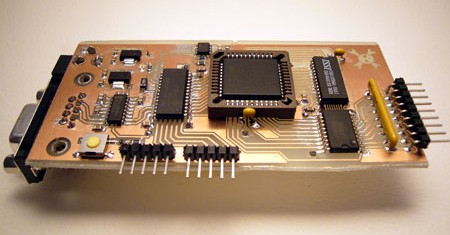
Complex programmable logic devices (CPLDs) contain the building blocks for hundreds of 7400-serries logic ICs. Complete circuits can be designed on a PC and then uploaded to a CPLD for instant implementation. A microcontroller connected to a CPLD is like a microcontroller paired with a reprogrammable circuit board and a fully stocked electronics store.

At first we weren’t sure of the wide appeal and application of CPLDs in hobbyist projects, but we’ve been convinced. A custom logic device can eliminate days of reading datasheets, finding the ideal logic IC combination, and then waiting for chips to arrive. Circuit boards are simpler with CPLDs because a single chip with programmable pin placement can replace 100s of individual logic ICs. Circuit mistakes can be corrected by uploading a new design, rather than etching and stuffing a new circuit board. CPLDs are fast, with reaction times starting at 100MHz. Despite their extreme versatility, CPLDs are a mature technology with chips starting at $1.

We’ve got a home-etchable, self programming development board to get you started. Don’t worry, this board has a serial port interface for working with the CPLD, and doesn’t require a separate (usually parallel port) JTAG programmer.

Continue reading “How-to: Programmable Logic Devices (CPLD)”