Scratch Built Subnautica Sub Explores The Pool

In Subnautica, players explore an alien underwater landscape with the help of a number of futuristic tools and vehicles. [Robert Cook] found himself particularly enamored with the large submarine you unlock towards the later parts of the game, so much so that he decided to build his own real-life version.

Even though the RC version of the Cyclops [Robert] has designed is only big enough to explore swimming pool sized alien landscapes, it’s by no means a simple build. In fact, the sub’s internal watertight compartment holds an impressive array of electronics and systems that are arguably overkill for what’s essentially a toy. Not that we’re complaining, of course.

Beyond the electronics and a few key components, almost every part of the RC Cyclops has been 3D printed. From the bulkheads that cap off the internal watertight acrylic tube to the hull itself, there’s a lot of plastic aboard this ship. Which might explain why it takes nearly two kilograms of lead weight to get the sub close to neutral buoyancy. From there, a clever ballast tank arrangement made from a syringe and peristaltic pump allow the vehicle to dive and surface on command.

[Robert] is in the process of releasing the STL files for all the submarine’s 3D printed components, and has done an excellent job of documenting the roughly four months he’s spent working on the project in a series of videos on his YouTube channel. The videos contain a wealth of fascinating tips and tricks regarding DIY submersible vehicles, such as selecting the proper radio frequencies for maximum penetration through water and counteracting the permeability of 3D printed parts with a generous coating of epoxy.

Modern RC hardware makes it easier than ever to cobble together a “submarine”, but there’s still something to be said for a project that takes the long way around and actually implements features like a functioning ballast system.

Continue reading “Scratch Built Subnautica Sub Explores The Pool”

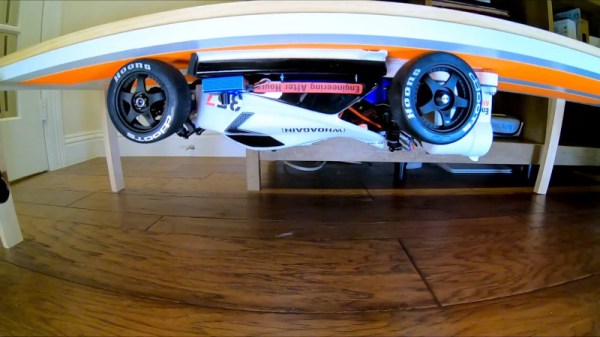
RC Car Becomes Cable Cam

The prevalence of drones has made airborne photography much more widespread, especially among hobby photographers and videographers. However, drone photos aren’t without their problems. You have to deal with making the drone follow the shot which can be difficult unless you have a very expensive one. Worse, you can’t really fly a drone through heavily wooded or otherwise obstructed terrain.

[Makesome’s] friend faced these issues and wanted to buy a cable cam — a mount for the camera that could go back and forth on a cable strung between two trees or other structures. Instead of a design from scratch, they decided to cannibalize a cheap RC car along with an HP printer and the effect — as you can see in the video below — is pretty good.

Repurposing toys is an honored tradition and, after all, what do you need but a motor that goes forward and reverses? We can’t help but notice though that toy hacking is much easier now that you can 3D print custom widgets to connect everything together.

Continue reading “RC Car Becomes Cable Cam”

Bubbles, The People-Pleasing Pandemic Panda

This year, [Thomas]’ neighborhood has gone from a quiet burg to a bustling lane full of families and children who go out walking for exercise and a change of scenery. Early on, a game emerged to distract children from the pandemic by turning these walks into bear hunts — that is, looking for stuffed bears sitting in the windows of houses and keeping count of them.

With no stuffed bears in the house, he decided to join in the fun by pasting up a 2D panda bear in the window that’s cute enough to calm anyone’s nerves. That was fun for a while, but then he turned it up to eleven by making an interactive 3D version named Bubbles the Bear that blows bubbles and speaks in a friendly voice.

Bubbles sits in a second-story window and waits for passers-by to press one of the buttons mounted on the utility pole below. Both buttons are wired to a 433MHz remote that sends a signal to an ESP32 in Bubbles’ habitat that says it’s time to perform.

We particularly like the bubble maker that [Thomas] designed, which aims a blower fan with an air concentrator at a carousel of 3D printed bubble wands. Both the fan and the carousel can be controlled with a custom web app, and he gets an email every time Bubbles has a visitor that tells him how much bubble liquid is left. Check out the fun-size demo after the break.

Bubbles are fun, especially if you can make them in extremely large quantities. Bubbles can also do work — remember this next time you need a random number generator.

Continue reading “Bubbles, The People-Pleasing Pandemic Panda”

The Trouble With Tamagotchis…

The must-have toy of a couple of decades ago was the Tamagotchi, a virtual pet in an LCD screen on a keyring, that demanded your attention and which would die were you to neglect it. Fortunately it had a reset button on the back through which it could be resuscitated, but even so it lacked a satisfying tactile experience. [Nadine] has done something about this with her Tamagotchi-style Tribble, an anthropomorphic ball of fluff that demands attention and purrs when it receives some.

Inside the ball of fake fur is an Adafruit Circuit Playground with a capacitive touch pad and a haptic motor. After a random time with no attention it “cries”, and its owner strokes it, after which it responds with a purring vibration. It’s quite cute as you can  see in the Twitter video below, and fortunately it won’t multiply and fill up your starship. We wonder whether a small resistive heater to give it a body temperature would complete its appeal as a virtual pet.

Given the popularity of Star Trek TOS among Hackaday readers perhaps it’s surprising that we don’t see more Tribble related projects. They have made a notable appearance as a DEF CON badge though.

Continue reading “The Trouble With Tamagotchis…”

Lonnie Johnson, Prolific Engineer And Hero To Millions Of Kids (Even If They Don’t Know It)

The current generation Super Soaker XP30. (Hasbro)

To be a child in the 1970s and 1980s was to be of the first generations to benefit from electronic technologies in your toys. As those lucky kids battled blocky 8-bit digital foes, the adults used to fret that it would rot their brains. Kids didn’t play outside nearly as much as generations past, because modern toys were seducing them to the small screen. Truth be told, when you could battle aliens with a virtual weapon that was in your imagination HUGE, how do you compete with that.

How those ’80s kids must have envied their younger siblings then when in 1990 one of the best toys ever was launched, a stored-pressure water gun which we know as the Super Soaker. Made of plastic, and not requiring batteries, it far outperformed all squirt guns that had come before it, rapidly becoming the hit toy of every sweltering summer day. The Super Soaker line of water pistols and guns redefined how much fun kids could have while getting each other drenched. No longer were the best water pistols the electric models which cost a fortune in batteries that your parents would surely refuse to replace — these did it better.

You likely know all about the Super Soaker, but you might not know it was invented by an aerospace engineer named Lonnie Johnson whose career included working on stealth technology and numerous projects with NASA.

Continue reading “Lonnie Johnson, Prolific Engineer And Hero To Millions Of Kids (Even If They Don’t Know It)”

Remotely Navigate The Apocalypse In Mid-Century Style

One of the few positives to come of this pandemic is that the restrictive nature of scarcity can be a boon to creativity. Plus, the doom and gloom of it all is causing people to loosen up and do things they never felt free enough to do before in the demanding world of the before times.

For example, [ossum] makes R/C vehicles on commission to exacting standards, but took a break from perfection to build this remote control hellscape-faring van by the seat of his pants. It’s quite a resourceful build that combines pieces from previous projects with a few standard R/C parts and a handful of clever hacks.

The body is a test print of a 1957 Chevy Suburban van that [ossum] made for someone a few years back. It’s mounted on a scrap metal chassis and moves on printed tank treads designed for a different vehicle.

Since glass is a liability in an apocalypse (and because [ossum] doesn’t have a resin printer yet), the windows have fortified coverings that are printed, patina’d, and detailed with tiny rivet heads.

As far as hacks go, our favorite has to be the clothespin steering. [ossum] only had one electronic speed controller, so he used a servo to actuate a pair of spring-loaded clips, alternating between the two to move the tank-van. There’s a short video after the break that shows the rack and clothes-pinion steering, and it’s loaded up right after a brief demo of the van.

We realize that everyone’s apocalyptic needs are different, but there’s more than enough here to get you started. Don’t have access to enough R/C parts? Gear boxes and drive shafts can be printed, too.

Continue reading “Remotely Navigate The Apocalypse In Mid-Century Style”

Re-used Materials Make Tiny Offroad Track For Micro R/C

What does one do with tiny 1:35 scale remote controlled off-road vehicles? Build appropriately-tiny tracks for them to drive on, of course. That’s exactly what [David] did when he created his fantastic rock crawling track that he has dubbed the ‘4×4 Arena’, and what’s even better is that he used leftover foam inserts and acrylic paints and materials to do it, and didn’t have to spend a penny.

The original track is only just visible in the back; the new track expands it considerably.

This isn’t [David]’s first track. He originally made a smaller rock-crawling track he called Rubble Wasteland for the tiny vehicles, and he liked it so much he expanded it considerably. The new track builds on the original and is three levels deep, sports tight cave-like passages, tunnels, tricky climbs, and and realistic terrain textures.

An enormous photo gallery is right here, and other than the first and final images, it’s roughly in chronological build order. If your curiosity has been piqued about the tiny 1:35 scale remote controlled vehicles that this track is built for, around gallery page nine is where pictures of what makes these tiny things tick begins.

We have seen some amazing projects in the RC field; like this tiny 3D printed truck, and in-depth details of a micro RC plane that weighs only 2.9 grams.