Leather Working With A 3D Printer

No, you can’t print in leather — at least not yet. But [Make Everything] has a tutorial about how to produce a custom leather embossing jig with a 3D printer. From a 3D printing point of view, this isn’t very hard to do and you might want to skip over the first six minutes of the video if you’ve done 3D printing before.

The real action is when he has the 3D print completed. He glues the stamp down to some wood and then fits the assembly to a vise that he’ll use as a press. After wetting the leather, the wood and 3D printed assembly sandwiches the piece and the vise applies pressure for ten minutes. He did make the leather a bit oversized to make alignment more forgiving. After the embossing is complete, he trims it out.

Continue reading “Leather Working With A 3D Printer”

MIT Makes Washable LED Fabric

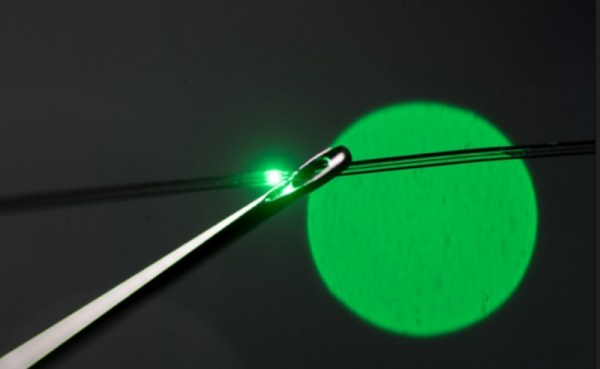
Let’s face it, one of the challenges of wearable electronics is that people are filthy. Anything you wear is going to get dirty. If it touches you, it is going to get sweat and oil and who knows what else? And on the other side it’s going to get spills and dirt and all sorts of things we don’t want to think about on it. For regular clothes, that’s not a problem, you just pop them in the washer, but you can’t say the same for wearable electronics. Now researchers at MIT have embedded diodes like LEDs and photodetectors, into a soft fabric that is washable.

Traditionally, fibers start as a larger preform that is drawn into the fiber while heated. The researchers added tiny diodes and very tiny copper wires to the preform. As the preform is drawn, the fiber’s polymer keeps the solid materials connected and in the center. The polymer protects the electronics from water and the team was able to successfully launder fabric made with these fibers ten times.

Continue reading “MIT Makes Washable LED Fabric”

Programmable Badge Uses E-Ink And ESP8266

You’ve probably noticed that the hacker world is somewhat enamored with overly complex electronic event badges. Somewhere along the line, we went from using a piece of laminated paper on a lanyard to custom designed gadgets that pack in enough hardware that they could have passed for PDAs not that long ago. But what if there was a way to combine this love for weighing down one’s neck with silicon jewelry and the old school “Hello my name is…” stickers?

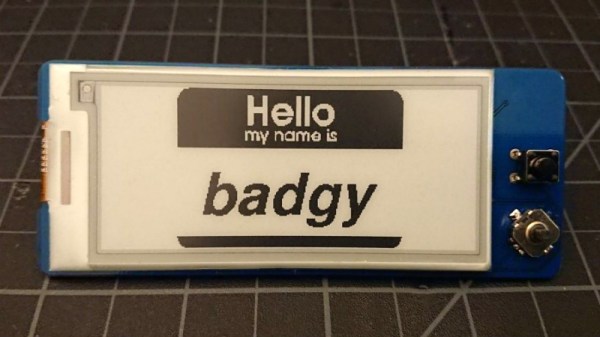
[Squaro Engineering] might have the solution with Badgy, their multi-function e-ink name…well, badge. Compatible with the Arduino SDK, it can serve as anything from a weather display to a remote for your smart home. Oh, and we suppose in an absolute emergency it could be used to avoid having to awkwardly introduce yourself to strangers.

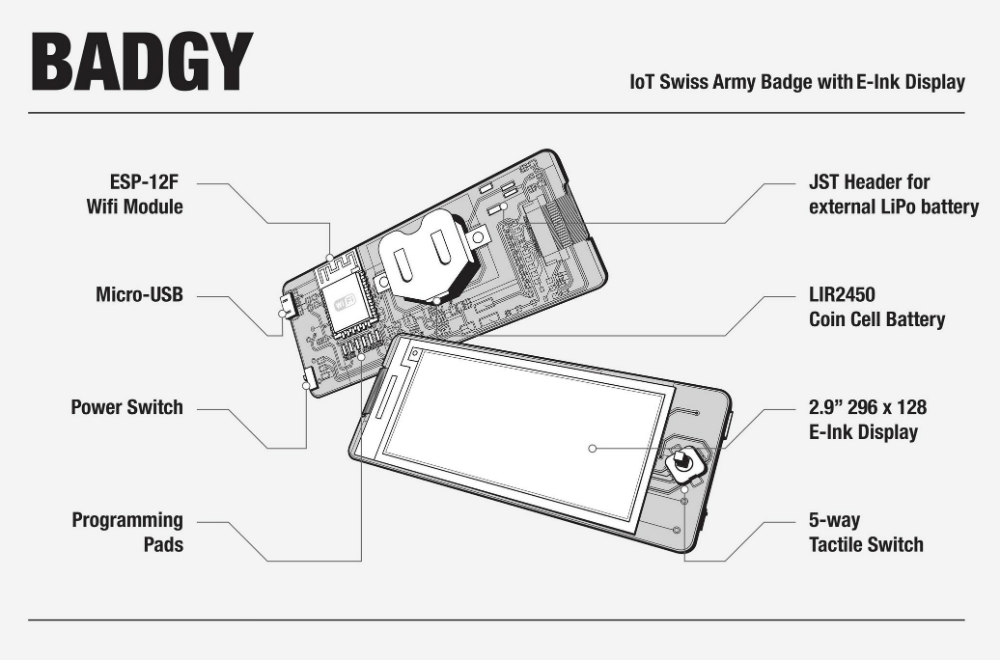
Powered by an ESP-12F, Badgy features a 2.9″ 296×128 E-Ink display and a five-way tactical switch for user input. The default firmware includes support for WiFiManager and OTA updates to make uploading your own binaries as easy as possible, and a number of example Sketches are provided to show you the ropes. Powered by a LIR2450 3.6 V lithium-ion rechargeable coin cell, it can run for up to 35 days in deep sleep or around 5 hours of heavy usage.

Schematics, source code, and a Bill of Materials are all available under the MIT license if you want to try your hand at building your own, and assembled badges are available on Tindie. While it might not be as impressive as a retro computer hanging around your neck, it definitely looks like an interesting platform to hack on.

Hacked LCD Shutter Glasses See The Light

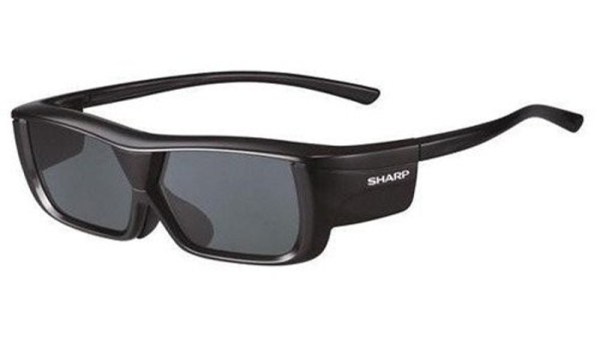
It’s always a little sad to see a big consumer technology fail. But of course, the upside for us hacker types is that the resulting fire sale is often an excellent source for hardware that might otherwise be difficult to come by. The most recent arrival to the Island of Unwanted Consumer Tech is 3D TV. There was a brief period of time when the TV manufacturers had nearly convinced people that sitting in their living room wearing big dorky electronic glasses was a workable solution, but in the end we know how it really turned out.
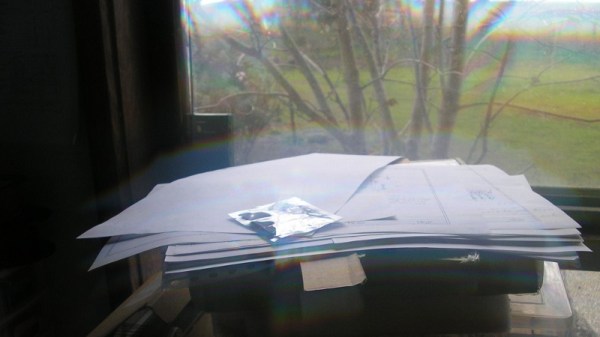
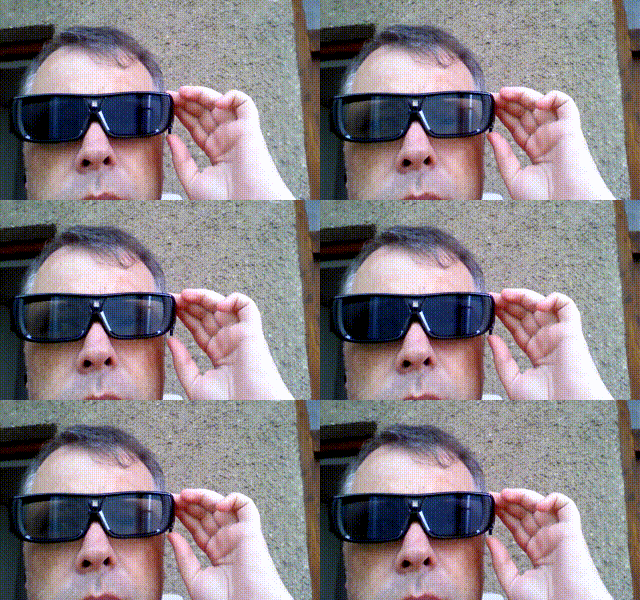
Those same dorky glasses are now available for a fraction of their original price, and are ripe for hacking. [Kevin Koster] has been playing around with them, and he’s recently came up with a circuit that offers the wearer a unique view of the world. Any reflective surface will look as though it is radiating rainbows, which he admits doesn’t show up as well in still images, but looks cool enough that he thought it was worth putting the board into production in case anyone else wants in on the refraction action.

To explain how it works, we need to take a couple of steps back and look at the mechanics of the LCD panels used in these type of glasses. At the risk of oversimplification, one could say that LCDs are sort of like capacitors: when charged the crystals align themselves in such a way that the polarization of the light passing through is changed. Combined with an external polarization filter, this has the end result of turning the panel opaque. To put the crystals back in their original arrangement, and let the light pass through again, the LCD panel is shorted out in the same way you might discharge a capacitor.

What [Kevin] found was that if he slowly discharged the LCD panel rather than shorting it out completely, it would gradually fade out instead of immediately becoming transparent. His theory is that this partial polarization is what causes the rainbow effect, as the light that’s passing through to the wearers eyes is in a “twisted” state.

[Kevin] has provided all of the information necessary to build your own “Rainbow Adapter”, but you can also purchase a kit or assembled board from Tindie. If you’re looking for other projects to make use of those 3D glasses collecting dust, how about turning them into automatic sunglasses or having a go at curing your lazy eye.


Automatic Sunglasses, No Battery!

There are some projects that are so simple they require very little description, and [Bobricius’s] automatic sunglasses definitely fit into that category. Their story starts with the fad for 3D displays a few years ago, a resurfacing of the movie business’s periodic flirtation with the third dimension in the hope of using the gimmick to bring in more moviegoers. There was a time when you could hardly encounter a new TV or graphics card without it coming with a pair of cheap plastic glasses with LCD panels instead of lenses that would alternately shutter the view for each eye to create the 3D illusion.

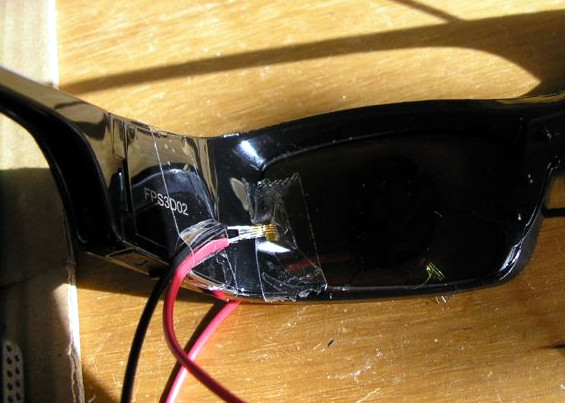
Of course, once everyone had seen the film with the blue aliens and tried a few other titles on their new toy, they grew tired of headaches, nausea, and half-brightness. The glasses gathered dust, and the fancy 3D telly never ventured beyond two dimensions again. Except for [Bobricius’s] glasses, that is, for he’s levered out the 3D driver electronics and replaced them with a tiny SOIC-8 solar cell. Light hits the cell, the LCD gets a charge and darkens, no light and they remain transparent. Similar to welding goggles — though they usually use a battery. It’s unclear whether they can get a little too dark on a really bright day and whether they are something akin to [Zaphod Beeblebrox]’s peril-sensitive sunglasses, but we really applaud the idea. They are so simple that this Hackaday write-up is probably longer than their write-up, but they remain a neatly executed idea and we like that.
You can, of course, use a battery, or achieve the same effect by more complex means. But if the [Beeblebrox] glasses are closer to your requirements, we’ve got that covered too.

Sonar In Your Hand

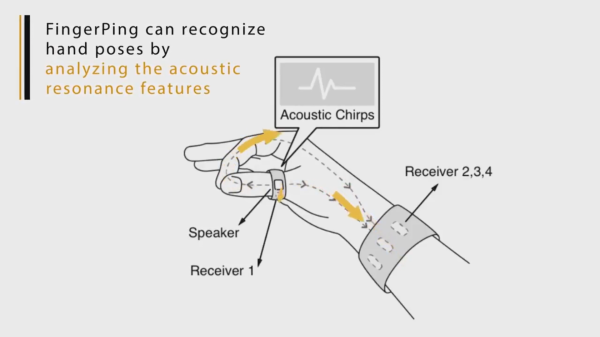
Sonar measures distance by emitting a sound and clocking how long it takes the sound to travel. This works in any medium capable of transmitting sound such as water, air, or in the case of FingerPing, flesh and bone. FingerPing is a project at Georgia Tech headed by [Cheng Zhang] which measures hand position by sending soundwaves through the thumb and measuring the time on four different receivers. These readings tell which bones the sound travels through and allow the device to figure out where the thumb is touching. Hand positions like this include American Sign Language one through ten.

From the perspective of discreetly one through ten on a mobile device, this opens up a lot of possibilities for computer input while remaining pretty unobtrusive. We see prototypes which are more capable of reading gestures but also draw attention if you wear them on a bus. It is a classic trade-off between convenience and function but this type of reading is unique and could combine with other bio signals for finer results.

Continue reading “Sonar In Your Hand”

Rachel Wong Keynote: Growing Eyeballs In The Lab And Building Wearables That Enhance Experience

The keynote speaker at the Hackaday Belgrade conference was Rachel “Konichiwakitty” Wong presenting Jack of All Trades, Master of One. Her story is one that will be very familiar to anyone in the Hackaday community. A high achiever in her field of study, Rachel has learned the joy of limiting how much energy she allows herself to expend on work, rounding out her life with recreation in other fascinating areas.

There are two things Rachel is really passionate about in life. In her professional life she is working on her PhD as a stem cell researcher studying blindness and trying to understand the causes of genetic blindness. In her personal life she is exploring wearable technology in a way that makes sense to her and breaks out of what is often seen in practice these days.

Continue reading “Rachel Wong Keynote: Growing Eyeballs In The Lab And Building Wearables That Enhance Experience”