On-Air Sign Helps Keep Your Broadcasts G-Rated

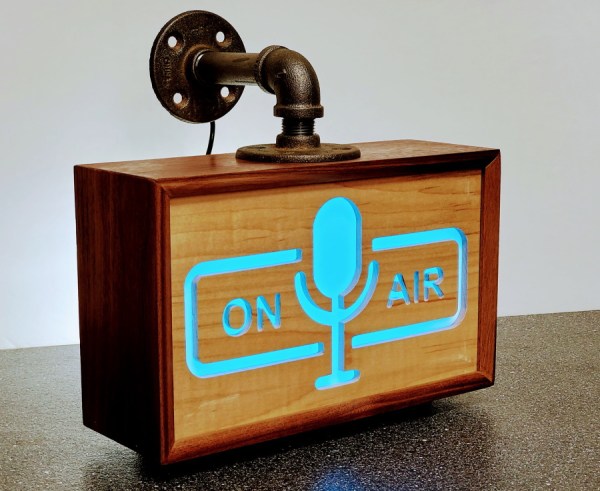
Like many of us, [Michael] needed a way to let the family know whether pants are required to enter the room — in other words, whenever a videoconference is in progress. Sure he could hang a do not disturb sign, but those are easy to forget. There’s no need to worry about forgetting to change status because this beautiful wall-mounted sign can be controlled with Alexa.

Inside the gorgeous box made from walnut, curly maple, and oak is an ESP32, some RGB LEDs, and three MOSFETs. [Michael] is using the fauxmoESP library to interface the ESP32 with Alexa, which emulates a Phillips Hue bulb for the sake of using a protocol she already knows. [Michael] can change the color and brightness percentage with voice commands.

The sign is set up as four different devices — one default, and one for each color. Since talking to Alexa isn’t always appropriate, [Michael] can also change the color of the LEDs using sliders on a website that’s served up by the ESP. Check out the full build video after the break.

Need something quick and dirty that works just as well? Our own [Bob Baddeley] made a status indicator that’s simple and effective.

Continue reading “On-Air Sign Helps Keep Your Broadcasts G-Rated”

Is Your Echo Flex Listening?

We are always surprised that Amazon or Google doesn’t employ Kelsey Grammer — TV’s Frasier — as a spokesman for their smart home devices. After all, his catchphrase was, “I’m listening…” Maybe they don’t want to remind you that the device could, theoretically, be sending everything you say to them or a nefarious hacker or government agency. Sure, there’s a mute button and it lights up a red LED.

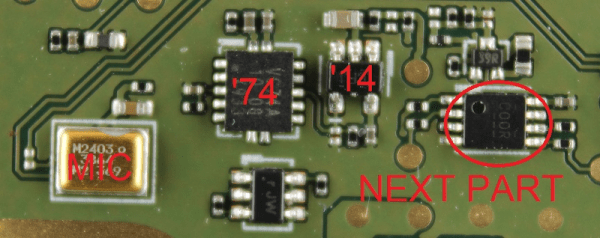
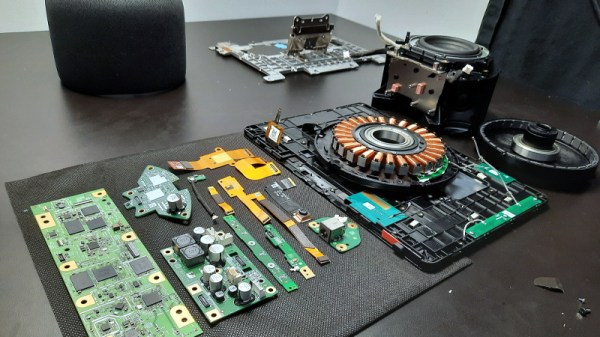
But if you are truly paranoid, that’s not enough. After all, the same people want to eavesdrop on you would be happy to fake a red light. [Electronupdate] had the same thought and decided to answer the question: does the mute button really mute your microphone? The answer required not only some case opening and analysis, but there was even some IC decapsulation.

We were impressed with the depth of the analysis. The tiny SMD parts are marked confusingly, and if you are really paranoid you don’t believe them anyway. But looking at the actual circuit die is pretty unambiguous. The  parts in question turned out to be a Schmitt trigger, a flip flop, and a NAND gate.

Continue reading “Is Your Echo Flex Listening?”

Amazon Sidewalk: Should You Be Co-Opted Into A Private Neighbourhood LoRa Network?

WiFi just isn’t very good at going through buildings. It’s fine for the main living areas of an average home, but once we venture towards the periphery of our domains it starts to become less reliable.  For connected devices outside the core of a home, this presents a problem, and it’s one Amazon hope to solve with their Sidewalk product.

It’s a low-bandwidth networking system that uses capability already built into some Echo and Ring devices, plus a portion of the owner’s broadband connection to the Internet.  The idea is to provide basic connectivity over longer distances to compatible devices even when the WiFi network is not available, but of most interest and concern is that it will also expose itself to devices owned by other people. If your Internet connection goes down, then your Ring devices will still provide a basic version of their functionality via a local low-bandwidth wide-area wireless network provided by the Amazon devices owned by your neighbours. Continue reading “Amazon Sidewalk: Should You Be Co-Opted Into A Private Neighbourhood LoRa Network?”

Stay Smarter Than Your Smart Speaker

Smart speakers have always posed a risk to privacy and security — that’s just the price we pay for getting instant answers to life’s urgent and not-so-urgent questions the moment they arise. But it seems that many owners of the 76 million or so smart speakers on the active install list have yet to wake up to the reality that this particular trick of technology requires a microphone that’s always listening. Always. Listening.

With so much of the world’s workforce now working from home due to the global SARS-CoV-2 pandemic, smart speakers have suddenly become a big risk for business, too — especially those where confidential conversations are as common and crucial as coffee.

Imagine the legions of lawyers out there, suddenly thrust from behind their solid-wood doors and forced to set up ramshackle sub rosa sanctuaries in their homes to discuss private matters with their equally out-of-sorts clients. How many of them don’t realize that their smart speaker bristles with invisible thorns, and is even vulnerable to threats outside the house? Given the recent study showing that smart speakers can and do activate accidentally up to 19 times per day, the prevalence of the consumer-constructed surveillance state looms like a huge crisis of confidentiality.

So what are the best practices of confidential work in earshot of these audio-triggered gadgets?

Continue reading “Stay Smarter Than Your Smart Speaker”

The Amazon Dash Button: A Retrospective

The Internet of Things will revolutionize everything! Manufacturing? Dog walking? Coffee bean refilling? Car driving? Food eating? Put a sensor in it! The marketing makes it pretty clear that there’s no part of our lives which isn’t enhanced with The Internet of Things. Why? Because with a simple sensor and a symphony of corporate hand waving about machine learning an iPhone-style revolution is just around the corner! Enter: Amazon Dash, circa 2014.

The first product in the Dash family was actually a barcode scanning wand which was freely given to Amazon Fresh customers and designed to hang in the kitchen or magnet to the fridge. When the Fresh customer ran out of milk they could scan the carton as it was being thrown away to add it to their cart for reorder. I suspect these devices were fairly expensive, and somewhat too complex to be as frequently used as Amazon wanted (thus the extremely limited launch). Amazon’s goal here was to allow potential customers to order with an absolute minimum of friction so they can buy as much as possible. Remember the “Buy now with 1-Click” button?

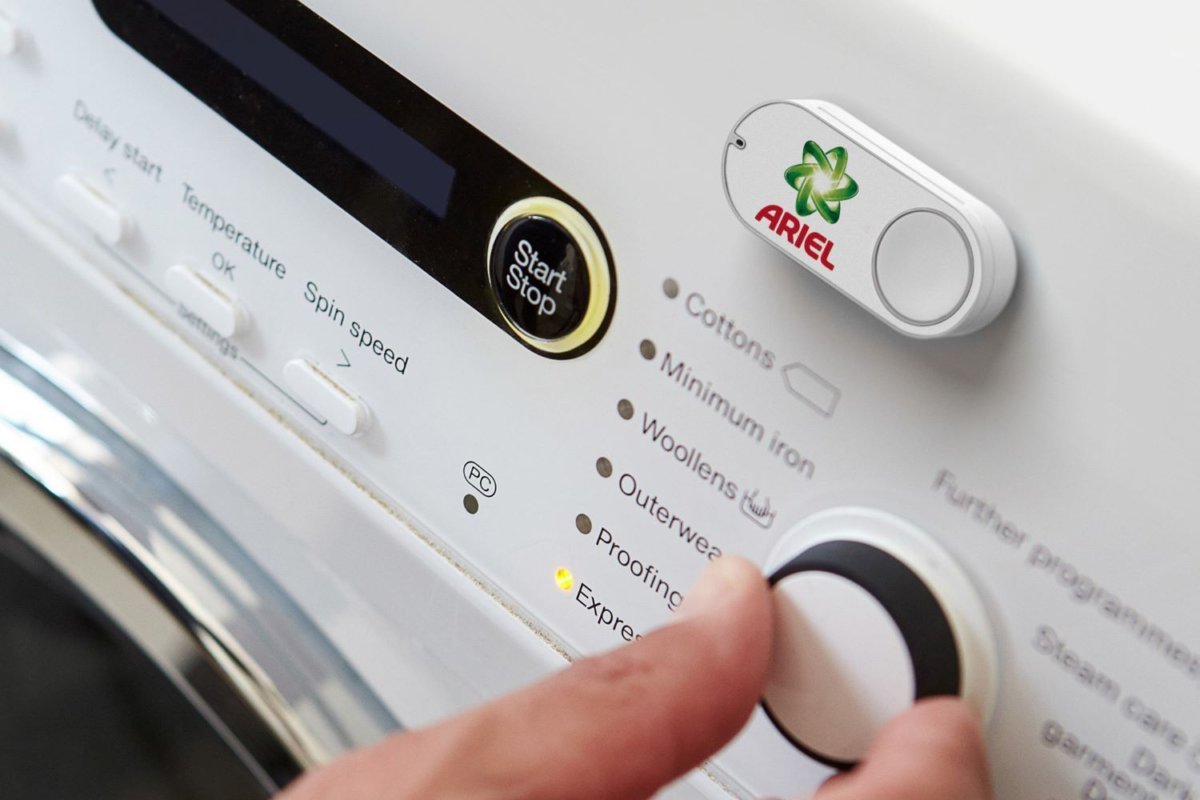
That original Dash Wand was eventually upgraded to include a push button activated Alexa (barcode scanner and fridge magnet intact) and is generally available. But Amazon had pinned its hopes on a new beau. Mid 2015 Amazon introduced the Dash Replenishment Service along with a product to be it’s exemplar – the Dash Button. The Dash Button was to be the 1-Click button of the physical world. The barcode-scanning Wands require the user to remember the Wand was nearby, find a barcode, scan it, then remember to go to their cart and order the product. Too many steps, too many places to get off Mr. Bezos’ Wild Ride of Commerce. The Dash Buttons were simple! Press the button, get the labeled product shipped to a preconfigured address. Each button was purchased (for $5, with a $5 coupon) with a particular brand affinity, then configured online to purchase a specific product when pressed. In the marketing materials, happy families put them on washing machines to buy Tide, or in a kitchen cabinet to buy paper towels. Pretty clever, it really is a Buy now with 1-Click button for the physical world.

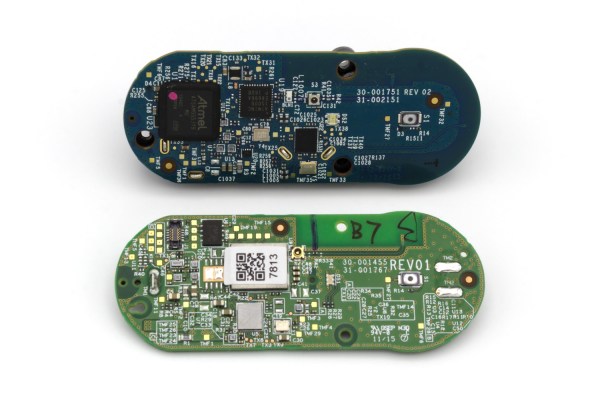
There were two versions of the Dash button. Both have the same user interface and work in fundamentally the same way. They have a single button (the software can recognize a few click patterns), a single RGB LED (‘natch), and a microphone (no, it didn’t listen to you, but we’ll come back to this). They also had a WiFi radio. Version two (silently released in 2016) added Bluetooth and completely changed the electrical innards, though to no user facing effect.

In February 2019, Amazon stopped selling the Dash Buttons. Continue reading “The Amazon Dash Button: A Retrospective”

Building A Smart Speaker From Scratch

Smart speakers have proliferated since their initial launch earlier this decade. The devices combine voice recognition and assistant functionality with a foreboding sense that paying corporations for the privilege of having your conversations eavesdropped upon could come back to bite one day. For this reason, [Yihui] is attempting to build an open-source smart speaker from scratch.

The initial prototype uses a Raspberry Pi 3B and a ReSpeaker microphone array. In order to try and bring costs down, development plans include replacing these components with a custom microphone array PCB and a NanoPi board, then implementing basic touch controls to help interface with the device.

There’s already been great progress, with the build showing off some nifty features. Particularly impressive is the ability to send WiFi settings to the device using sound, along with the implementation of both online and offline speech recognition capabilities. This is useful if your internet goes down but you still want your digital pal to turn out the lights at bed time.

It’s not the first time we’ve seen a privacy-focused virtual assistant, and we hope it’s not the last. Video after the break.

Continue reading “Building A Smart Speaker From Scratch”

Chatterbox Voice Assistant Knows To Keep Quiet For Privacy

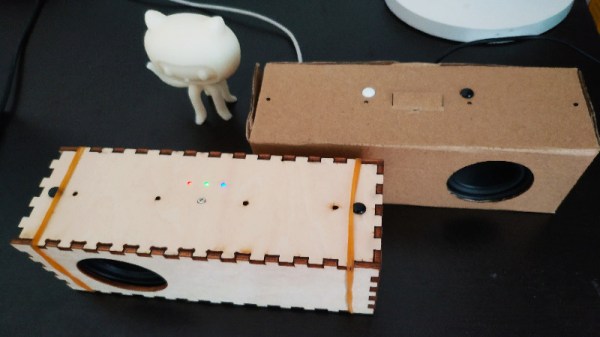
Cruising through the children’s hands-on activity zone at Maker Faire Bay Area, we see kids building a cardboard enclosure for the Chatterbox smart speaker kit. It would be tempting to dismiss the little smiling box as “just for kids” but doing so would overlook something more interesting: an alternative to data-mining corporations who dominate the smart speaker market. People are rightly concerned about Amazon Echo and Google Home, always-listening devices for online retail sending data back to their corporate data centers. In order to be appropriate for children, Chatterbox is none of those things. It only listens when a button is pressed, and its online model is designed to support the mission of CCFC (Campaign for a Commercial-Free Childhood.)

Getting started with a Chatterbox is much like other products designed to encourage young makers. The hardware — Raspberry Pi, custom HAT, speaker and button inside a cardboard enclosure — is conceptually similar to a Google AIY Voice kit but paired with an entirely different software experience. Instead of signing in to a Google developer account, children create their own voice interaction behavior with a block-based programming environment resembling MIT Scratch. Moving online, Chatterbox interactions draw upon resources of similarly privacy-minded entities like DuckDuckGo web search. Voice interaction foundation is built upon a fork of Mycroft with changes focused on education and child-friendliness. If a Chatterbox is unsure whether a query was for “Moana” or “Marijuana”, it will decide in favor of the Disney movie.

Many of these privacy-conscious pieces are open source or freely available, but Chatterbox pulls them all together into a single package that’s an appealing alternative to the big brand options. Based on conversations during Hackaday’s Maker Faire meetup, there’s a market beyond parents of young children. From technically aware adults who lack web API coding skills, to senior citizens unaware of dark corners of the web. Chatterbox Kickstarter campaign has a few more weeks to run but has already reached funding goals. We look forward to having a privacy-minded option in voice assistants.