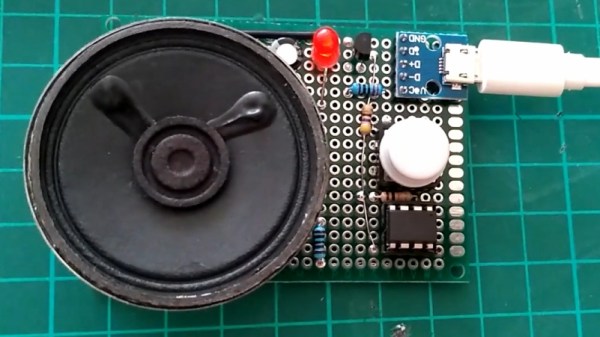
ATtiny85 on circuit board with 2n2222, pushbutton, usb-c power connector, LED, and speaker.

Custom Compression Squeezes Classic Computer Choruses Into A Tiny Controller

Geeks of a certain vintage will have fond memories of games that were simplistic by today’s standards, but drew one in all the same. Their low fidelity graphics were often complimented by equally low fidelity music being forced through the afterthought of a speaker that inhabited most computers. Despite the technical constraints of the era, these games didn’t just offer gameplay. They told stories, and they were immersive in a way that some would think wouldn’t be relatable to a younger generation.

That didn’t stop [Thanassis Tsiodras] from sharing the classic “The Secret of Monkey Island” with his niece and nephew when they were young. Excited to see his family after a year of separation due to COVID-19, [Thanassis] wanted to give them a handmade gift: The music from “The Secret of Monkey Island” on a custom player. What an uncle!

[Thanassis] could have just recorded the music and played it back using any number of chips made for the purpose, but being a long time software engineer, he decided to take the scenic route to his destination. First, DOSBox was hacked to dump the speaker output into a file. Python, C, and 30 years of experience were leveraged to squeeze everything into the 8 KB storage of an ATtiny85. Doing so was no small feat, as it required that he create a custom implementation of Huffman compression to get the data small enough to fit on chip. And when it fit, but didn’t work, even more optimization was needed.

The end result was worth it however, with the music from “The Secret of Monkey Island” playing in its original form from a speaker driven by the ever so humble but useful 2n2222. [Thanassis]’ site is replete with details too intricate to post here, but too neat to miss. Watch the video below the break for a demonstration.

Continue reading “Custom Compression Squeezes Classic Computer Choruses Into A Tiny Controller”
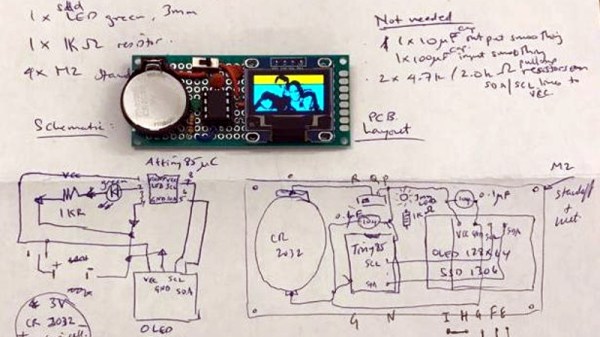
An OLED Photo Frame Powered By The ATtiny85

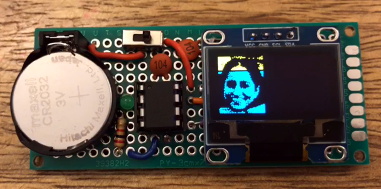
Rolling your own digital picture frame that loads images from an SD card and displays them on an LCD with a modern microcontroller like the ESP32 is an afternoon project, even less if you pull in somebody else’s code. But what if you don’t have the latest and greatest hardware to work with?

Whether you look at it as a practical application or an interesting experiment in wringing more performance out of low-end hardware, [Assad Ebrahim]’s demonstration of displaying digital photographs on an OLED using the ATtiny85 is well worth a look. The whole thing can put put together on a scrap of perfboard with a handful of common components, and can cycle through the five images stored on the chip’s flash memory for up to 20 hours on a CR2032 coin cell.

As you might expect, the biggest challenge in this project is getting all the code and data to fit onto the ATtiny85. To that end [Assad] wrote his own minimal driver for the SSD1306 OLED display, as the traditional Adafruit code took up too much space. The driver is a pretty bare bones implementation, but it’s enough to initialize the screen and get it ready for incoming data. His code also handles emulating I2C over Atmel’s Universal Serial Interface (USI) at an acceptable clip, so long as you bump the chip up to 8 MHz.

For the images, [Assad] details the workflow he uses to take the high-resolution color files and turn them into an array of bytes for the display. Part of that it just scaling down and converting to 1-bit color, but there’s also a bit of custom Forth code in the mix that converts the resulting data into the format his code expects.

This isn’t the first time we’ve seen somebody use one of these common OLED displays in conjunction with the ATtiny85, and it’s interesting to see how their techniques compare. It’s not a combination we’d necessarily chose willingly, but sometimes you’ve got to work with whats available.

Spectrum Display Uses Tiny CPU And Many LEDs

You would think the hard part about creating a spectrum analyzer using a pint-sized ATTiny85 would be the software. But for [tuenhidiy], we suspect the hard part was fabricating an array of 320 LEDs that the little processor can drive. The design does work though, as you can see in the video below.

The key is to use a TPIC6B595N which is an 8-bit shift register made to drive non-logic outputs. With all outputs on, the driving FETs can supply 150 mA per channel and the device can handle 500 mA per channel peak. At room temperature, the part can go over 1W of total power dissipation, although that goes down with temperature, of course. If you need higher power, there’s a DW-variant of the part that can handle a few hundred milliwatts more.

Continue reading “Spectrum Display Uses Tiny CPU And Many LEDs”

Air Extractor Automatically Gives AC A Boost

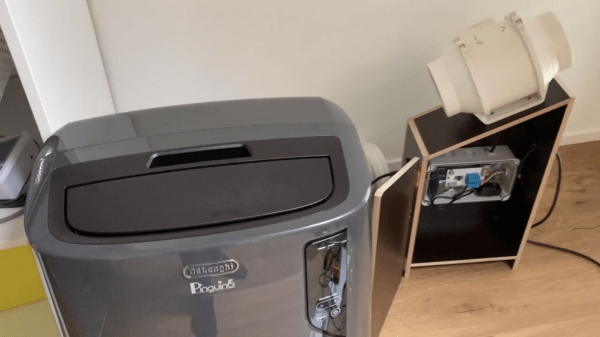
Portable air conditioning units are a great way to cool off a space during the hot summer months, but they require some place to blow the heat they’ve removed from your room. [VincentMakes] got a portable AC unit for his home, but he found that the place he wanted to put it was too far from the only window he could use to dump the hot air. Having too long of a duct on the hot air exhaust increases the back pressure on the fan which could cause it to prematurely fail, so [Vincent] used an extractor fan to automatically give is AC unit’s exhaust a boost on its way to the window.

Because his AC can operate at low, medium, and high speeds, he chose an extractor fan that also supported multiple speeds and took care to match the airflow of the AC and extractor fan to avoid putting too much strain on either fan. He designed a system to automatically set the speed of the boosting fan to match that of the AC using a Hall effect current sensor to measure the AC unit’s power draw and an Arduino Nano for control. A custom PCB interfaces the Nano to the Hall Sensor and control relays, and we have to applaud [Vincent] for keeping the +5V DC and 230V AC far, far away from each other. In addition to this fine electronics work, [Vincent] also built an enclosure for the fan controller that allows the fan to be mounted on top at an angle, which helps avoid having hard bends in the exhaust duct.

If this has you thinking about smart air conditioners to keep cool this summer, check out this ESP8266-powered smart AC system, or this Raspberry Pi-based system that controls both AC and blinds!

Arduboy FX Mod-Chip: Now You’re Playing With Power

Traditionally, a forum full of technical users trying integrate their own hardware into a game system for the purposes of gaining unfettered access to its entire software library was the kind of thing that would keep engineers at Sony and Nintendo up at night. The development and proliferation of so called “mod chips” were an existential threat to companies that made their money selling video games, and as such, sniffing out these console hackers and keeping their findings from going public for as long as possible was a top priority.

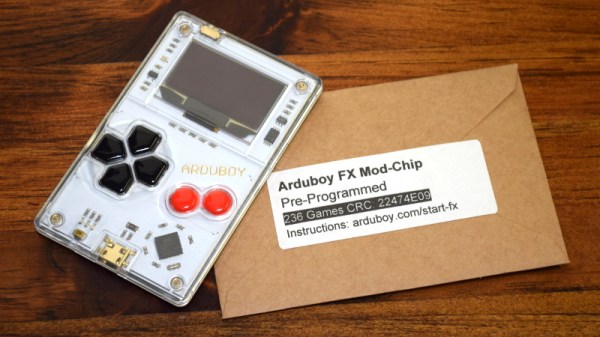
But the Arduboy is no traditional game system. Its games are distributed for free, so a chip that allows users to cram hundreds of them onto the handheld at once isn’t some shady attempt to pull a fast one on the developers, it’s a substantial usability improvement over the stock hardware. So when Arduboy creator Kevin Bates found out about the grassroots effort to expand the system’s internal storage on the official forums, he didn’t try to put a stop to it. Instead, he asked how he could help make it a reality for as many Arduboy owners as possible.

Now, a little less than three years after forum member Mr.Blinky posted his initial concept for hanging an external SPI flash chip on the system’s test pads, the official Arduboy FX Mod-Chip has arrived. Whether you go the DIY route and build your own version or buy the ready-to-go module, one thing is for sure: it’s a must-have upgrade for the Arduboy that will completely change how you use the diminutive handheld.

Continue reading “Arduboy FX Mod-Chip: Now You’re Playing With Power”

Bike Wheel Light Flashes Just Right

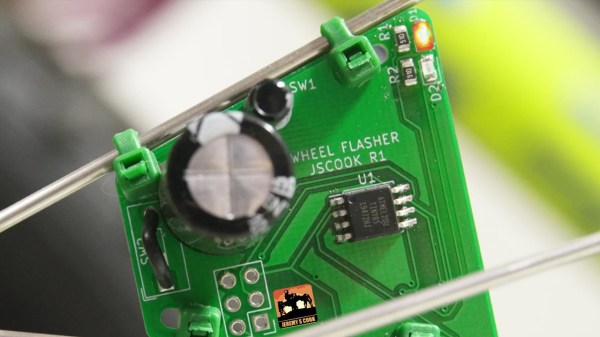
When it comes to safely riding a bike around cars, the more lights, the better. Ideally, these lights would come on by themselves, so you don’t have to remember to turn them on and off every time. That’s exactly the idea behind [Jeremy Cook]’s latest build — it’s an automatic bike light that detects vibration and lights up some LEDs in response.

The build is pretty simple — a coin cell-powered ATtiny85 reads input from a spring vibration sensor and flashes the LEDs. This is meant to complement [Jeremy]’s primary bike light, which is manually operated and always on. We especially like that form follows function here — the board shape is designed to be zip-tied to the spokes so it’s as close to the action as possible. He cleverly used cardboard and a laser cutter to mock up a prototype for a board that fits between the spokes. Pretty cool for your second professionally-fabbed PCB ever, if you ask us. Ride past the break to check out the build video.

If you don’t think fireflies on your spokes are enough to keep you safe, go full rainbow party bike.

Continue reading “Bike Wheel Light Flashes Just Right”

Your NES Classic Mini Controller, On Your Desktop Computer

The NES Classic Mini was one of the earlier releases in what became a wider trend for tiny versions of classic retro consoles to be released. Everybody wanted one but numbers were limited, so only the lucky few gained this chance to relive their childhood through the medium of Donkey Kong or Mario Brothers on real Nintendo hardware. Evidently [Albert Gonzalez] was one of them, because he’s produced a USB adapter for the Mini controller to allow it to be used as a PC peripheral.

On the small protoboard is the Nintendo connector at one end, an ATtiny85 microcontroller, and a micro-USB connector at the other. The I2C interface from the controller is mapped to USB on the ATtiny through the magic of the V-USB library, appearing to the latter as a generic gamepad. It’s thought that the same interface is likely to also work with the later SNES Classic Mini controller. For the curious all the code and other resources can be found in a GitHub repository, so should you have been lucky enough to lay your hands on a NES Classic Mini then you too can join the PC fun.

The mini consoles were popular, but didn’t excite our community as much as could be expected. Our colleague Lewin Day tool a look at the phenomenon last summer.