Choosing The Right Battery For Your Electric Vehicle Build

Many a hacker has looked at their scooter, bike, or skateboard, and decided that it would be even better if only it had a motor on it. Setting out to electrify one’s personal transport can be an exciting and productive journey, and one that promises to teach many lessons about mechanical and electronic engineering. Fundamentally, the key to any build is the battery, which has the utmost say in terms of your vehicle’s performance and range. To help out, we’ve prepared a useful guide on selecting the right battery for your needs.

One Chemistry To Rule Them All

Batteries come in all shapes and sizes, and a variety of different chemistries that all have their own unique properties and applications. When it comes to small electric vehicles, it’s desirable to have a battery with a low weight, compact size, plenty of current delivery for quick acceleration, and high capacity for long range.

30 years ago, options were limited to lead acid, nickel cadmium, and nickel metal hydride batteries. These were heavy, with low current output, poor capacity, and incredibly slow charge times. Thankfully, lithium polymer batteries have come along in the meantime and are more capable across the board. Offering huge discharge rates, fast charging, light weight and high capacity, they’re undeniably the ultimate choice for a high performance electric vehicle. They’re also wildly popular, and thus cheap, too!

There are some hangups, however. It’s important to keep all the cells in a pack at the same voltage in order to avoid cells back-charging each other. This can cause damage to the pack, or even explosions or fire. Maintaining the battery voltages to avoid this is called “balancing”. It can be handled in various ways, depending on the exact style of battery you’re using, as we’ll cover later.

Additionally, lithium batteries do not like being over-discharged. As a rule of thumb, it’s a good idea not to let your batteries drop below 3.0 V per cell. Failure to keep this in check can lead to ruining a pack, hurting its maximum capacity and ability to deliver current.

There are thankfully ways around these issues, and which ones you use depends on the battery you choose for your application. Continue reading “Choosing The Right Battery For Your Electric Vehicle Build”

Hackaday Links Column Banner

Hackaday Links: December 15, 2019

When you’re right, you’re right. Back in January, we predicted that exoskeletons were about to break out as a mainstream product, and gave several examples of prototypes poised to become products. So it was with interest that we read about Sarcos Robotics and their new Guardian XO, a cyber suit aimed at those doing heavy lifting tasks. The wearable, full-body exoskeleton is supposed to amplify the wearer’s effort 20-fold, making a 200-pound load feel like lifting 10 pounds. It runs untethered for two hours on hot-swappable battery packs, and will be offered for lease to civilian heavy industries and the military for $100,000 a year. Honestly, it seems like you could hire a fair number of meat-robots for that sum, but still, it’s an interesting technology and a promising development.

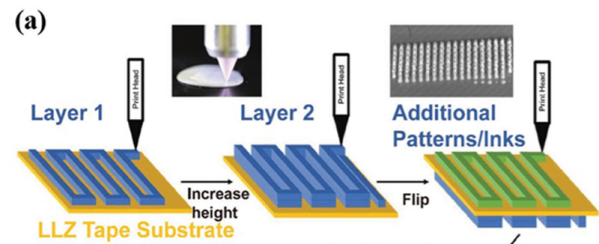
Aficionados of 3D printing know all too well the limitations of the technology. While we’ve come a long way with things like a print in place, multiple materials, embedded electronics, and even direct 3D printing of complex mechanisms like electric motors, there’s been a long-standing obstacle to turning the 3D printer into the replicators of the Star Trek universe: batteries. But even that barrier is falling, and a new paper shows just how far we’ve come to printing batteries right into our designs. Using an off-the-shelf Prusa Mk 3 and specially formulated lithium iron phosphate/PLA and silicon dioxide/PLA filaments, the group was able to print working batteries in one shot. It’s exciting news because previous 3D-printed batteries required special printers or laborious post-processing steps. We’ll be watching for developments here.

Speaking of laboratory work, anyone who has been around labs is probably familiar with LabVIEW, the de facto standard for programming data capture and automation applications in the laboratory setting. The graphical programming language makes it easy to throw together a quick interface, and many lab-rats regret not having the expensive, proprietary environment available for their after-hours hacking. That might no longer be true, though, with special LabVIEW licensing for non-commercial users. It looks like there are two levels: LabVIEW Home Edition and a Community Edition of LabVIEW, which is currently in Beta. Either way, it’s good news for LabVIEW fans.

Friend of Hackaday Eric Strebel released a video the other day that we just had to comment on. It has nothing to do with electronics – unless you’re into circuit sculpture, that is. In the first of a two-part series, Eric covers the basics of modeling with brass and copper, using both wire and tubing. He has some great tips, like work-hardening and straightening copper wire by stretching it, and the miniature roll bender seen at 7:40 looks like something that could easily be 3D-printed. We recently did a Hack Chat on circuit sculpture with Mohit Bhoite, and saw his Supercon talk on the subject, so this video really got the creative juices flowing.

If you’re local to the Elkhorn, Wisconsin area, consider stopping by the Elkhorn Mini Maker Faire on February 15 and 16. Elkhorn looks like it has a nice central location between Milwaukee and Madison, and doesn’t appear too far from Chicago either, which is probably why they drew 1,200 people to the inaugural Faire last year. They’re looking to get that up to 2,000 people this year and over 150 booths, so if you’ve got something hackish to show off, check it out. The organizers have even set up a Hackaday.io event page to coordinate with the Hackaday community, so drop them a line and see what you can do to pitch in.

And finally, this one has us scratching our head. Activist group Extinction Rebellion (XR) has claimed they’ve “decommissioned” thousands of electric scooters in French cities. Why they’ve done this is the puzzler; they claim that the scooters-for-hire are an “ecological disaster” due to the resources needed to produce them compared to their short lifespan. We haven’t done the math. What is interesting, though, is the mode of decommissioning: XR operatives simply defaced the QR code on the scooters, rendering them un-rentable with the vendor’s smartphone app. Scooter companies might want to look into alternative rental methods if this keeps up.

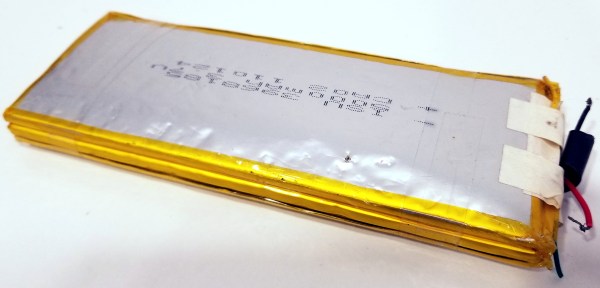
pierced puffed exposed leads lithium ion battery

Lessons In Li-Ion Safety

If you came here from an internet search because your battery just blew up and you don’t know how to put out the fire, then use a regular fire extinguisher if it’s plugged in to an outlet, or a fire extinguisher or water if it is not plugged in. Get out if there is a lot of smoke. For everyone else, keep reading.

I recently developed a product that used three 18650 cells. This battery pack had its own overvoltage, undervoltage, and overcurrent protection circuitry. On top of that my design incorporated a PTC fuse, and on top of that I had a current sensing circuit monitored by the microcontroller that controlled the board. When it comes to Li-Ion batteries, you don’t want to mess around. They pack a lot of energy, and if something goes wrong, they can experience thermal runaway, which is another word for blowing up and spreading fire and toxic gasses all over. So how do you take care of them, and what do you do when things go poorly?

Continue reading “Lessons In Li-Ion Safety”

3D Printing Batteries

We’ve all gotten pretty adept at 3D printing keychains and enclosures. Some people can even 3D print circuit boards to an extent. But the real goal is a Star Trek-style replicator that just pushes out finished products. Printing different components would be a key technology and unless you want to supply external power, one of those components better be a battery or other power source like a solar cell. A recent paper entitled Additive Manufacturing of Batteries explores this technology. The paper is behind a paywall, but you can probably find a copy if you are persistent.

Some of the techniques are pretty exotic. For example, holographic lithography can produce high-performance lithium-ion batteries. However, some of the processes didn’t sound much different than some of the more common printing techniques employed by desktop printers, although with more exotic materials. For example, some batteries can be made with inkjet printing and even fused deposition printing. Continue reading “3D Printing Batteries”

Protect Your Batteries Before You Wreck Your Batteries

[Jan] is solving a problem many of us have had, deeply discharging our project’s batteries and potentially damaging the cells.

His board can handle batteries from 6 to 34 volts and supports both LiPo or Lion batteries. The board can be flexible about its cut-off voltage. It also has a feature we really like; the user can set a delay before it shuts off the battery: useful in cases where a heavy peak current draw causes the battery to operate at a lower-than-threshold voltage for a few seconds. Once the board is shut down it takes a manual reset to allow power to be drawn again.

His latest iteration of the board is an impressive 1 sq. inch in size! This can fit in just about any project and it’s even flexible in the choice of battery connector. Next time we have a high current draw project with expensive batteries or maybe a monitoring device that’s expected to run a long time we may throw one of these boards in there just to be safe.

Better Battery Management Through Chemistry

The lead-acid rechargeable battery is a not-quite-modern marvel. Super reliable and easy to use, charging it is just a matter of applying a fixed voltage to it and waiting a while; eventually the battery is charged and stays topped off, and that’s it. Their ease is countered by their size, weight, energy density, and toxic materials.

The lithium battery is the new hotness, but their high energy density means a pretty small package that can get very angry and dangerous when mishandled. Academics have been searching for safer batteries, better charge management systems, and longer lasting battery formulations that can be recharged thousands of times, and a recent publication is generating a lot of excitement about it.

Consider the requirements for a battery cell in an electric car:

  • High energy density (Lots of power stored in a small size)
  • Quick charge ability
  • High discharge ability
  • MANY recharge cycles
  • Low self-discharge
  • Safe

Lithium ion batteries are the best option we have right now, but there are a variety of Li-ion chemistries, and depending on the expected use and balancing and charging, different chemistries can be optimized for different performance characteristics. There’s no perfect battery yet, and conflicting requirements mean that the battery market will likely always have some options.

Continue reading “Better Battery Management Through Chemistry”

Fail Of The Week: Taking Apart A Tesla Battery

It takes a lot of energy to push a car-sized object a few hundred miles. Either a few gallons of gasoline or several thousand lithium batteries will get the job done. That’s certainly a lot of batteries, and a lot more potential to be unlocked for their use than hurling chunks of metal around on wheels. If you have an idea for how to better use those batteries for something else, that’s certainly an option, although it’s not always quite as easy as it seems.

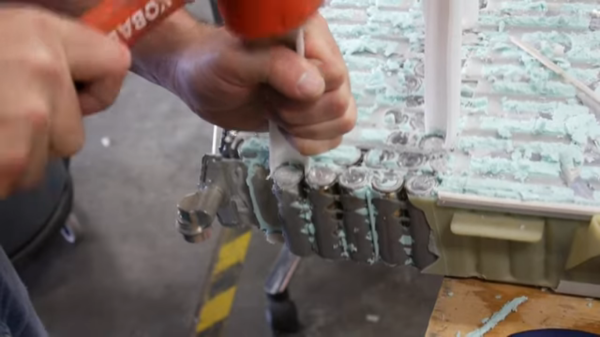
In this video, [Kerry] at [EVEngineering] has acquired a Tesla Model 3 battery pack and begins to take it apart. Unlike other Tesla batteries, and even more unlike Leaf or Prius packs, the Model 3 battery is extremely difficult to work with. As a manufacturing cost savings measure, it seems that Tesla found out that gluing the individual cells together would be less expensive compared to other methods where the cells are more modular and serviceable. That means that to remove the individual cells without damaging them, several layers of glue and plastic have to be removed before you can start hammering the cells out with a PEX wedge and a hammer. This method tends to be extremely time consuming.

If you just happen to have a Model 3 battery lying around, [Kerry] notes that it is possible to reuse the cells if you have the time, but doesn’t recommend it unless you really need the energy density found in these 21700 cells. Apparently they are not easy to find outside of Model 3 packs, and either way, it seems as though using a battery from a Nissan Leaf might be a whole lot easier anyway.

Continue reading “Fail Of The Week: Taking Apart A Tesla Battery”