Hydrofoil Bikes Are Harder To Build Than You Think

Hydrofoils are perhaps best known for their application on boring ferries and scary boats that go too fast. However, as [RCLifeOn] demonstrates, you can also use them to build fun and quirky personal watercraft. Like a hydrofoil bike! Only, there are some challenges involved.

Hydrofoils work much like airfoils in air. The shape of the foil creates lift, raising the attached vehicle out of the water. This allows the creation of a craft that can travel more quickly because the majority of its body is not subject drag from the water. The key is to design the craft such that the hydrofoils remain at the right angle and depth to keep the craft lifted out of the water while remaining stable.

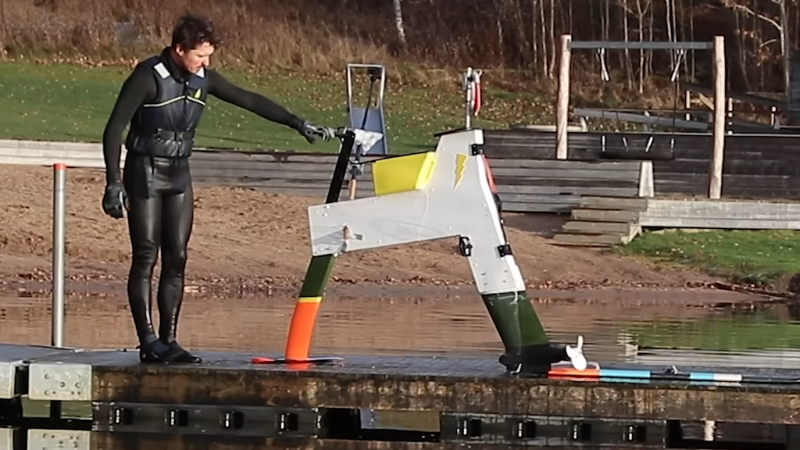
The hydrofoil bike is created out of a combination of plywood, foam, and 3D printed components. It uses a powerful brushless motor for propulsion, and that’s about it. Sadly, despite the simplicity, it wasn’t an instant success. As you might expect, balancing on the bike is quite difficult, particularly when trying to get it started—as the foils need some speed to actually start generating meaningful lift.

After further research into commercial hydrofoil bikes, [RCLifeOn] realized that the buoyancy of the bike made it too hard to straddle when starting out. Some of the 3D printed foils also proved more than a little fragile. It’s back to the drawing board for now—the power system is likely up to snuff, but the dynamics of the platform need work. It’s perhaps no surprise; we’ve covered the challenges of hydrofoil stability before. If you want to go fast on water, you could go the easier route and just build an electric surfboard. Video after the break.

Continue reading “Hydrofoil Bikes Are Harder To Build Than You Think”

A dismantled drill on a cluttered workbench

Going Brushless: Salvaging A Dead Drill

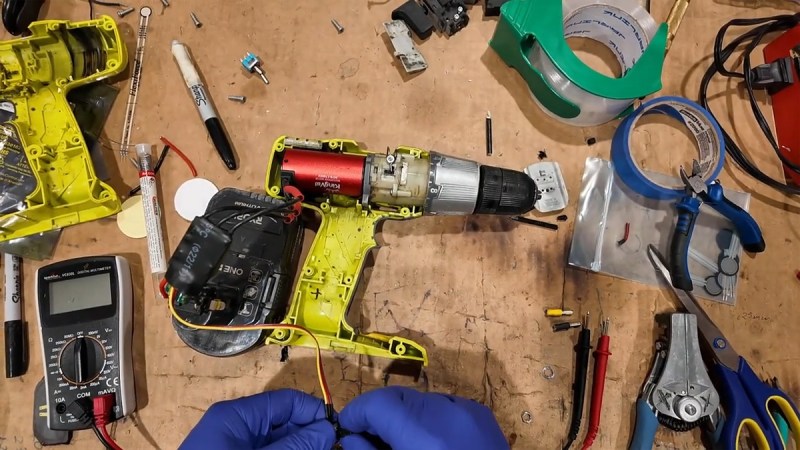
Let’s face it—seeing a good tool go to waste is heartbreaking. So when his cordless drill’s motor gave up after some unfortunate exposure to the elements, [Chaz] wasn’t about to bin it. Instead, he embarked on a brave journey to breathe new life into the machine by swapping its dying brushed motor for a sleek brushless upgrade.

Things got real as [Chaz] dismantled the drill, comparing its guts to a salvaged portable bandsaw motor. What looked like an easy swap soon became a true hacker’s challenge: incompatible gear systems, dodgy windings, and warped laminations. Not discouraged by that, he dreamed up a hybrid solution: 3D-printing a custom adapter to make the brushless motor fit snugly into the existing housing.

The trickiest part was designing a speed control mechanism for the brushless motor—an impressively solved puzzle. After some serious elbow grease and ingenuity, the franken-drill emerged better than ever. We’ve seen some brushless hacks before, and this is worth adding to the list. A great tool hack and successful way to save an old beloved drill. Go ahead and check out the video below!

Continue reading “Going Brushless: Salvaging A Dead Drill”

Brushless ESC Becomes Dual-Motor Brushed ESC With A Few Changes

What is a brushless ESC, really? Well, generally, it’s usually a microcontroller with a whole lot of power transistors hanging off it to drive three phases of brushless motor coils. [Frank Zhao] realised that with a little reprogramming, you could simply use a brushless ESC to independently run two brushed motors. Thus, he whipped up a custom firmware for various AM32-compatible ESCs to do just that.

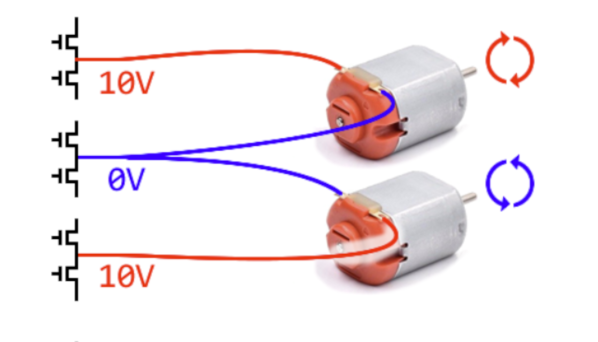
The idea of the project is to enable a single lightweight ESC to run two brushed motors for combat robots. Dual-motor brushed ESCs can be hard to find and expensive, whereas single-motor brushless ESCs are readily available. The trick is to wire up the two brushed motors such that each motor gets one phase wire of its own, and the two motors share the middle phase wire. This allows independent control of both motors via the brushless ESC’s three half-bridges, by setting the middle wire to half voltage. Depending on how you set it up, the system can be configured in a variety of ways to suit different situations.

[Frank’s] firmware is available on Github for the curious. He lists compatible ESCs there, and notes that you’ll need to install the AM32 ESC firmware before flashing his version to make everything work correctly.

The VESC project has long supported brushed motor operation, too, though not in a tandem configuration. Meanwhile, if you’ve got your own neat ESC hacks, don’t hesitate to hit us up on the tipsline!

Electric Boomerang Does Laps

Boomerangs are known for their unique ability to circle back to the thrower, but what if you could harness this characteristic for powered for free flight? In a project that spins the traditional in a new direction, [RCLifeOn] electrifies a boomerang to make it fly laps.

The project started with several of the 3D printed boomerang designs floating around on the internet, and adding motor mounts to the tips. [RCLifeOn] is no stranger to RC adventures, and his stockpile of spare parts from previous flying and floating projects proved invaluable. He added motor mounts and mounted all the electronics, including a RC receiver for controlling the throttle,  but first iteration didn’t have enough lift, so the boomerang and motors were scaled up.

[RCLifeOn] launched the contraptions by letting them spin on the end of a stick until they achieve lift-off. The second iteration still couldn’t quite get into the air, but after increasing the blade angles using a heat gun it was flying laps around the field.

Although we’ve seen spinning drones that are controllable, it would be no small control systems challenge to make it completely RC controlled. In the meantime this project is a fun, if somewhat risky way to mix the traditional with modern tech.

Continue reading “Electric Boomerang Does Laps”

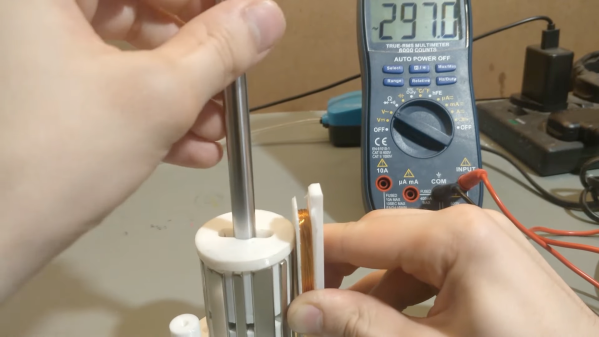
Two hands hold an electric motor rotor and a 3D printed coil structure next to each other. A multimeter in the background displays 297.0 mV.

ModuCoil – A Modular Coil For Motor And Generator Projects

While renewable energy offers many opportunities for decentralizing energy production, it can sometimes feel that doing so on a truly local level remains unachievable with increasingly large utility-scale deployments re-centralizing the technology. [AdamEnt] hopes to help others seize the means of energy production with the development of the ModuCoil.

This modular coil is intended to be used in motor and generator applications, and features a 3D printed structure to wind your copper about as well as a series of ferromagnetic machine screws and nuts meant to boost the field strength. This project really emphasizes the rapid part of rapid prototyping with this version 2 of the coil following only a week after the first.

[AdamEnt] only reached a peak of ~600 mV in the short test of a single coil, but is optimistic the current design could hit 1V/coil given a fully wound coil actually affixed to something instead of just held in his hand. It’s definitely early stages, but we think this could be the start of an interesting ecosystem of motor and generator designs.

If you want to learn more about how those big wind turbines work, look here, or you could check out a 3D printed brushless motor, or where all that copper comes from anyway.

Continue reading “ModuCoil – A Modular Coil For Motor And Generator Projects”

You Can 3D Print A 12,500 RPM Brushless Motor

Typically, when most of us need a motor, we jump online to order one from a catalogue. [Levi Janssen] recently had to build his own for a college project, however, and learned a lot along the way.

[Levi] whipped up his brushless DC motor design in OnShape. The motor has six coils in the stator, with the rotor carrying eight neodymium magnets. It’s an axial flux design, with the rotor’s magnets sitting above the coils. This makes construction very easy using 3D printed components. Axial flux motors also have benefits when it comes to power density and cooling, though optimization is outside the scope of [Levi]’s work here.

[Levi]’s video covers both the development of the motor itself as well as the drive circuit, too. The latter is of key value if you’re interested in the vagaries of driving these motors, which is far more complex than running a simple brushed motor. He even gets his motor up to 12,500 rpm with his homebrewed drive circuit.

Making your own motors can help you solve some difficult engineering challenges, like building motorized rollerblades. Alternatively, if winding coils sounds too slow and too hard, you can just use off-the-shelf gear and hack it to make it work. Here, we support both methods.

Continue reading “You Can 3D Print A 12,500 RPM Brushless Motor”

Adding A Third Wheel (And Speed Boost) To An Electric Scooter

The story of how [Tony]’s three-wheeled electric scooter came to be has a beginning that may sound familiar. One day, he was browsing overseas resellers and came across a new part, followed immediately by a visit from the Good Ideas Fairy. That’s what led him to upgrade his DIY electric scooter to three wheels last year, giving it a nice speed boost in the process!

The part [Tony] ran across was a dual brushless drive unit for motorizing a mountain board. Mountain boards are a type of off-road skateboard, and this unit provided two powered wheels in a single handy package. [Tony] ended up removing the rear wheel from his electric scooter and replacing it with the powered mountain board assembly.

He also made his own Arduino-based interface to the controller that provides separate throttle and braking inputs, because the traditional twist-throttle of a scooter wasn’t really keeping up with what the new (and more powerful) scooter could do. After wiring everything up with a battery, the three-wheeled electric scooter was born. It’s even got headlights!

[Tony]’s no stranger to making his own electric scooters, and the fact that parts are easily available puts this kind of vehicular experimentation into nearly anybody’s hands. So if you’re finding yourself inspired, why not order some stuff, bolt that stuff together, and go for a ride where the only limitation is personal courage?