Fixing My 4×4: The Battle Of The Bent Valves

If you know me at all, you know I’m a car guy. I’m pretty green as far as hardcore wrenching skills go, but I like to tackle problems with my vehicles myself – I like to learn by doing. What follows is the story of how I learned a few hard lessons when my faithful ride died slowly and painfully in my arms over the final months of 2016.

For context, my beast of a machine was a 1992 Daihatsu Feroza. It’s a 4WD with a 1.6 litre fuel injected four-cylinder engine. It had served me faithfully for over a year and was reading around 295,000 kilometers on the odometer. But I was moving house and needed to pull a trailer with all my possessions on an 800 km journey. I didn’t want to put the stress on the car but I didn’t have a whole lot of choice if I wanted to keep my bed and my prized Ricoh photocopier. I did my best to prepare the car, topping up the oil which had gotten perilously low and fitting new tyres. I’d had a hell of a time over the winter aquaplaning all over the place and wasn’t in the mood for a big ugly crash on the highway. Continue reading “Fixing My 4×4: The Battle Of The Bent Valves” →

Making A Shifter Knob From Old Skateboards

Do you have a car? Does that car have a manual transmission? Do you want to beautify your shifter knob, while simultaneously gaining mad street cred, yo? Well, you’re in luck, because all of that can be done for the low, low price of a couple old skateboard decks, a lathe, and a lot of glue.

This project, from [basiltab] illustrates how you can use old skateboard decks to create really cool looking custom shifter knobs. The process starts with cutting the decks up into uniform strips, which are then glued and clamped to form small planks. Sections of the decks were alternated, to create a visually interesting pattern. The planks are then sanded so that they’re smooth and flat, and then glued up in a jig to form blocks with a threaded aluminum insert in the center. Optionally, aluminum can be used for some of the layers to add a little flair (2-part epoxy was used in place of glue for the aluminum).

After the glue has dried, the blocks can then be turned on a lathe to create the desired shape of the knob. As you can see, the results are pretty darn nifty. And, they certainly have a little more artistic credibility than the giant acrylic shifter knobs you normally find at your local auto parts store. Don’t worry, if you thought this article was about shift registers, we’ve got you covered there too.

Another Kind Of Cloud: The Internet Of Farts

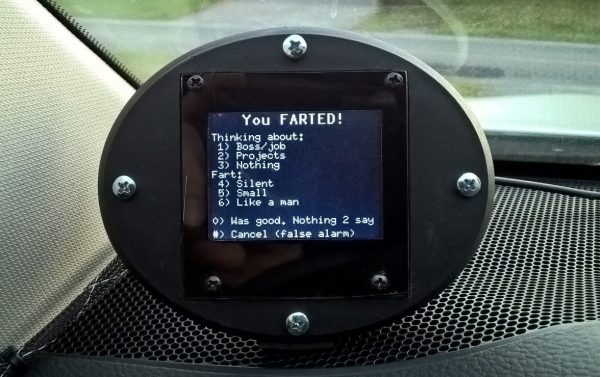
It’s taken as canon that girls mature faster than boys. In reality, what happens is that boys stop maturing at about age 12 while girls keep going. And nothing tickles the fancy of the ageless pre-teen boy trapped within all men more than a good fart joke. To wit, we present a geolocating fart tracker for your daily commute.

[Michel] is the hero this world needs, and although he seems to have somewhat of a preoccupation with hacks involving combustible gasses, his other non-methane related projects have graced our pages before, like this electrical meter snooper or an IoT lawn mower. The current effort, though, is a bit on the cheekier side.

The goal is to keep track of his emissions while driving, so with a PIC, an ESP8266, a GPS module, and a small LCD display and keyboard, he now has a way to log his rolling flatulence. When the urge overcomes him he simply presses a button, which logs his location and speed and allows him to make certain qualitative notes regarding the event. The data gets uploaded to the cloud every Friday, which apparently allows [Michel] to while away his weekends mapping his results.

It turns out that he mainly farts while heading south, and he’s worried about the implications both in terms of polar ice cap loss and how Santa is going to treat him next month. We’re thinking he’s got a lock on coal — or at least activated charcoal.

Our beef with this project is obvious – it relies on the honor system for input. We really need to see this reworked with an in-seat methane detector to keep [Michel] honest. Until then, stay young, [Michel].

The Lotus Sevens: The Real Most-Hackable Cars

In the late 1940s and early 1950s, Europe was still struggling to recover from the crippling after-effects of war. In Britain it is referred to as the “austerity period”, with food still rationed and in which “make do and mend” was very much the order of the day. The consumer boom of the late 1950s and 1960s was very far in the future, and if you were a hardware hacker your source materials were limited to whatever you could find from war surplus or whatever prewar junk might come your way. This was a time in which the majority of adults had recently returned from war service, during which they had acquired practical skills through the necessities of battle that they sought an outlet for in peacetime.

One field that benefited from this unexpected flowering of creativity was that of motor racing. Before the war it had been an exclusive pursuit, with bespoke cars at famous circuits like the banked track at Brooklands, in Surrey. In a reflection of the wider social changes that followed the war the motor racers of the post-war years came from humbler backgrounds, they raced homemade specials made from tired-out prewar motors on wartime airfield perimeter tracks like the one at Silverstone which still hosts Formula One racing today.

Continue reading “The Lotus Sevens: The Real Most-Hackable Cars” →

Glow-In-The-Dark Antenna Helps You Spot Your Car At Night

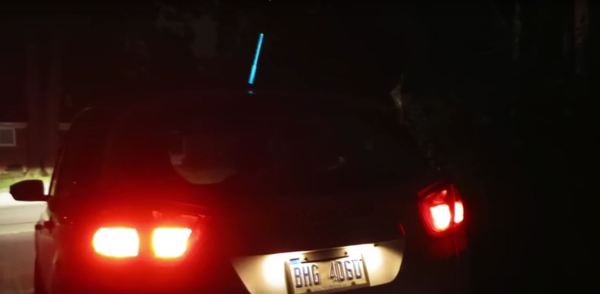
It’s late, and you’re lost in a sea of cars trying to remember where you parked. If only your vehicle had a glow-in-the-dark antenna to make it easier to find, you wouldn’t be in this situation. Faced with just such a problem himself, Instructables user [botzendesign] has put together a handy tutorial to do just that.

[botzendesign] first removed the antenna and lightly abraded it to help the three coats adhesion promoter do its job. A white base coat of vehicle primer was applied — lightly, so it doesn’t crack over time — and once it had set, three coats of Plasti Dip followed. Before that had a chance to dry, he started applying the glow-in-the-dark powder, another coat of Plasti Dip, repeating four more times to ensure the entire antenna had an even coat of the photo-luminescent powder and then letting it dry for 24 hours. Continue reading “Glow-In-The-Dark Antenna Helps You Spot Your Car At Night” →

Newsflash: A Bunch Of Arduinos Is Not An Autonomous Car

Nobody’s perfect. Sometimes you’re up late at night writing a blog post and you stumble upon an incredible story. You write it up, and it ends up being, well, incredible. IEEE Spectrum took the bait on this video (embedded below) where [Keran McKenzie] claims to have built a self-driving car for under $1,000 AUS with Arduinos.

The video is actually pretty funny, and we don’t think it’s intended to be a mass-media hoax as much as a YouTube joke. After letting the car “take over” for a few seconds, it swerves and [Keran] pretends to have hit something. (He’s using his knees people!) There are lots of takes with him under the car, and pointing at a single wire that supposedly makes the whole thing work. Yeah, right.

Continue reading “Newsflash: A Bunch Of Arduinos Is Not An Autonomous Car” →

Hacker Helps His Mother Lift Her Walker When He’s Not There

[typo]’s mother gets around with a walker. It’s a great assistive device until she has to lift the heavy thing up into her car. Noting that this was a little cruel he did as any hacker would and found a way to automate the process.

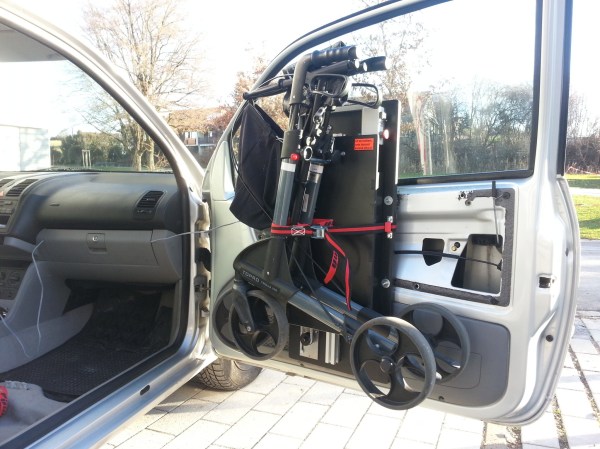
The build is pretty cool. She had to give up her passenger seat, but it’s a small price to pay for independence. He removed the door paneling on the passenger side. Then he welded on a few mounting points. Next he had to build the device.

The well-built device has a deceptively simple appearance. The frame is made from CNC milled panels and the ever popular aluminum extrusion. It uses a 12V right angle drive and some belting to lift the chair. There’s no abundance of fancy electronics here. A toggle switch changes the direction of the motor. There are some safety endstops and an e-stop.

Now all she has to do is strap the walker to the door. She picks the direction she wants the lift to go and presses a button. After which she walks the short distance to the driver’s seat, and cruises away.