Hackaday Prize Entry: A CNC Mill Without The C

It’s a staple of home CNC construction, the 3D mill built on the bench from available parts. Be the on a tubular, plywood, or extruded aluminum frame, we’ve seen an astonishing array of mills of varying levels of capability.

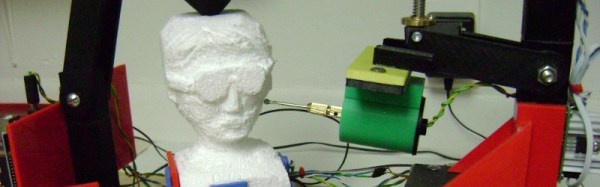
The norm for such a mill is to have a computer controlling it. Give it a CAD file, perform the software magic, press button, receive finished object (Or so the theory goes). It’s a surprise then to see a mill in which the input doesn’t come from a CAD file, instead all control is done by hand through the medium of a joystick. [Mark Miller]’s 3D printed freeform carving machine is a joystick-controlled mill with a rotary tool on an arm facing a rotatable bed, and it can perform impressive feats of carving in expanded foam.

You might ask why on earth you should make a machine such as this one when you could simply pick up a rotary tool in your hand and start carving. And you’d be right, from that perspective there’s an air of glorious uselessness to the machine. But to take that view misses the point entirely, it’s a clever build and rather a neat idea. We notice he’s not put up the files yet for other people to have a go, if someone else fancies making CNC software work with it then we’re sure that would be possible.

There is a video showing the basic movements the mill is capable of, which we’ve put below the break. Best to say, though, it’s one on which to enable YouTube’s double speed option.

Continue reading “Hackaday Prize Entry: A CNC Mill Without The C”

CNC Turns Empty Cans Into Action Figures

[apollocrowe] at Carbide 3D (a company that does desktop CNC machines) shared a project of his that spent years being not-quite-there, but recently got dusted off and carried past the finish line. His soda can robot action figures were originally made by gluing a paper design to aluminum from a soda can, but [apollocrowe] was never really able to cut the pieces as reliably or as accurately as he wanted and the idea got shelved. With a desktop CNC machine to take care of accurate cutting, the next issue was how to best hold down a thin piece of uneven metal during the process. His preferred solution is to stick the metal to an acrylic wasteboard with hot glue, zero high enough and cut deep enough to account for any unevenness, and afterwards release the hot glue bond with the help of some rubbing alcohol.

Assembly involves minor soldering and using a few spare resistors. A small spring (for example from a retractable pen) provides the legs with enough tension for the figure to stand by itself. The results look great, and are made entirely from a few cents worth of spare parts and recycled materials. A video of the process is embedded below, and the project page contains the design files.

Continue reading “CNC Turns Empty Cans Into Action Figures”

Moving Microns With A High Precision Linear Stage

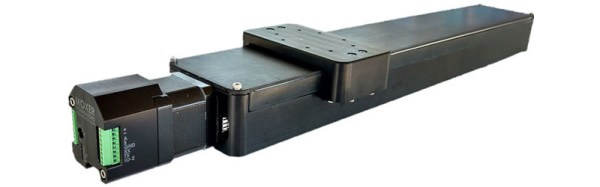
As anyone who has experimented with their own home-made CNC machinery will tell you, precision isn’t cheap. You can assemble a gantry mill using off-the-shelf threading and kitchen drawer slides. But it’s a safe assumption that if you put the tool at a particular position it won’t be quite at the same position next time you return. But if you take your budget from dirt cheap to reasonably priced you can do much better. [Adam Bender] designs high-precision automation systems for a living, so when he needed a precision linear stage for a personal project he achieved micron level accuracy for under $500.

micron-precision-linear-actuator
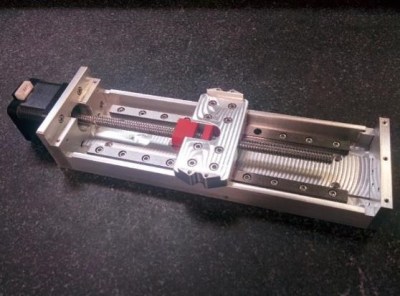
Red parts are the two spring-loaded nuts

He explains the problem of backlash with an inexpensive lead screw — the wiggle between threaded components that cause positional chaos. His solution uses two nuts preloaded against each other with a spring. There is still a stick-slip issue; a tendency to move in lurches due to differences between the coefficients of static and dynamic friction between the materials. Careful choice of machining stock for the nut to picking materials in which these coefficients were almost identical reduced the stick-slip to as little as possible.

He goes into significant detail on the design, manufacture, and testing of all the components of his stage, its body, sealing system, and control. If you are a precision CNC guru maybe you’ll find it interesting as a cleverly designed component, but if you are a mere dilettante you’ll find it fascinating to read a comprehensive but accessible write-up from a professional in the field.

This build probably goes a step beyond most we’ve featured in the past, but that’s not to say we’ve not seen some pretty good efforts.

Pint-Sized, Low-Cost CNC Machine

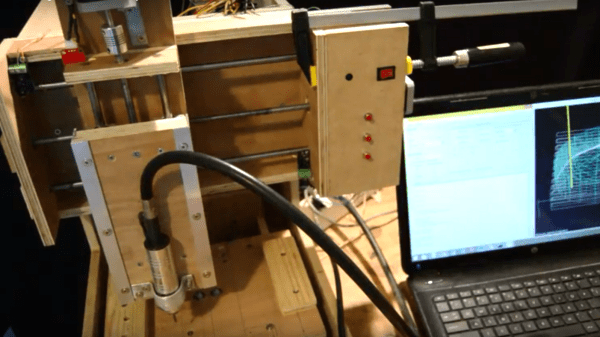
A little MDF, a little plywood, some bits of threaded rod – put it all together and you’ve got this low-cost desktop CNC build using very few parts you’d need to go farther afield than the local home center to procure.

We’ve seen lots of e-waste and dumpster diving CNC builds here before; what’s appealing here is not only the low price tag of the build but also its approachability. As the short videos below show, [Thimo Voorwinden] does an admirable job of using the tools and materials he has on hand. We also appreciate the modularity of the build – the X- and Y-axis carriages are nearly identical and could be interchanged to alter the dimensions of the work area, or even replaced with a larger carriage if needed. The Z-axis is a little different from the usual low-end CNC build in that it doesn’t use a Dremel or other small rotary tool but rather mounts the handpiece of a flexible shaft rotary tool. Keeping the motor off the machine allows for more torque, less vibration, and reduced dead load.

The end result is a desktop CNC for about €200 with a work area large enough to fabricate small wooden and plastic parts, or to mill foam blocks for use as casting molds. It looks like [Thimo] has more in store for his little CNC machine, and we’re looking forward to seeing what improvements he can come up with.

Continue reading “Pint-Sized, Low-Cost CNC Machine”

Live Counter Revives Old Nokia Phone’s Utility

Old hardware you may have on hand cannot only inspire projects in their own right, but can facilitate the realization of any ideas you have been planning. Using a Nokia N900, [MakerMan] concocted a light-up sign with a live subscriber and view count of his videos.

[MakerMan] milled out the logo used on the sign with his DIY CNC machine — built from rotary bearings and recycled stepper motors off industrial Xerox printers. The meticulous application of a jigsaw, rotary tool, and grinder resulted in a sturdy frame for the sign while a few strips of RGB LEDs imbue it with an inspiring glow. All that was left was to mount the phone in place and tape it for good measure.

Continue reading “Live Counter Revives Old Nokia Phone’s Utility”

Add Broken Tool Detection To Your CNC Mill

A tool breaking in the midst of a CNC machining operation is always a disaster. Not only do you have a broken tool (no small expense), but if the program continues to run there is a good chance it’ll end up ruining your part too. In particularly bad cases, it’s even possible to for this to damage the machine itself. However, if the breakage is detected soon enough, the program can be stopped in time to salvage the part and avoid damage to your machine.

Many new machining centers have the ability to automatically detect tool breaks, but this is a feature missing from older machines (and inexpensive modern machines). To address this issue, [Wiley Davis] came up with a process for adding broken tool detection to an older Haas mill. The physical modifications are relatively minor: he simply added a limit switch wired to the existing (but unused) M-Function port on the Haas control board. This port is used to expand the functionality of the machine, but [Wiley] didn’t need it anyway.

Continue reading “Add Broken Tool Detection To Your CNC Mill”

3D Printer Transforms To CNC

Superficially, it is easy to think about converting a 3D printer into a CNC machine. After all, they both do essentially the same thing. They move a tool around in three dimensions. Reducing this to practice, however, is a problem. A CNC tool probably weighs more than a typical hotend. In addition, cutting into solid material generates a lot of torque.

[Thomas Sanladerer] knew all this, but wanted to try a conversion anyway. He had a few printers to pick from, and he chose a very sturdy MendelMax 3. He wasn’t sure he’d wind up with a practical machine, but he wanted to do it for the educational value, at least. The result, as you can see in the video below, exceeded his expectations.

Continue reading “3D Printer Transforms To CNC”