The TinyG Motion Controller

When you go to a trade show of any kind, you’re expecting cool demos in the booths. At Maker Faire, there were plenty, but one of the most hypnotic was a robot built around Synthetos’ TinyG motion controller.

The demo was simply a large CNC gantry moving a ball bearing around on a string. The gantry moved in the X and Y axes, and the miniature wrecking ball was spooled and unspooled in the Z axis. The ball move around the space, coming to a complete stop without any swaying. There were even a few clear plastic tubes that the ball fell in, and popped out of without raising or lowering the string. It’s the height of motion controller coolness, all made possible with the TinyG.

The TinyG was one of a few motion control and CNC boards found at the faire. In its base configuration, it has 6 axes of motion control, RS485 to network several boards for crazy machine configurations, and a suitably powerful processor to do everything correctly.
A Folding Laser Cutter

Want a laser cutter, but don’t have the space for one? How about a portable machine to engrave and cut wood and plastics? A folding laser cutter solves these problems, and that’s exactly what Red Ant Lasers was showing off last weekend at Maker Faire.

Inside the team’s Origami laser cutter is a 40 Watt CO2 tube, shooting its beam along an entirely enclosed beam path. The beam travels through the body of the machine, out into the folding arm of the machine, and down to whatever material you’ve placed the Origami on. It’s a 40 Watt laser so it will cut plywood and plastics, and as shown in the video above, does a fine job at engraving plywood.

This is a Class 4 laser device operating without any safety glass, but from the short time I spent with the Red Ant team, this is a reasonably safe device. You will need safety glasses if you’re within five feet, but after that, everything (according to OSHA, I think) is safe and not dangerous. Either way, it’s a tool just like a table saw. You don’t see commentors on the Internet complaining about how a spinning metal blade is dangerous all the time, do you?

The Red Ant guys are currently running a Kickstarter for their project, with a complete unit going for $4200. It’s pricier than a lot of other lasers, but not being constrained by the size of a laser cutters enclosure does open up a few interesting possibilities. You could conceivably cut a 4×8 sheet of plywood with this thing, and exceptionally large engravings start looking easy when you have a portable laser cutter.

Cryogenic Machining Custom Rubber Parts

Cryogenic Machining: Custom Rubber Parts

Fashioning a custom, one-off rubber part for your project isn’t usually an option, but [Ben Krasnow] has an alternative to injection molding and casting: machining frozen rubber.

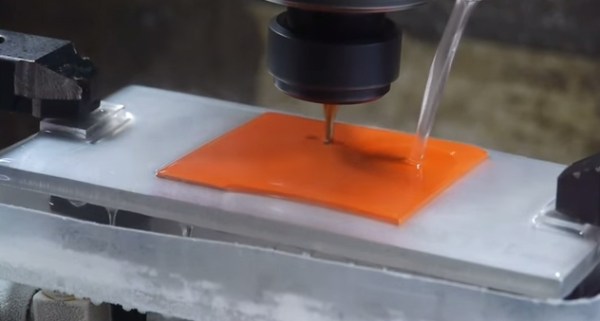
As [Ben] points out, you can’t exactly pop a sheet of rubber on your mill and CNC the needed shape; the bit will push the material around rather than cut it. Freezing the rubber first, however, allows you to carve into the now-hardened material.

His initial setup consisted of a sheet of aluminum with water drizzled on top, a square of neoprene placed on the water, and a steady stream of -60 to -80C alcohol flowing directly onto the rubber. The water underneath freezes, holding the neoprene in place. This proved problematic as the ice-clamp gives way before the milling is complete. [Ben] later adds some bolts to clamp the pieces down, allowing the milling process finish as planned.

A small plastic tray sits underneath this assembly to capture the alcohol as it runs off, feeding it back with some tubing. [Ben] recommends against a submersible aquarium pump—his initial choice—because the pump stopped working after a few minutes immersed in the chilly alcohol. An external, magnetically-driven pump solved the problem although it does require manual priming.

Stick around after the jump for the video and check out some of [Ben’s] other projects, like his quest for the perfect cookie, or CT scanning a turkey.

Continue reading “Cryogenic Machining: Custom Rubber Parts”

Farmbot Progress

THP Semifinalist: Farmbot

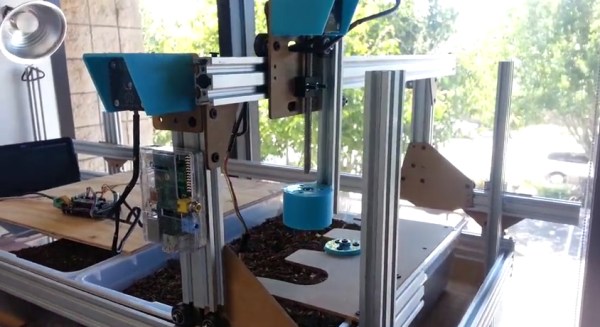
The FarmBot team has been pretty busy with their CNC Farming and Gathering machine. The idea is to automate the farming process with precise deployment of tools: plows, seed injection, watering, sensors, etc. An Arduino with an added RAMPS handles the movement, and a Raspi provides internet connectivity. Their prototype has already experienced four major iterations: the first revision addressed bigger issues such as frame/track stability and simplification of parts. Now they’re locking down the specifics on internet-of-things integration and coding for advanced movement functions.

The most recent upgrade provides a significant improvement by overhauling the implementation of the tools. Originally, the team envisioned a single, multi-function tool head design that carried everything around all the time. Problem is, the tool that’s in-use probably works best if it’s lower than the others, and piling them all onto one piece spells trouble. The solution? a universal tool mounting system, of course. You can see them testing their design in a video after the break.

If the FarmBot progress isn’t impressive enough—and admittedly we’d have called project lead [Rory Aronson] crazy for attempting to pull this off…but he did it—the FarmBot crew started and successfully funded an entire sub-project through Kickstarter. OpenFarm is an open-source database set to become the go-to wiki for all things farming and gardening. It’s the result of [Rory] encountering an overwhelming amount of generic, poorly written advice on plant growing, so he just crowdsourced a solution. You know, no sweat.


SpaceWrencherThe project featured in this post is a semifinalist in The Hackaday Prize.

Continue reading “THP Semifinalist: Farmbot”

USB-Parallel-GRBL

USB To DB25 Adapter Uses GRBL For Parallel Port CNC Communication

With the continuing manufacture of new computers, there is a clear and obvious trend of the parallel port becoming less and less common. For our younger readers; the parallel port is an interface standard used for bi-directional communication between a computer and a variety of peripherals. The parallel port’s demise is partially due to the invention of the USB standard.

If tinkering with CNC Machines is one of your hobbies then you are familiar with the parallel port interface being fairly popular for CNC control board connections. So what do you do if your new fancy computer doesn’t have a parallel port but you still want to run your CNC Machine? Well, you are certainly not stuck as [Bray] has come up with a USB to Parallel Port Adapter solution specifically for CNC use.

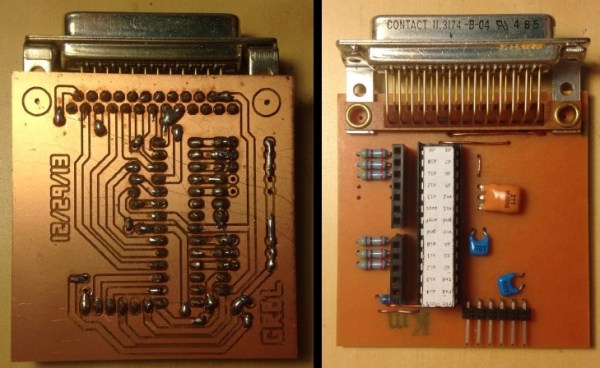
A cheap off-the-shelf USB to DB25 adapter may look like a good idea at first glance but they won’t work for a CNC application. [Bray’s] adapter is Arduino-based and runs GRBL. The GRBL code is responsible for taking the g-code commands sent from the computer, storing them in a buffer until they are ready to be converted to step and direction signals and sent to the CNC controller by way of the parallel port DB25 connector. This is a great solution for people needing to control a CNC Machine but do not have a parallel port available.

[Bray] is using a Raspberry Pi running GRBLweb to control his adapter board. However, there are other programs you can use to communicate with GRBL such as Universal G-Code Sender and GRBL Controller.

The board has been created in Eagle PCB Software and milled out using [Bray’s] CNC Router. The design is single-sided which is great for home-brew PCBs. He’s even made a daughter board for Start, Hold and Reset input buttons. As all great DIYers, [Bray] has made his board and schematic files available for others to download.

A Tale Of Two Ring Boxes

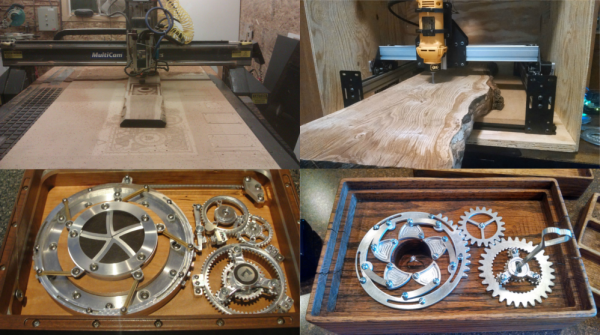
This is a tale of two hearts, two engagements, and two ring boxes. About a couple of years ago, [curtisabrina] proposed to his girlfriend. Rather than just hand her the ring, he placed it in a locking ring box [imgur link] he custom-made. The box seems normal at first glance, but lifting up the first drawer reveals a complex and ornate gear system. The gears can only be turned by a pair of interlocking heart-shaped keys – a gift [curtisabrina] had given her months earlier. The mechanism is nothing short of stunning – planetary reductions drive a spring-loaded iris which opens to reveal an engagement ring.

[curtisabrina] built his ring box after hours at his signmaking job. The job gave him access to some incredible tools, such as the MultiCam 3000 series CNC. The box turned out great, and he showed his work off in a Reddit thread.

Fast forward two years. [joetemus] was getting ready to propose to his girlfriend, and wanted to do something similar. He didn’t have access to high-end shop tools, but he did have a Shapeoko 2. Using the original box as inspiration, [joetemus] started designing. Over time, trial, and error, a second ring box emerged [imgur link]. Like the original box, [joetemus] started with a rough cut board. Nearly every part, including the aluminum gears, was cut on the Shapeoko 2. [joetemus] also celebrated his accomplishment with a Reddit thread.

[joetemus’s] ring box isn’t quite as complex or polished as [curtisabrina’s], but he was working with a machine that cost much less than the equipment [curtisabrina] was using. We think both of them are great, and are happy to report that both of their girlfriends said, “Yes!”

Continue reading “A Tale Of Two Ring Boxes”

CNC3020 Linear Rail and Lead Screw Lubrication

A Little Lubricant Goes A Long Way…. With Your CNC Machine

[Peter] has been having some positional repeatability problems with his CNC3020 Router recently. The problem was mostly in the Z axis and was measured to be up to 0.3mm off position after 10cm of travel. This may not seem like a lot but it was enough to break a few 1mm diameter end mills. The X and Y axes generally seemed OK. Surfing the ‘net reveled that the control board’s power rails did not have any filtering capacitors and that may have been the cause of the problems. Unfortunately, the positioning problem still persisted even after the cap’s were added. Frustrated, [Peter] then started a full-blown investigation to figure out why his Z axis wasn’t cutting the mustard.

In a CNC system there are 2 major components, the electronics and the physical machine. Since it was unknown which portion of the system contained the problem, [Peter] decided to quickly swap the X and Z channels, running the Z axis with the X axis electronics. The problem was still evident on the Z axis which means that there is something wrong in the mechanics of the machine. The Z electronics were put back on the Z axis and the testing continued by lowering the acceleration and the maximum speed. The positioning error was still there. Since it is possible that the Z motor could be the problem, it was decided to swap the X and Z motors but midway through the process the problem became evident. When trying to rotate the Z axis lead screw by hand there was a noticeable lack of smoothness and the axis seemed to jump around a bunch!

Continue reading “A Little Lubricant Goes A Long Way…. With Your CNC Machine”