Hackaday Prize 2023: AutoDuct Smart Air Duct

Modern building techniques are relying more and more on passive elements to improve heating and cooling efficiencies, from placing windows in ways to either absorb sunlight or shade it out to using high R-value insulation to completely sealing the living space to prevent airflow in or out of the structure. One downside of sealing the space in this fashion, though, is the new problem of venting the space to provide fresh air to the occupants. This 3D printed vent system looks to improve things.

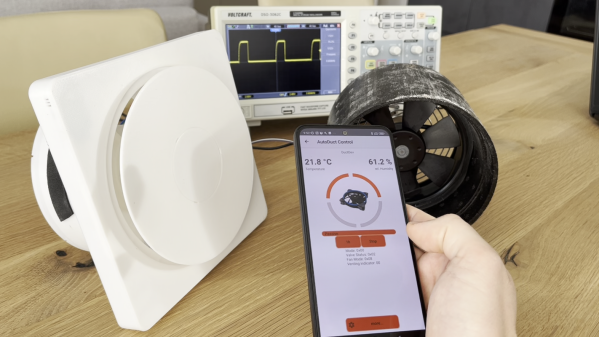
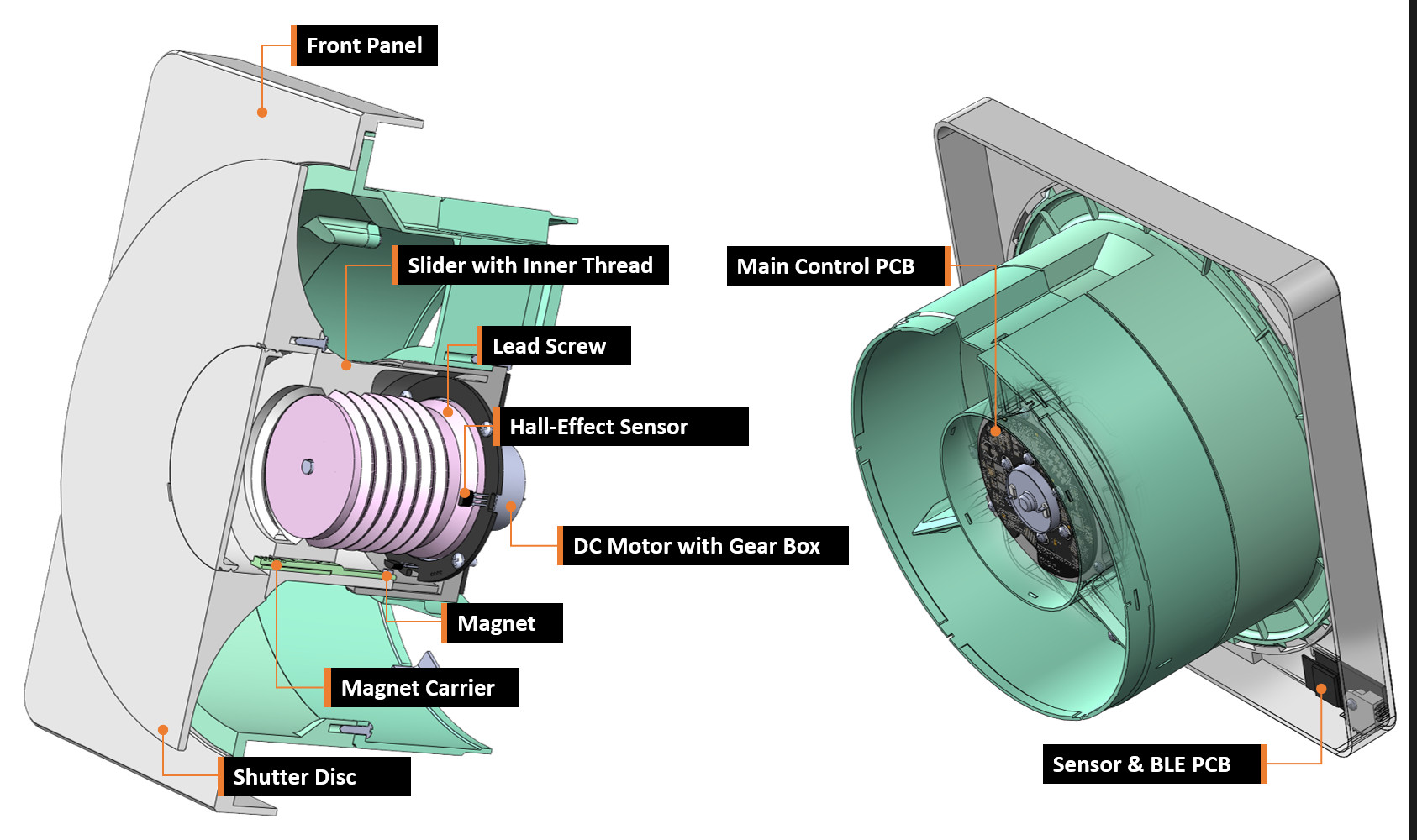
Known as the AutoDuct, the shutter and fan combination is designed to help vent apartments with decentralized systems. It can automatically control airflow and also reduces external noise passing through the system using a printed shutter mechanism which is also designed to keep out cold air on windy days.

A control system enables features like scheduling and automatic humidity control. A mobile app is available for more direct control if needed. The system itself can also integrate into various home automation systems like Apple’s HomeKit.

A 100% passive house that’s also as energy-efficient as possible might be an unobtainable ideal, but the closer we can get, the better. Some other projects we’ve seen lately to help climate control systems include this heat pump control system and this automatic HVAC duct booster fan system.

Heat Pump Control That Works

Heat pumps are taking the world by storm, and for good reason. Not only are they many times more efficient than electric heaters, but they can also be used to provide cooling in the summer. Efficiency aside, though, they’re not perfectly designed devices, largely with respect to their climate control abilities especially for split-unit setups. Many of them don’t have remotely located thermostats to monitor temperature in an area, and rely on crude infrared remote controls as the only user interface. Looking to make some improvements to this setup, [Danilo] built a setup more reminiscent of a central HVAC system to control his.

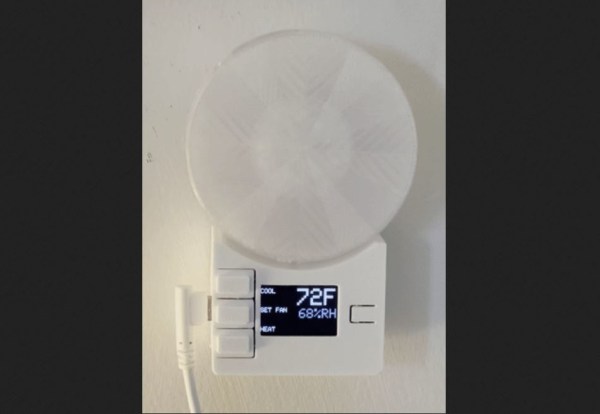
Based on an ESP32 from Adafruit with an integrated TFT display, the device is placed away from the heat pump to more accurately measure room temperature. A humidity sensor is also included, as well as an ambient light sensor to automatically reduce the brightness of the display at night. A large wheel makes it quick and easy to adjust the temperature settings up or down. Armed with an infrared emitter, the device is capable of sending commands to the heat pump to more accurately control the climate of the room than the built-in controls are able to do. It’s also capable of logging data and integrating with various home automation systems.

While the device is optimized for the Mitsubishi heat pumps that [Danilo] has, only a few lines of code need to be changed to get this to work with other brands. This is a welcome improvement for those frustrated with the inaccurate climate controls of their heat pumps, and since it integrates seamlessly into home automation systems could also function in tandem with other backup heat sources, used in cold climates when it’s too cold outside to efficiently run the heat pump. And, if you don’t have a heat pump yet, you can always try and build your own.

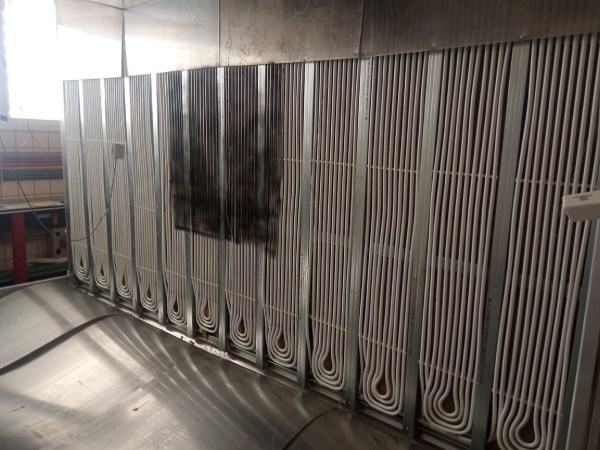
A series of tubes wound up and down as modules in a metal-framed, free-standing wall. The wall is inside a climate-controlled test chamber with a series of differently-colored tubes running behind the free-standing wall.

Cooling Off The Bus Stop

If you’ve taken the bus in the summer, you know it can get hot while you wait on your ride, even if there is a roof over the stop. Researchers at the University of Seville have devised a way to keep you cooler while you wait.

As temperatures around the world get warmer due to climate change, keeping cool in the summer is increasingly not just a matter of comfort. For the prototype in a climate-controlled chamber, 500L of water were cooled with a chiller and used as a thermal reservoir to reduce temps in the bus stop during the day. Pumps circulate the water through panels when a rider approaches the stop, cooling the space by ~8˚C (~14˚F) over a 20 minute period. Pumps for the system and lighting for the stop will be powered via solar panels and keep the system self-contained.

The amount of cooling offered by the system can be controlled by the flow rate of the water. The researchers plan to use Falling-Film radiant cooling in the outdoor version to replace the chiller to cool the water at night. They also say the system can be used for radiant heating in the winter, so it isn’t just for hot climates.

If you want to know how to survive a wet bulb event or want a better way to determine your bus route, we’ve got you covered there too.

[via Electrek]

Graphene And Copper Nanowire Thermal Interface With Low Thermal Resistance

With the increasing waste heat production by today’s electronics in ever smaller spaces, drawing this heat away quickly enough to prevent thermal throttling or damage is a major concern. This is where research by Lin Jing and colleagues from Carnegie Mellon University’s Department of Mechanical Engineering demonstrates a thermal interface material (TIM) that should provide a significant boost here. In the article, published in ACS Nano (paywalled; open access preprint alternative) the construction of this copper and graphene ‘sandwich’ TIM is described, along with tests.

The general idea is to use pillars between the two surfaces that can quickly carry the heat from the hot surface to the cool one. Although pure copper versions exist and do work, they suffer from the complications of having to build up these copper pillars in place, and subsequent oxidation reducing the effectiveness. While graphene and similar materials have shown superior heat-transfer capabilities, interfacing these materials with copper and other metals has proven problematic.

What Lin Jing et al. demonstrate in this study is to use essentially the pure copper approach, but to combine it with earlier research by Raghav Garg et al. (2017), who demonstrated how to grow 3-dimensional graphene structures. By cladding the copper pillars with graphene, this material improves heat transfer by 60%, while preventing oxidation of the metal. While the challenge is obviously to transfer these findings to something that can be mass-produced for consumer devices, it demonstrates how much potential there is in the use of graphene, which is a relatively new material for such applications due to how hard it was to produce until recently.


Increasing PV Solar Cell Efficiency Through Cooling

An unavoidable aspect of photovoltaic (PV) solar panels is that they become less efficient when they warm up. [Tech Ingredients] explains in a new video the basic reason for this, which involves the input of thermal energy affecting the semiconductor material. In the subsequent experiment, it is demonstrated how cooling the backside of the panel affects the panel’s power output.

There are commercial solutions that use water cooling on the back of panels to draw heat away from panels, but this still leaves the issues of maintenance (including winter-proofing) and dumping the heat somewhere. One conceivable solution for the latter is to use this heat for a household’s hot water needs. In the demonstrated system a heatsink is installed on the back of the panel, with fans passing cool air over the heatsink fins.

On a 100 Watt PV panel, 10 W was lost from the panel heating up in the sun. After turning on the fans, the panel dropped over 10 °C in temperature, while regaining 5.5 W. Since the installed fans consumed about 3 W, this means that the fans cost no extra power but resulted in increased production. Not only that, but the lower temperatures will in theory extend the panel’s lifetime. Though even with active cooling, even the best of PV panels will need to be replaced after a couple decades.

Continue reading “Increasing PV Solar Cell Efficiency Through Cooling”

Cool Face Mask Turns Into Over-Engineered Headache

Seeing his wife try to use a cool face mask to get through the pain of a migraine headache, [Sparks and Code] started thinking of ways to improve the situation. The desire to save her from these debilitating bouts of pain drove him to make an actively cooled mask, all the while creating his own headache of an over-engineered mess.

Void spaces inside the printed mask are filled with chilled water.

Instead of having to put the face mask into the refrigerator to get it cold, [Sparks and Code] wanted to build a mask that he could circulate chilled water through. With a large enough ice-filled reservoir, he figured the mask should be able to stay at a soothing temperature for hours, reducing the need for trips to the fridge.

[Sparks and Code] started out by using photogrammetry to get a 3D model of his wife’s face. Lack of a compatible computer and CUDA-enabled GPU meant using Google Cloud to do the heavy lifting. When they started making the face mask, things got complicated. And then came the unnecessary electronics. Then the overly complicated  and completely unnecessary instrumentation. The… genetic algorithms? Yes. Those too.

We won’t spoil the ending — but suffice it to say, [Sparks and Code] learned a cold, hard lesson: simpler is better! Then again, sometimes being over-complicated is kind of the point such as in this way-too-complex gumball machine.

Continue reading “Cool Face Mask Turns Into Over-Engineered Headache”

The Benefits Of Displacement Ventilation

The world has been shaken to its core by a respiratory virus pandemic. Humanity has been raiding the toolbox for every possible weapon in the fight, whether that be masks, vaccinations, or advanced antiviral treatments.

As far as medicine has come in tackling COVID-19 in the past two years, the ultimate solution would be to cut the number of people exposed to the pathogen in the first place. Improving our ventilation methods may just be a great way to cut down on the spread. After all, it’s what they did in the wake of the Spanish Flu.

Continue reading “The Benefits Of Displacement Ventilation”