Antique Oscilloscope Gets New Home And Purpose

As the pace of technology charges blindly forward, a lot of older tools or products get left in the dust, forgotten to most but those left with them. This doesn’t mean they’re useless, though. In fact, old technology that continues to survive in the present tends to be more robust and sturdy than most modern, cheap replacements. While this might be survivorship bias, this is certainly true in particular of oscilloscopes. Rugged CRTs in large metal housings with discrete through-hole components in simple layouts made them reliable, but they’re heavy, bulky, and lack features of modern instruments. With some modifications, though, you can give them a new home and keep their vintage aesthetic.

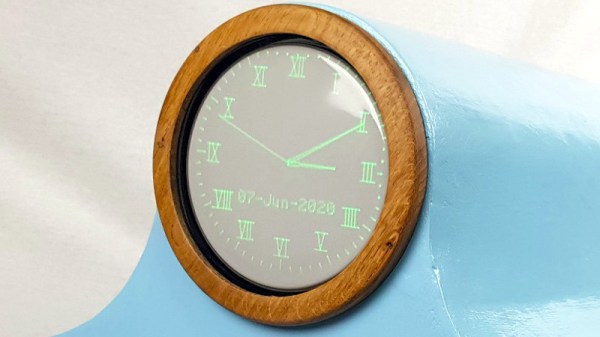
[BuildComics] had just such an oscilloscope on hand and set out to make it into something useful but aesthetically pleasing as well. With a small circuit board, formerly available as a kit from Sparkfun/Dutchtronix but now only available if you can build them yourself, the cathode ray tube can be modified to output not waveforms but rather a working clock face. The donor oscilloscope was a Heathkit IO-102 which was fine for its time but is now lacking, so the CRT was removed from its housing and placed in a custom-built enclosure with a 40s radio style that suits its new purpose well.

Seeing old hardware that is past its prime being put to work in a new way is great, both from a technical standpoint and also because that’s usable hardware that’s being kept out of the landfill. Oscilloscopes are popular for projects like these too since they are relatively easy to understand and modify. Besides being used as clocks, we’ve also seen them modified to play video games such as Pac-Man.


Arduino Music Box Turns Stuffed Animal Into TV Personality

Childlike imagination is a wonderful thing. The ability to give life to inanimate objects and to pretend how they’re living their own life is precious, and not for nothing a successful story line in many movies. With the harsh facts or adulthood and reality coming for all of us eventually, it’s nice to see when some people never fully lose that as they get older. Even better when two find each other in life, like [er13k] and his girlfriend, who enjoy to joke about all the mischief their giant dog-shaped plush toy [Tobias] might secretly get into in their absence. The good thing about growing up on the other hand is the advanced technical opportunities at one’s disposal, which gave the imagined personality an actual face, and have it live inside an old CRT screen.

The initial idea was to just build a little music box as a gift, which beeps out [er13k]’s girlfriend’s favorite song with an Arduino on a speaker he salvaged from an old radio. But as things tend to go when you’re on a roll, he decided to make the gift even more personal. The result is still that music box, built in a 3D-printed case with a little piano that lights up the notes it plays, but in addition the Arduino now also displays a cartoon version of [Tobias] through composite video on an old TV. You can see for yourself in the video after the break how he goes through the day gifting flowers and drawings, and ponders about work and alternative career plans — adult problems are clearly universal.

Sure, the music box sound is a bit one-dimensional, but it’s nevertheless a highly thoughtful gift idea that triumphs with a peak personalization factor. If [er13k] ever wants to change the sound though, maybe there’s some inspiration in this drum machine we’ve seen just a few weeks ago, or this pocket sampler.

Continue reading “Arduino Music Box Turns Stuffed Animal Into TV Personality” →

Adding RGB To A CRT

There was a time when all TVs came with only an antenna socket on their backs, and bringing any form of video input to them meant dicing with live-chassis power supplies. Then sets with switch-mode supplies made delving into a CRT TV much safer, and we could bodge in composite video and even RGB sockets by tapping into their circuitry. For Europeans the arrival of the SCART socket gave us ready-made connectivity, but in the rest of the world there was still a need to break out the soldering iron for an RGB input. [Jacques Gagnon] is in Canada, and has treated us to a bit of old-school TV input hacking as he put an RGB socket on his JVC CRT set.

Earlier hacks had inventive incursions into discrete analogue circuitry, but on later sets such as this one the trick was to take advantage of the on-screen-display features. The signal processing chip would usually have an RGB input with a blanking input to turn of the picture during the OSD chip’s output. These could be readily hijacked to provide an RGB input, and this is the course taken here. We see a VGA socket on the rear panel going to a resistor network on a piece of protoboard stuck in a vacant space on the PCB, from which a set of lines then go to the signal processing chip. The result is a CRT gaming monitor for retro consoles, of the highest quality.

For those of us who cut our teeth on CRT TVs it’s always good to see a bit of TV hacking. It’s a mod we’ve seen before, too.

A Pair Of CRTs Drive This Virtual Reality Headset

With the benefit of decades of advances in miniaturization, looking back at the devices of yore can be entertaining. Take camcorders; did we really walk around with these massive devices resting on our shoulders just to record the family trip to Disneyworld? We did, but even if those days are long gone, the hardware remains for the picking in closets and at thrift stores.

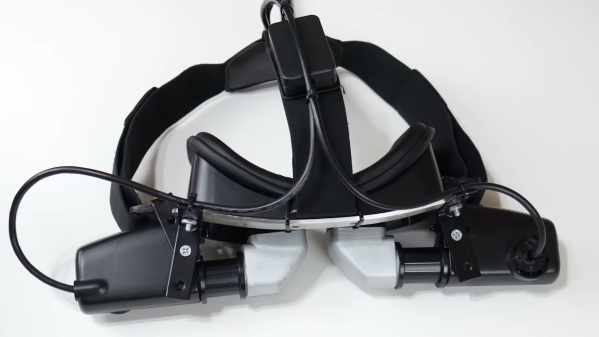
Those camcorders can be turned into cool things such as this CRT-based virtual reality headset. [Andy West] removed the viewfinders from a pair of defunct Panasonic camcorders from slightly after the “Reggievision” era, leaving their housings and optics as intact as possible. He reverse-engineered the connections and hooked up the composite video inputs to HDMI-to-composite converters, which connect to the dual HDMI ports on a Raspberry Pi 4. An LM303DLHC accelerometer provides head tracking, and everything is mounted to a bodged headset designed to use a phone for VR. The final build is surprisingly neat for the number of thick cables and large components used, and it bears a passing resemblance to one of those targeting helmets attack helicopter pilots use.

The software is an amalgam of whatever works – Three.js for browser-based 3D animation, some off-the-shelf drivers for the accelerometers, and Python and shell scripts to glue it all together. The video below shows the build and a demo; we don’t get the benefit of seeing what [Andy] is seeing in glorious monochrome SD, but he seems suitably impressed. As are we.

We’ve seen an uptick in projects using CRT viewfinders lately, including this tiny vector display. Time to scour those thrift stores before all the old camcorders are snapped up.

Continue reading “A Pair Of CRTs Drive This Virtual Reality Headset” →

Camcorder Viewfinder Converted To Diminutive Vector Display

We generally cast a skeptical eye at projects that claim some kind of superlative. If you go on about the “World’s Smallest” widget, the chances are pretty good that someone will point to a yet smaller version of the same thing. But in the case of what’s touted as “The world’s smallest vector monitor”, we’re willing to take that chance.

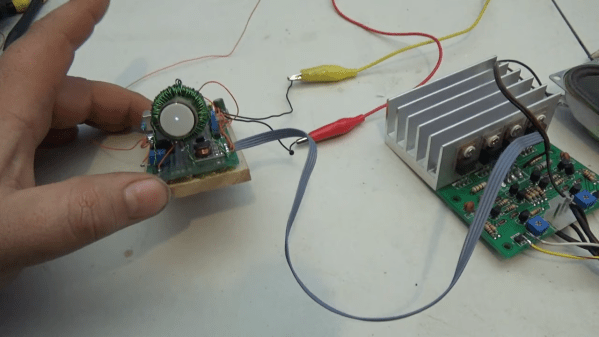
If you’ve seen any of [Arcade Jason]’s projects before, you’ll no doubt have noticed his abiding affection for vector displays. We’re OK with that; after all, many of the best machines from the Golden Age of arcade games such as Asteroids and Tempest were based on vector graphics. None so small as the current work, though, based as it is on the CRT from an old camcorder’s viewfinder. The tube appears to be about 3/4″ (19 mm) in diameter, and while it still had some of its original circuitry, the deflection coils had to be removed. In their place, [Jason] used a ferrite toroid with two windings, one for vertical and one for horizontal. Those were driven directly by a two-channel push-pull audio amplifier to make patterns on the screen. Skip to 15:30 in the video below to see the display playing [Jerobeam Fenderson]’s “Oscilloscope Music”.

As much as we’d love to see a tiny game of Battlezone played on the diminutive display, there’s only so much it can do. Maybe an analog version of this adorable digital oscilloscope would be possible?

Continue reading “Camcorder Viewfinder Converted To Diminutive Vector Display” →

Monochrome CRT And Liquid Crystal Shutter Team Up For Color Video

If you were tasked with designing a color video monitor, it’s pretty clear how you’d go about it. But what if you’d been asked to do so 20 years ago? Would it have been a cut and dried from an engineering standpoint? Apparently not, as this hybrid LCD-CRT video monitor demonstrates.

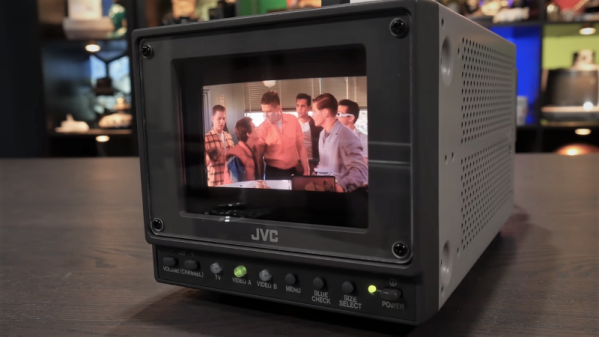
We’d honestly never heard of this particular design, dubbed “LCCS”, or liquid crystal color shutter, until [Technology Connections]’ partial teardown of the JVC monitor and explanation of its operation. The idea is simple and hearkens back to the earliest days of color TV in the United States, when broadcasters were busy trying to bring color to a monochrome world in a way that would maximize profits. One scheme involved rotating a color wheel in front of the black-and-white CRT and synchronizing the two, which is essentially what’s happening in the LCCS system. The liquid crystal panel cycles between red, blue, and green tints in time with the CRT’s images behind it, creating a full-color picture. “But wait!” you cry. “Surely there were small color CRTs back in the year 2000!” Of course there were, but they kind of sucked. Just look at the comparison of a color CRT and the LCCS in the video below and you’ll see why this system carved out a niche in the pro video market, especially for video assist monitors in the days before digital cinematography. A similar system was used by Tektronix for color oscilloscopes, too.

As usual, [Technology Connections] has managed to dig up an interesting bit of the technological fossil record and present it in a fascinating way. From video on vinyl to 1980s copy protection to the innards of a toaster, we enjoy the look under the hood of forgotten tech.

Continue reading “Monochrome CRT And Liquid Crystal Shutter Team Up For Color Video” →

History of Sony 1970s

Retrotechtacular: History Of Sony Mini Doc Bursts With 1970s Style

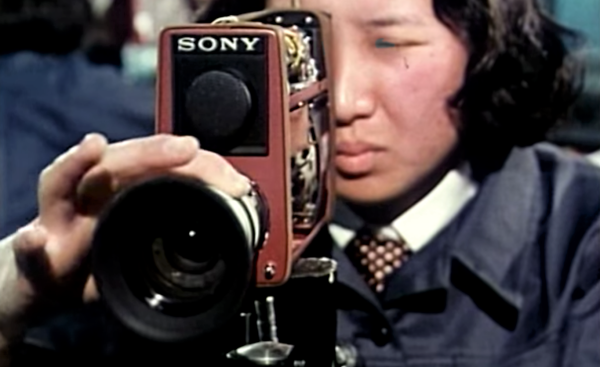
The 1970s, it was a time when cameras needed film, phones had cords, and televisions masqueraded as furniture. A time where hi-fi systems were judged by the volume knob feel, and thanks to YouTube user [nefesh22] we have a behind-the-scenes glimpse of what the era was like from the Sony corporate perspective in this mini documentary of the company’s history below. The film was originally created for internal use at Sony’s US manufacturing facilities in San Diego, however, now it now can be watched by anyone with an internet connection.

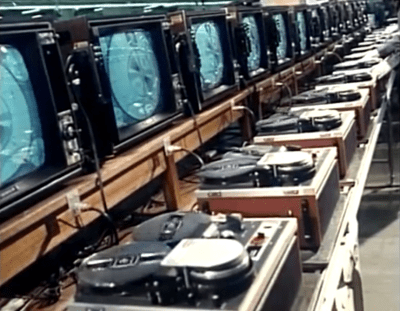
Sony CRT Testing Rig 1970s

Sony’s corporate ethos of allowing its engineers to drive business innovation is on full display here. For instance how in 1950 Sony introduced the first magnetic tape recorder, the G-Type, in Japan and followed that up with the first portable television, the TV8-301, a decade later. Throughout the 1970s Sony became an innovator in the video space. In fact, the Sony Trinitron brand of color TVs garnered so much notoriety in the television industry that the company was awarded an Emmy in 1973. Though the most telling feature is the documentary’s focus on the 3/4-inch U-Matic videocassette format, a precursor to VHS and Sony’s own Betamax videotapes. Highlighting the “superiority” of those VTR systems of the day really does date the film as those hulking decks failed to penetrate the market beyond early adopters and media companies.

It’s interesting to see how hands-on quality assurance testing used to be. Whether it’s glancing at NPN transistors under a microscope, dialing in the focus on a Super 8 camera, or a quick wave of the degaussing wand before a tube leaves the line, each of the QA tasks were carried out by individual employees rather than the automated methods of today. On an unrelated note, the brief overview of the Sony’s on-site “fiefdom” for its young workforce is a reminder that some ideas may be better left in the past… Google’s Mountain View campus anyone? If anything is to be gleaned from this retrotechtacular retrospective is that we could all use a little more wood-grain in our electronics these days.

Continue reading “Retrotechtacular: History Of Sony Mini Doc Bursts With 1970s Style” →