The Prusa I3 MK3S And A Tale Of Two Sensors

When the Prusa i3 MK3 was released in 2017, it was marketed as being “bloody smart” thanks to the impressive number of sensors that had been packed into the printer. The update wasn’t really about improving print quality over the MK2, but rather to make the machine easier to use and more reliable. There was a system for resuming prints that had stopped during a power outage, a thermometer so the firmware could compensate against thermal drift in the inductive bed sensor, RPM detection on all of the cooling fans, and advanced Trinamic stepper drivers that could detect when the printer had slipped or gotten stuck.

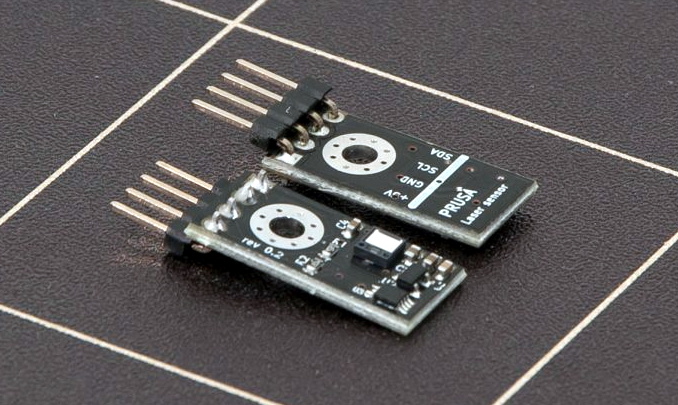
The optical filament sensor of the Prusa i3 MK3.

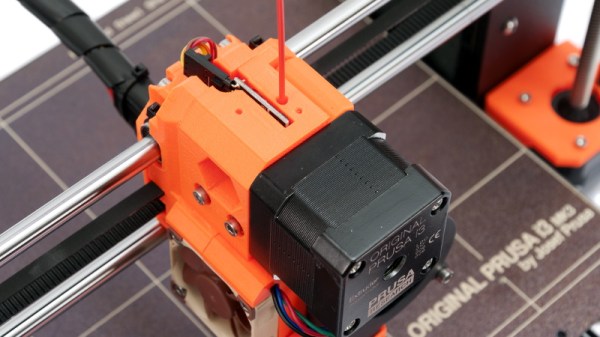
But the most exciting upgrade of all was the new filament sensor. Using an optical encoder similar to what you’d find in a mouse, the Prusa i3 MK3 could detect when filament had been inserted into the extruder. This allowed the firmware to pause the print if the filament had run out, a feature that before this point was largely unheard of on consumer-grade desktop 3D printers. More than that, the optical encoder could also detect whether or not the filament was actually moving through the extruder.

In theory, this meant the MK3 could sense problems such as a jammed extruder or a tangle in the filament path that was keeping the spool from unrolling. Any other consumer 3D printer on the market would simply continue merrily along, not realizing that it wasn’t actually extruding any plastic. But the MK3 would be able to see that the filament had stalled and alert the user. The capabilities of the optical filament sensor represented a minor revolution in desktop 3D printing, and combined with the rest of the instrumentation in the MK3, promised to all but eradicate the heartbreak of failed prints.

Fast forward to February of 2019, and the announcement of the Prusa i3 MK3S. This relatively minor refresh of the printer collected up all the incremental tweaks that had been made during the production of the MK3, and didn’t really add any new features. Though it did delete one: the MK3S removed the optical encoder sensor used in the MK3, and with it the ability to sense filament movement. Users would have to decide if keeping the ability to detect clogs and tangles was worth giving up all of the other improvements offered by the update.

But why? What happened in those three years that made Prusa Research decide to abandon what promised to be a huge usability improvement for their flagship product? The answer is an interesting look at how even the cleverest of engineering solutions don’t always work as expected in the real-world.

Continue reading “The Prusa I3 MK3S And A Tale Of Two Sensors”

The B-Sides: Curious Uses Of Off-the-Shelf Parts

I admit: a few years of prototyping without easy machine shop access really whets my tastebuds for turning metal chips. But all that time spent away from proper machine tools has also pushed me to re-imagine part catalogs, something I see almost every day. Without any precision metalworking tools handy, stock mechanical parts have become my supplement for complexity. And so a former dogma to machine-everything-thyself has been transformed into a hunt for that already-made-part-that-does-it-for-you.

But with part catalogs featuring tens of thousands of purpose-built parts, I started reimagining some of them for other misdeeds. And after a few years spent reinventing use cases for some of these parts, I’m about ready to tell you how to misuse them properly. So today I’d like to show you some of my favorite mechanical part B-sides, so to speak. These are ordinary parts in unorthodox places–something you surely won’t find in the datasheet! Now let’s have a look. Continue reading “The B-Sides: Curious Uses Of Off-the-Shelf Parts”

CNC On The Desktop Hack Chat

Join us on Wednesday, August 26 at noon Pacific for the CNC on the Desktop Hack Chat with Matt Hertel and John Allwine!

Once limited to multi-million dollar machines on the floors of cavernous factories, CNC technology has moved so far downscale in terms of machine size that it’s often easy to lose track of where it pops up. Everything from 3D-printers to laser engravers use computer numeric control to move a tool to some point in three-dimensional space, and do it with unmatched precision and reproducibility.

CNC has gotten so pervasive that chances are pretty good that there’s a CNC machine of some sort pretty close to everyone reading this, with many of those machines being homebrew designs. That’s the backstory of Pocket NC, a company that was literally started in a one-bedroom apartment in 2011 by Matt and Michelle Hertel. After a successful Kickstarter that delivered 100 of their flagship five-axis desktop CNC mills to backers, they geared up for production and now turn out affordable machine tools for the masses. We’ve even seen some very complex parts made on these mills show up in projects we’ve featured.

For this Hack Chat, we’ll be joined by Pocket NC CTO and co-founder Matt Hertel and John Allwine, who recently joined the company as Principal Software Engineer. We’ll discuss not only Pocket NC’s success and future plans, but the desktop CNC landscape in general. Drop by with your questions regarding both the hardware and the software side of CNC, about turning an idea into a business, and where the CNC world and next-generation manufacturing will be heading in the future.

join-hack-chatOur Hack Chats are live community events in the Hackaday.io Hack Chat group messaging. This week we’ll be sitting down on Wednesday, August 26 at 12:00 PM Pacific time. If time zones baffle you as much as us, we have a handy time zone converter.

Click that speech bubble to the right, and you’ll be taken directly to the Hack Chat group on Hackaday.io. You don’t have to wait until Wednesday; join whenever you want and you can see what the community is talking about.

Open And Sustainable Engineering Hack Chat

Join us on Wednesday, August 19 at noon Pacific for the Open and Sustainable Engineering Hack Chat with Joshua Pearce!

Since the first of our hominid ancestors learned to pick up a rock and make it into a tool, we humans have been using our engineering skills to change the world. For most of the 2 million or so years since that first technological leap, natural materials like stone and wood were the focus of our engineering projects, and except for a few tantalizing remnants, most of what was built has returned to the Earth whence it came.

Then we discovered other materials; we learned to free metals from rocks and how to harvest the fossilized hydrocarbon remains of ancient plants. Iron, aluminum, plastic, and silicon became our stock in trade, and the planet is now layered so thick with these materials and the byproducts of harvesting them that a new geological epoch, the Anthropocene Epoch, has been proposed to cover this time of human activity and its impact on the geological record.

But if we humans are clever enough to make such an impact, we should be clever enough to think our way out of the mess, and wise enough to see the need. That’s where the efforts of Dr. Pearce’s research at the Michigan Tech Open Sustainability Technology (MOST) lab are focused. Dr. Pearce envisions a sustainable future powered by pervasive solar photovoltaic systems and using open-source technologies like 3D printing to drive new models for manufacturing. We’ve recently seen interesting work from his lab, like this grinder that makes custom compression screws for plastic recycling. The MOST page on Hackaday.io is filled with other great examples of the technology that supports their mission, from low-cost environmental testing instruments to 3D-printable microfluidics.

Dr. Pearce will join us on the Hack Chat to talk about open and sustainable engineering. Be sure to stop by with your questions and to find out what you can do to engineer a brighter future, starting right in your own shop.

join-hack-chatOur Hack Chats are live community events in the Hackaday.io Hack Chat group messaging. This week we’ll be sitting down on Wednesday, August 19 at 12:00 PM Pacific time. If time zones baffle you as much as us, we have a handy time zone converter.

Click that speech bubble to the right, and you’ll be taken directly to the Hack Chat group on Hackaday.io. You don’t have to wait until Wednesday; join whenever you want and you can see what the community is talking about.

Continue reading “Open And Sustainable Engineering Hack Chat”

Wall-Climbing Robot Grabs Prize

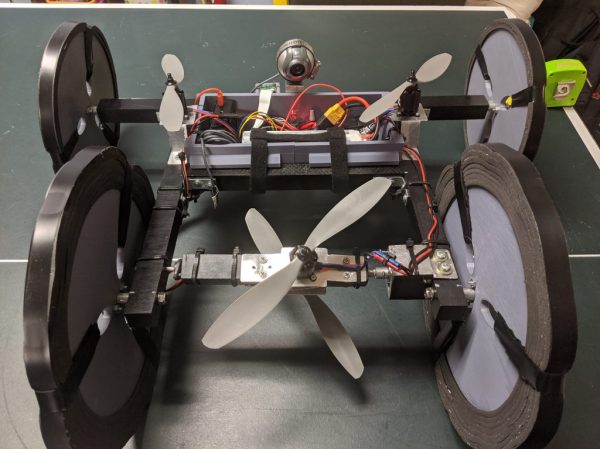
Gravity is a nice thing to have most of the time, but sometimes it would be nice to be able to ignore it for certain applications. Rock climbing, for example, would be much easier, as would performing bridge inspections in the way that a group of mechanical engineering cadets (students) at The Citadel, a military college in South Carolina, were tasked with doing. Frustrated with the amount of traffic backups that normal bridge inspections caused, they invented a robot that defies gravity, and won a $10k prize for their efforts.

The result is essentially an RC car with a drone built in, or looking at it another way it’s a drone with wheels. The car is able to drive on vertical surfaces to inspect the bridges by using its propellers to force itself onto the surface. The lack of complicated moving parts or machinery, like a cable suspension system or other contraption, makes this device exceptionally versatile for the task at hand, reduces the amount of time needed for inspections, and can do them more safely and without closing lanes of traffic. The group hopes to build a second prototype soon and present it to the Department of Transportation for approval for more widespread use.

The need for tools like these is in high demand now as well, especially in the United States where crumbling infrastructure is often not thought about, taken seriously, or prioritized. Even for bridges that aren’t major pieces of infrastructure, tools like these will prove to be very useful.

Thanks to [Ben] for the tip!

The Mark 14 Torpedo — When Just About Everything Goes Wrong, Even The Testing

I am a fan of the saying that those who don’t know history are doomed to repeat it. After all, humans have been building things for a number of centuries and we should learn from the engineers of the past. While you can learn a lot studying successes, sometimes — maybe even most of the time — we learn more from studying failure. The US Navy’s Mark 14 torpedo certainly has a lot to teach us.

The start of the story was the WWI-era Mark 10 torpedo which was fine for its day, but with faster destroyers and some additional data about how to best sink enemy ships it seemed necessary to build a new torpedo that would be faster, carry more explosive charge, and use a new method of detonation. Work started in 1931 with a $143,000 budget which may sound laughable today, but that was a lot of coin in the 1930s. Adjusted for inflation, that’s about $2.5 million.

Continue reading “The Mark 14 Torpedo — When Just About Everything Goes Wrong, Even The Testing”

Peek At The Off-Ear Speaker Prototypes For Valve’s VR

The Valve Index VR headset incorporates a number of innovations, one of which is the distinctive off-ear speakers instead of headphones or earbuds. [Emily Ridgway] of Valve shared the design and evolution of this unusual system in a deep dive into the elements of the Index headset. [Emily] explains exactly what they were trying to achieve, how they determined what was and wasn’t important to deliver good sound in a VR environment, and what they were able to accomplish.

First prototype, a proof-of-concept that validated the basic idea and benefits of off-ear audio delivery.

Early research showed that audio was extremely important to providing a person with a good sense of immersion in a VR environment, but delivering a VR-optimized audio experience involved quite a few interesting problems that were not solved with the usual solutions of headphones or earbuds. Headphones and earbuds are optimized to deliver music and entertainment sounds, and it turns out that these aren’t quite up to delivering on everything Valve determined was important in VR.

The human brain is extremely good at using subtle cues to determine whether sounds are “real” or not, and all kinds of details come into play. For example, one’s ear shape, head shape, and facial geometry all add a specific tonal signature to incoming sounds that the brain expects to encounter. It not only helps to localize sounds, but the brain uses their presence (or absence) in deciding how “real” sounds are. Using ear buds to deliver sound directly into ear canals bypasses much of this, and the brain more readily treats such sounds as “not real” or even seeming to come from within one’s head, even if the sound itself — such as footsteps behind one’s back — is physically simulated with a high degree of accuracy. This and other issues were the focus of multiple prototypes and plenty of testing. Interestingly, good audio for VR is not all about being as natural as possible. For example, low frequencies do not occur very often in nature, but good bass is critical to delivering a sense of scale and impact, and plucking emotional strings.

“Hummingbird” prototype using BMR drivers. Over twenty were made and lent to colleagues to test at home. No one wanted to give them back.

The first prototype demonstrated the value of testing a concept as early as possible, and it wasn’t anything fancy. Two small speakers mounted on a skateboard helmet validated the idea of off-ear audio delivery. It wasn’t perfect: the speakers were too heavy, too big, too sensitive to variation in placement, and had poor bass response. But the results were positive enough to warrant more work.

In the end, what ended up in the Index headset is a system that leans heavily on Balanced Mode Radiator (BMR) speaker design. Cambridge Audio has a short and sweet description of how BMR works; it can be thought of as a hybrid between a traditional pistonic speaker drivers and flat-panel speakers, and the final design was able to deliver on all the truly important parts of delivering immersive VR audio in a room-scale environment.

As anyone familiar with engineering and design knows, everything is a tradeoff, and that fact is probably most apparent in cutting-edge technologies. For example, when Valve did a deep dive into field of view (FOV) in head-mounted displays, we saw just how complex balancing different features and tradeoffs could be.