The World’s Lightest Brushless FPV Quadcopter

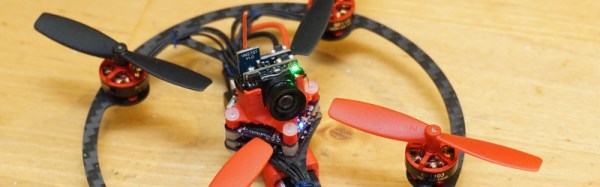
When a claim is made for something being the world’s lightest it is easy to scoff, after all that’s a bold assertion to make. It hasn’t stopped [fishpepper] though, who claims to have made the world’s lightest brushless FPV quadcopter. Weighing in at 32.4 grams (1.143 oz) it’s certainly pretty light.

The frame is a circular design cut from carbon-fiber-reinforced polymer, and on it are mounted four tiny brushless motors. In the center are the camera and battery on a 3D printed mount, as well as custom flight and speed controller boards. There are a series of posts detailing some of the design steps, and the result is certainly a capable aircraft for something so tiny. If you fancy experimenting with the design yourself, the files are available for download on the first page linked above.

There are two aspects to this build that make it interesting to us. First, the lightest in the world claim. We think someone will come along with something a bit lighter, and we can’t wait to see a lightest multirotor arms race. Good things come of technology races, which brings us to the second aspect. Governments are busy restricting the use of larger multirotors, to the extent that in some parts of the world all that will be available for non professionals will be sub-200g toy craft. Any project like this one which aims to push the boundaries of what is possible with smaller multirotors is thus extremely interesting, and we hope the community continue to innovate in this direction if only to make a mockery of any restrictions.

To get some idea of the sort of legislative measures we might be seeing, take a look at our coverage of a consultation in just one country.

3D Printed R/C Lifeboat

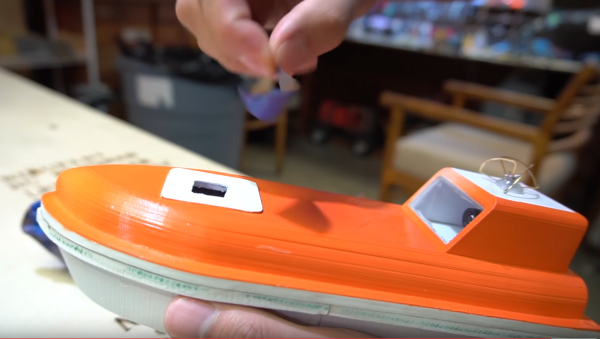
Radio control boats usually bring up thoughts of racing catamarans, or scale sailing yachts. This build takes things in a slightly different direction. A radio controlled lifeboat with a built-in First Person View (FPV) transmitter. [Peter Sripol] used to be one of the awesome folks over at Flite Test. Now he’s gone solo, and has been cranking out some great builds on his YouTube channel. His latest build is a lifeboat loosely based on the totally enclosed lifeboats used on oil tankers and other seafaring vessels.

[Peter] designed the boat in 3D modeling software and printed it on his Lulzbot Taz 6. The files are available on Thingiverse if you want to print your own. The lower hull was printed in two pieces then epoxied together. Peter’s musical build montage goes by fast, proving that he’s just as good editing video as he is scratch-building R/C craft. Along the way he shows us everything from wiring up speed controls to cutting and soldering up a rudder. The final touch on this boat is a micro FPV camera and radio transmitter. As long as the boat is in range, it can be piloted through video goggles.

[Peter’s] boat is destined to be tested on an upcoming trip to Hawaii, so keep an eye on his channel to see how it fares in the monster waves!

Look What Showed Up For Bring-A-Hack At OSH Park

Hackaday was in Portland last weekend for the Open Hardware Summit. I did a brief recap earlier this week but this post has been on my mind the entire time. The night before the summit, OSH Park (the Purveyors of Perfect Purple PCBs which we all know and love) hosted a Bring-A-Hack at their headquarters. [Laen] knows how to throw a party — with a catered spread and open bar which all enjoyed. The place was packed with awesome hackers, and everyone had something amazing to show off.

In fact, there were far too many people showing off hardware for me to capture all in one evening. But join me after the jump for six or seven examples that really stuck out.

Continue reading “Look What Showed Up For Bring-A-Hack At OSH Park” →

RC Car Piloting With The Blast Shield Down

Many of us have had a radio controlled car at some time in our youth, though it’s probable that none all of us entirely mastered it. There are memories of spectacular crashes, and if we were really unlucky, further boosts to Mr. Tamiya’s bank balance as fresh parts had to be fitted.

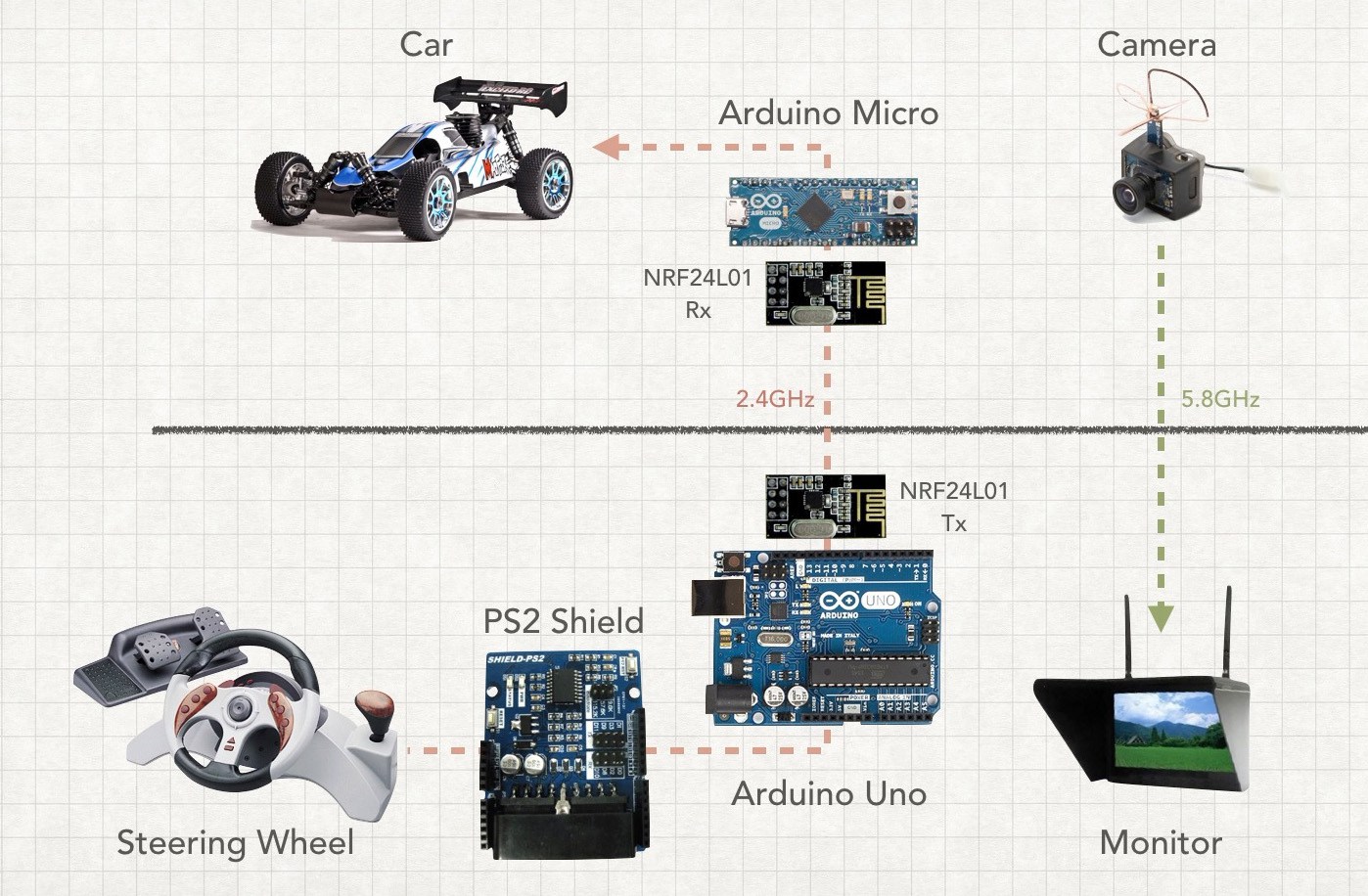
[Paul Yan] was watching his young son with a radio controlled toy, and was struck by how the two-joystick control layout is not necessarily as intuitive as it could be. By contrast when faced with a console game with first-person view and a steering wheel the boy had no problem dropping straight into play. This observation led him to investigate bringing a console steering wheel to an RC car, and the result is a rather impressive FPV immersive driving experience.

Paul's FPV car, explained.
Paul’s FPV car, explained.

His build took a PS2 steering wheel peripheral with pedals and mated it to an Arduino Uno via a PS2 shield. The Uno talks to a Nordic NRF24L01 RF module, which communicates with another NRF24L01 on the car. This in turn talks to a car-mounted Arduino Micro, which controls the car servos and speed controller.

FPV video is provided by a miniature camera and transmitter from the world of multirotor flying which is mounted on the car and transmits its pictures over 5GHz to a set of monitor goggles. Sadly he does not appear to have posted any of the software involved, though we doubt there is anything too challenging should you wish to try it for yourselves.

The video below shows the car in action, complete with an over-enthusiastic acceleration and crash from his young son. He tells us it’s a similar experience to playing a racing kart game in the real world, and having seen the video we wish we could have a go.

Continue reading “RC Car Piloting With The Blast Shield Down” →

Solar FPV Plane Flies Forever

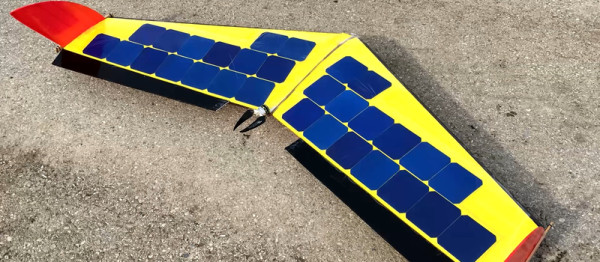
We love solar power. Not only is it environmentally friendly, but it’s relatively lightweight and involves fragile high technology. Just the sort of thing that we’d want to strap onto the wings of a large model aircraft.

Solar power on a remote-controlled plane would get you unlimited cruising range. Now, a normal land-and-swap-battery process might be good enough for some people, but judging from [Prometreus]’s YouTube channel, he’s a fan of long flights over the Alps, and of pushing long-distance FPV links to the breaking point. For him and his friends, the battery power is definitely the limiting factor in how far / long he can fly.

solar-powered-plane-_-drone-_-fpv-_-built-_-rc-aircraft-rmkpjbf6dnqmkv-shot0012

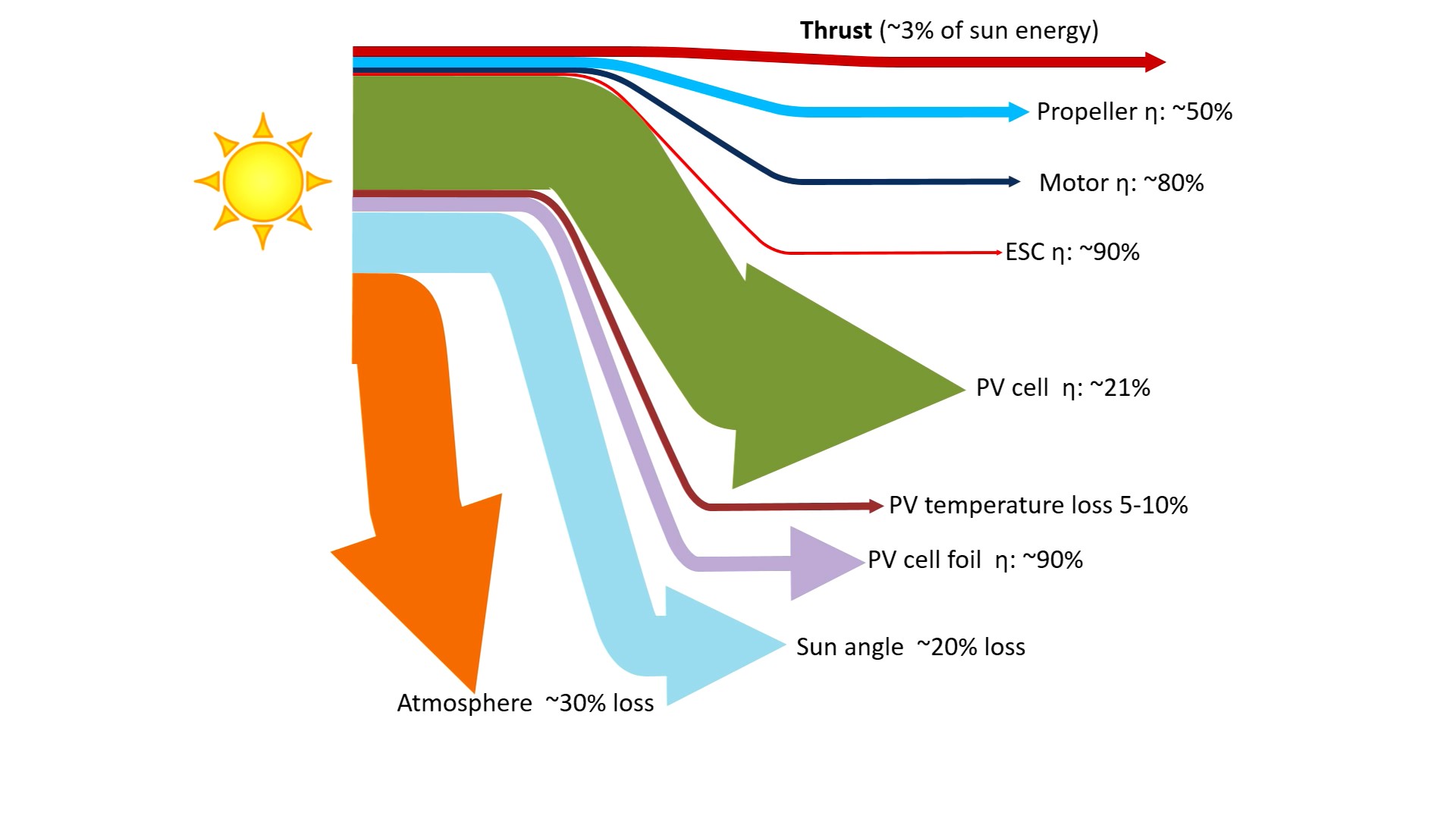
All of the information we have is in the video, but that’s plenty. [Prometreus] didn’t bother with maximum-power-point tracking, but instead wired up his solar cells to work just about right for the voltage of his batteries and the level of sun that he’s seeing. So it won’t work nearly as well on cloudy days. (Check out this MPPT build that was submitted for the Hackaday Prize.)

He could switch the solar cells in an out remotely, and it’s pretty gratifying to see the consumed current in the battery go down below zero. In the end, he lands with a full battery. How cool is that?

Continue reading “Solar FPV Plane Flies Forever” →

A Lucky Antenna

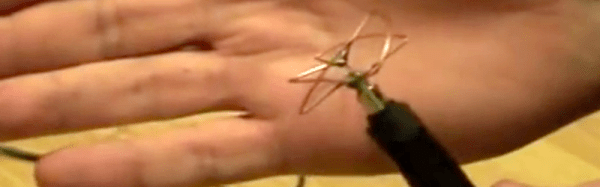
Antennas come in all shapes and sizes, and which one is best depends wholly on what you are doing with it. A very popular choice for sending video from drones is the cloverleaf antenna. It is circularly polarized which is an advantage when you have a moving vehicle. It also reduces multipath interference.

A cloverleaf contains three closed loops spaced at different angles. The antenna works well for transmitting but isn’t ideal for receiving. It is also difficult to tune after building it. However, for the right job, it is a good performer. [Vitalii Tereshchuk] shows how he made a cloverleaf antenna that fits a WiFi router.

Continue reading “A Lucky Antenna” →

Using Arduino For Quadcopter Spectrum Analyzers

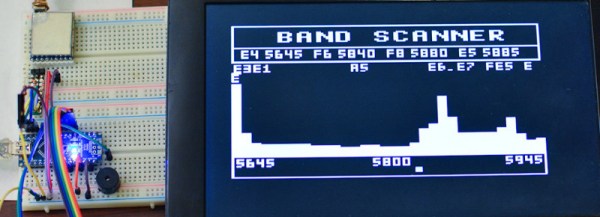
First-person-view (FPV) flying, by adding a camera, video transmitter, and video goggles to the meat on the ground, is one of the best ways to experience remote-controlled flight. For just a few hundred dollars, it’s the closest thing you’re going to get to growing wings and flying through the trees of your local park. One of the most popular and cheapest ways to go about this is the Boscam RX5808 wireless receiver – a $9 module able to pull down video from an aircraft over 5.8GHz radio. Stock, this radio module is just okay, but with a few modifications, it can be turned into a very good receiver with a spectrum analyzer and autoscan.

The Boscam RX5808 has three DIP switches to allow for eight different channels for receiving video, and this is where most RC hobbyists stop. But the module also has a very capable SPI interface, and by adding a simple Arduino, the complete capabilities of this receiver can be unlocked.

The core software for the build is [markohoepken]’s rx5808-pro and rx5808_pro_osd, and [crazyheea]’s rx5808-pro-diversity to enable all the capabilities available in the RX5808 receiver. With an off-the-shelf LCD, this mess of wires and boards turns into an auto-scanning spectrum analyzer that’s also able to put video from a drone onto a screen.

[garagedrone] put together a very complete demo video of the entire build. You can check that out below.

Continue reading “Using Arduino For Quadcopter Spectrum Analyzers” →