Great Badge Concept: A “Geiger Counter” For WiFi Deauthentication Frames

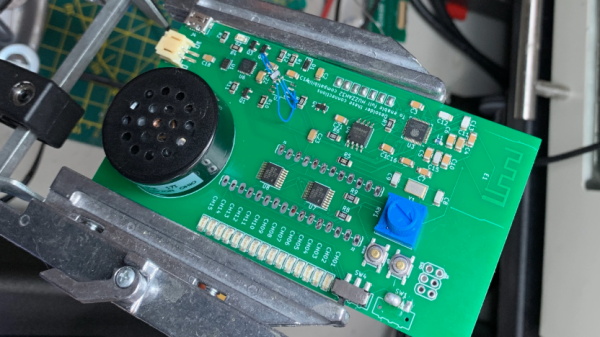
[Nick Price] had a wonderful concept for a DEFCON badge: a device that worked a lot like a directional Geiger counter, but chirped at detecting WiFi deauthentication packets instead of radiation. That’s a wild idea and it somehow slipped past us last year. Why detect such a thing? Well, the WiFi deauth attack is a kind of invisible toxicity, effectively jamming wireless communications by forcing users to be constantly tied up with authentication, and this device would detect it.

A few things were harder than expected, however. To make the device directional, [Nick] designed and built a PCB Yagi antenna but it wasn’t practical. Not only was it far too big, it would also have required going to four layers on a PCB that was already expensive. The solution he settled on — inspired by a friend’s joke about just dropping the badge into a Pringles can — was to surround the PCB omni antenna with a copper pipe end cap from the plumbing section of any hardware store. [Nick] figured that soldering that to the ground plane should result in a simple, cheap, and attractive directional antenna mod. Did it work? We’ll all have to wait and see.

Sadly, [Nick] wasn’t able to finish in time for last year’s DEFCON. Hardware revisions mounted, and fabrication times for his specialized PCB were longer than usual. Worse news is that this year’s is cancelled, or rather is going virtual, which means he’s going to have to deauth himself. The good news is that now he’s got another 12-month extension. Watch the brief video of the functional prototype, embedded below.

Continue reading “Great Badge Concept: A “Geiger Counter” For WiFi Deauthentication Frames”
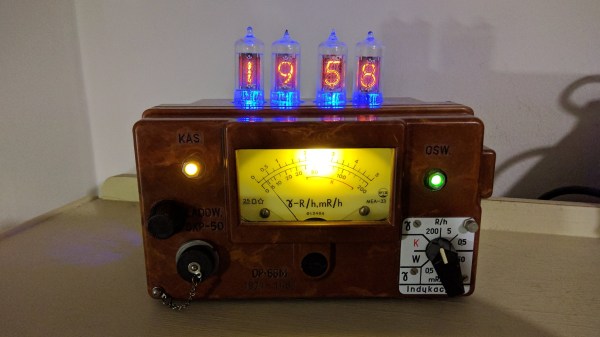
Nixies Adorn A Cold War Relic To Make A Geiger Clock

Say what you will about the centrally planned economies of the Soviet bloc during the Cold War, but their designs had a brutal style all their own. When one comes across an artifact from that time, like a defunct Polish Geiger counter from 1971, one celebrates that style the only way possible: by sticking Nixies tubes on it and making it into a Geiger clock.

Right off the hop, we’ve got to say that we’re in love with the look of [Tom Sparrow]’s build. And we’ll further stipulate that most of the charm comes from the attractive Bakelite case of the original Geiger counter. This looks like the real deal, with the marbleized look presumably caused by different color resins mixing in the mold. [Tom] did an admirable job bringing back the original shine with some polish and elbow grease; no doubt the decades had taken their toll on the original shine. The meter was gutted to make room for the clockworks, which is an off-the-shelf Nixie module. The tubes stick through holes drilled in the top; a pair of LEDs adorn the front panel and an incandescent bulb provides a warm glow behind the original meter. Combined with the original rotary switch and labels, the whole thing has a great look that’s perfect for a desk.

We’ve featured a lot of retro-classic Nixie builds, from digitizing a 1940s radio to a 1970s multimeter turned into a dice-roller. As for Nixie clocks, we’re just glad to take a break from the Nixie steampunk trend for a bit.

[via Dangerous Prototypes]

Hackaday Podcast 035: LED Cubes Taking Over, Ada Vanquishes C Bugs, Rad Monitoring Is Hot, And 3D Printing Goes Full 3D

Hackaday Editors Mike Szczys and Elliot Williams get caught up on the most interesting hacks of the past week. On this episode we take a deep dive into radiation-monitor projects, both Geiger tube and scintillator based, as well as LED cube projects that pack pixels onto six PCBs with parts counts reaching into the tens of thousands. In the 3D printing world we want non-planar printing to be the next big thing. Padauk microcontrollers are small, cheap, and do things in really interesting ways if you don’t mind embracing the ecosystem. And what’s the best way to read a water meter with a microcontroller?

Take a look at the links below if you want to follow along, and as always tell us what you think about this episode in the comments!

Take a look at the links below if you want to follow along, and as always, tell us what you think about this episode in the comments!

Direct download (60 MB or so.)

Continue reading “Hackaday Podcast 035: LED Cubes Taking Over, Ada Vanquishes C Bugs, Rad Monitoring Is Hot, And 3D Printing Goes Full 3D”

You Didn’t See Graphite Around This Geiger Counter

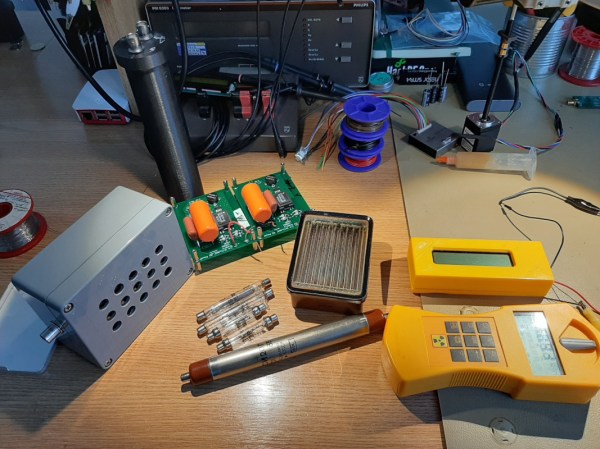
Even if you don’t work in a nuclear power plant, you might still want to use a Geiger counter simply out of curiosity. It turns out that there are a lot of things around which emit ionizing radiation naturally, for example granite, the sun, or bananas. If you’ve ever wondered about any of these objects, or just the space you live in, it turns out that putting together a simple Geiger counter is pretty straightforward as [Alex] shows us.

The core of the Geiger counter is the tube that detects the radiation. That’s not something you’ll be able to make on your own (probably) but once you have it the rest of the build comes together quickly. A few circuit boards to provide the tube with the high voltage it needs, a power source, and a 3D printed case make this Geiger counter look like it was ordered from a Fluke catalog.

The project isn’t quite finished ([Alex] is still waiting on a BNC connector to arrive) but seems to work great and isn’t too complicated to put together, as far as Geiger counters go. He did use a lathe for some parts which not everyone will have on hand, but a quick trip to a makerspace or machinist will get you that part too. We’ve seen some other parts bin Geiger counters too, so there’s always a way around things like this.

Global Radiation Montoring And Tracking Nuclear Disasters At Home

Many of us don’t think too much about radiation levels in our area, until a nuclear disaster hits and questions are raised. Radiation monitoring is an important undertaking, both from a public health perspective and as a way to monitor things like weapon development. So why is it done, how is it done, and what role can concerned citizens play in keeping an eye on things?

Continue reading “Global Radiation Montoring And Tracking Nuclear Disasters At Home”

A Cheap And Cheerful Geiger Counter Build

Hackers often have broad interests across the sciences, of which nuclear topics are no exception. The Geiger counter remains a popular build, and could be a handy tool to have in a time of rising tensions between nuclear powers. [Leonora Tindall] had tinkered with basic units, but wanted a better idea of actual radiation levels in her area. Thus began the build!

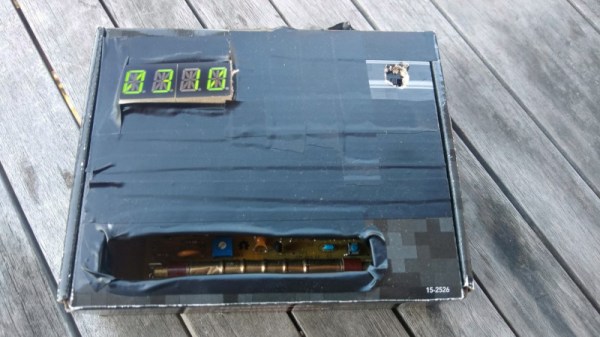
The project began by leveraging the Geiger counter kit from the Mighty Ohm. [Leonora] had built one of these successfully, but wished for a visual readout to supplement the foreboding ticking noises from the device. This was achieved by installing a Metro Mini microcontroller along with a 4-character, 14-segment alphanumeric display. This, along with the cardboard enclosure, makes the build look like a prop from an 80s hacker movie. Very fitting for the Cold War-era technology at work.

By using a pre-built kit and upgrading it with display hardware, [Leonora] now has readings at a glance without having to reinvent the wheel and design her own board from scratch. Of course, if you’re thinking of taking on a more complex build, you might consider a scintillation detector instead.

DIY Geiger Counter Is Sure To Generate Clicks

On the outside, a Geiger counter seems like a complicated thing. And you might think a device that detects a dangerous, mostly invisible threat like radiation should be complicated. But they’re actually pretty simple. The Geiger-Muller tube does most of the work, which boils down to detecting brief moments of conductivity caused by chain reactions of charged particles in radioactive materials.

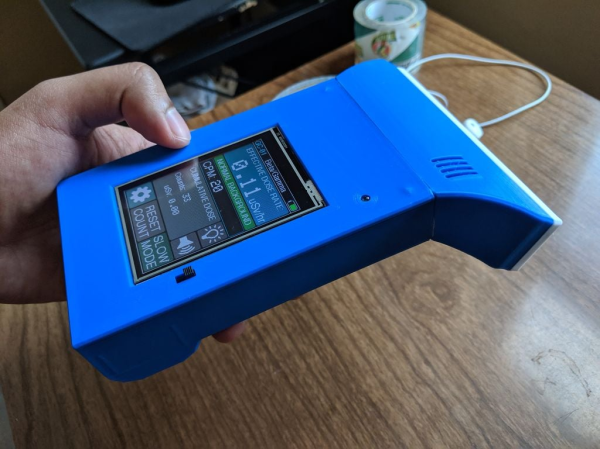
[Prabhat_] wanted to build a unique-looking Geiger counter, and we’d say that this slick, Star Trek-esque result succeeds. A well-organized display shows the effective dose rate, counts per minute, and cumulative dose, which can be displayed in either microsieverts or millirems. We dig the 3D printed case design, because we like to see form follow function.

The counter is powered by an 18650 cell that’s DC-to-DC boosted to 400+ volts. A NodeMCU processes the signal coming in from the G-M tube and expresses it in both clicks and LED blinks, both of which can be toggled on or off from the home screen. The alert threshold can be customized in the settings, which means the point at which green changes to red.

Click-click-click past the break for [prabhat_]’s great walk-through video, where he tests it with uranium ore and a thoriated gas lantern mantle.

If you want to take the opposite approach and get to clicking ASAP, well, fire up your hot glue gun and dump out your scrap bin.

Continue reading “DIY Geiger Counter Is Sure To Generate Clicks”