Recreating Retrocomputers Hack Chat

Join us on Wednesday, August 12 at noon Pacific for the Recreating Retrocomputers Hack Chat with Mike Gardi!

Building the first commercial computers in the late 1950s and early 1960s was certainly a complex a task, but building the computer industry was even harder. Sure, engineers were already getting on board with designing in silicon and germanium instead of glass and tungsten, and all digital circuits are really just abstractions of analog designs most of them were already familiar with. But what about all the other people who would need to get up to speed on the workings of digital computers? What good is a tool if the only people who know how to use it art the ones who built it?

To make computers make money, companies needed legions of installers, operators, programmers, marketers, and salespeople, and all of them needed training. And so early computer companies put a lot of effort into building training devices to get people up to speed. These trainers helped teach everything from basic logic circuits and Boolean relationships to simple programming concepts, and each of them contributed in their own way to developing the computer industry that we know today.

Mike Gardi has a unique hobby: among other things, he builds faithful replicas of some of the nicer examples of these lost bits of computing history. His reproduction of Claude Shannon’s Minivac 601 trainer is a great example of the art, as is the DEC H-500 Computer Lab build he’s currently working on. Along the way, he’s explored some side alleys on the road to our computerized world, like Dr. Nim and the paperclip computer. All his builds are lovingly created from 3D-prints and really capture the essence of the toys and tools of the time.

Join us as we take a trip inside this niche realm of retrocomputing and find out why Mike finds it fascinating enough to devote the time it obviously takes to build such exacting replicas. We’ll talk about what projects he’s got going on right now, what he has planned for the future, and maybe even dive into some of his secrets for such great looking 3D prints.

join-hack-chatOur Hack Chats are live community events in the Hackaday.io Hack Chat group messaging. This week we’ll be sitting down on Wednesday, August 12 at 12:00 PM Pacific time. If time zones baffle you as much as us, we have a handy time zone converter.

Click that speech bubble to the right, and you’ll be taken directly to the Hack Chat group on Hackaday.io. You don’t have to wait until Wednesday; join whenever you want and you can see what the community is talking about.

Continue reading “Recreating Retrocomputers Hack Chat”

Jan Czochralski And The Silicon Revolution

If you were to travel back in time to the turn of the previous century and try to convince the average person that the grains of sand on just about any beach would be the basis of an industry worth hundreds of billions of dollars within 100 years, they’d probably have thought you were crazy. Aside from being coarse, rough, and irritating, sand is everywhere, and convincing anyone of its value would be a hard sell, unless your interlocutor was a real estate visionary with an appreciation of the future value of seaside property and a lot of patience.

Fast forward to our time, and we all know the value of the material that comes from common quartz sand: silicon, specifically the ultra-purified crystals of silicon that end up as the wafers we depend on to build the circuitry of life. The trip from beach to chip foundry is a long and non-obvious one which would not have been possible without the insights of an undistinguished Polish student and one-time druggist who discovered the process that made the Information Age possible: Jan Czochralski.

Continue reading “Jan Czochralski And The Silicon Revolution”

Ham Radio Mobile Operations Circa 1919

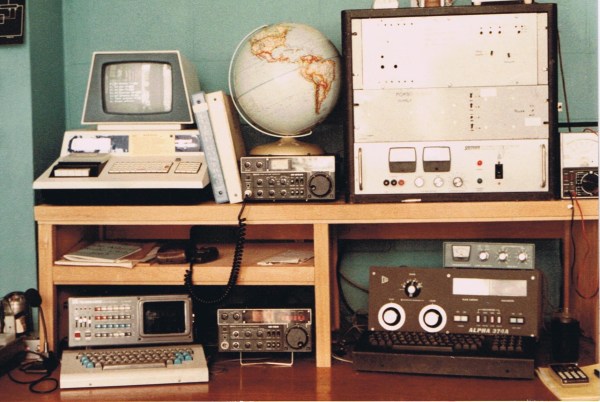
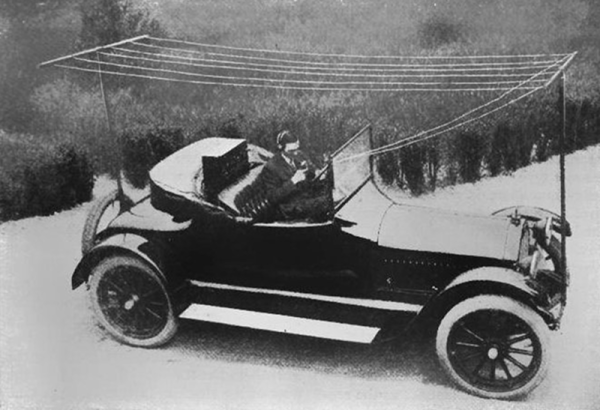
You used to be able to tell a die-hard ham radio operator on the road by the number and length of antennas protruding porcupine-like from their vehicle. There are still some mobile high frequency operators that have respectable car-mounted antenna farms, but they have nothing on Alfred H. Grebe. In 1919, he fitted a medium wave transmitter in his car that operated around 2 MHz. Since it needed a very large antenna, Grebe rigged a wire antenna that looked like a clothesline between the two bumpers. Obviously, you had to stop, set up your antenna, and then operate — you couldn’t talk and drive. But this may have been the world’s first automotive radio setup for voice communication.

The car had a separate battery for the radio and a dynamotor to generate high voltage for the tubes. Although many radio enthusiasts found ways to add receivers to their cars in the 1920s, it would be 1930 before Motorola made radios especially for cars in production quantities.

Continue reading “Ham Radio Mobile Operations Circa 1919”

Does PHP Have A Future, Or Are Twenty Five Years Enough?

In June, 1995, Rasmus Lerdorf made an announcement on a Usenet group. You can still read it.

Today, twenty five years on, PHP is about as ubiquitous as it could possibly have become. I’d be willing to bet that for the majority of readers of this article, their first forays into web programming involved PHP.

Announcing the Personal Home Page Tools (PHP Tools) version 1.0.

These tools are a set of small tight cgi binaries written in C.

But no matter what rich history and wide userbase PHP holds, that’s no justification for its use in a landscape that is rapidly evolving. Whilst PHP will inevitably be around for years to come in existing applications, does it have a future in new sites?

Continue reading “Does PHP Have A Future, Or Are Twenty Five Years Enough?”

How Can Heavy Metal Fly?

Scientists found a surprising amount of lead in a glacier. They were studying atmospheric pollution by sampling ice cores taken from Alpine glaciers. The surprising part is that they found more lead in strata from the late 13th century than they had in those deposited at the height of the Industrial Revolution. Surely mediaeval times were supposed to be more about knights in shining armour than dark satanic mills, what on earth was going on? Why was the lead industry in overdrive in an age when a wooden water wheel represented high technology?

The answer lies in the lead smelting methods used a thousand miles away from that glacier, and in the martyrdom of a mediaeval saint.

Continue reading “How Can Heavy Metal Fly?”

BINA-VIEW: A Fascinating Mechanical Interference Display

[Fran Blanche] tears down this fascinating display in a video teardown, embedded below.

These displays can support up to 64 characters of the buyer’s choosing which is controlled by 6 bits, surprisingly only requiring 128 mW per bit to control; pretty power-light for its day and age. Aside from alphanumeric combinations the display also supported “color plates” which we found quite fascinating. The fully decked model would only cost you $1,206 US dollars per unit in today’s money or five rolls of toilet paper at latest street price. And that’s just one digit.

If you dig through the documents linked here, and watch her video you can get an idea of how this display works. There are six solenoids attached to rods at the rear of the device. A lamp shines through a lens onto the back of a plate assembly. Each plate is a strategically perforated grid. When the solenoids activate the selected plates tilt interfering with a stationary grid. This causes the light to be blocked in some regions only.

It seems clear why this never took off. Aligning these seems like a production nightmare compared to things like flip displays and Nixie tubes. Still, the characters have quite a lot of charm to them. We wouldn’t mind seeing a 3D printable/laser cut version of this display type. Get working!

Continue reading “BINA-VIEW: A Fascinating Mechanical Interference Display”

Two Perspectives On James Clerk Maxwell And His Equations

We are unabashed fans of [The History Guy’s] YouTube channel, although his history videos aren’t always about technology, and even when they are, they don’t always dig into the depths that we’d like to see. That’s understandable since the channel is a general interest channel. However, for this piece on James Clerk Maxwell, he brought in [Arvin Ash] to handle the science side. While [The History Guy] talked about Maxwell’s life and contributions, [Arvin] has a complementary video covering the math behind the equations. You can see both videos below.

Of course, if you’ve done electronics for long, you probably know at least something about Maxwell’s equations. They unified electricity and magnetism and Einstein credited them with spurring one of his most famous theories.

Continue reading “Two Perspectives On James Clerk Maxwell And His Equations”