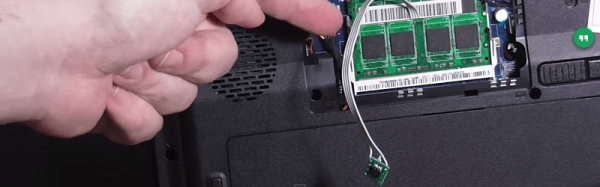
Heat up that iron, you’re going to want to try this one: [Hugatry] is adding hardware to his laptop by tapping into the i2c lines on the memory module. We love this because the penalty for borking memory during the soldering process is much lower than when soldering directly to a motherboard!
Until we watched the video after the break we hadn’t realized that memory modules usually have an i2c EEPROM on them. This is actually a standard called Serial Presence Detect which allows the BIOS to poll the memory and configure automatically. It seems ironic that we knew the Raspberry Pi HAT standard uses this same trick but didn’t know it was on computer memory as well.
Hardware-wise this provides an easy method of soldering your own equipment to the bus. From there it becomes a software hack. Linux, of course, makes this quite easy and that is demonstrated by [Hugatry] with an LM75 temperature sensors. We would like to hear from our Windows and OSX using readers on how the i2c bus can be accessed within those OS’s.
Continue reading “Solder Any Expansion Directly To Your Computer’s Memory”
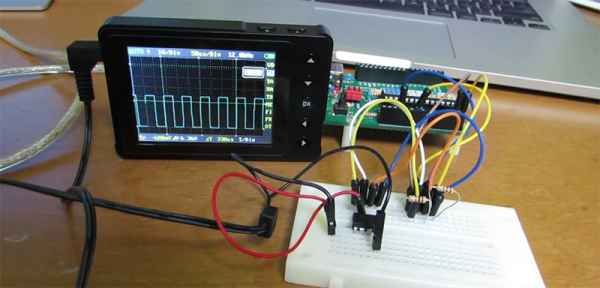


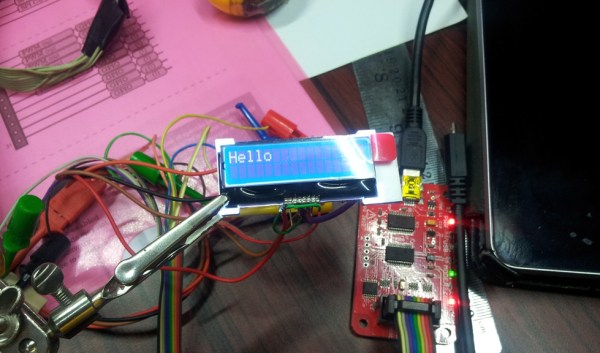
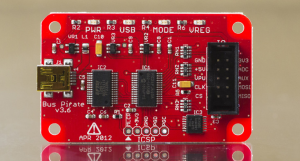 Before using the TI though, [Inderpreet] wanted to test with the Bus Pirate first. This would allow him to verify the hardware, and to make sure he was correctly using the I2C bus. The Bus Pirate can operate at 3.3V or 5V logic levels, and has on-board programming specific to the I2C bus. Controlling the Bus Pirate is as easy as hooking up a serial terminal program and plugging in a USB cable.