Casting Metal Tools With Kitchen Appliances

Perhaps the biggest hurdle to starting a home blacksmithing operating is the forge. There’s really no way around having a forge; somehow the metal has to get hot enough to work. Although we might be imagining huge charcoal- or gas-fired monstrosities, [Shake the Future] has figured out how to use an unmodified, standard microwave oven to get iron hot enough to melt and is using it in his latest video to cast real, working tools with it. (Also available to view on Reddit)

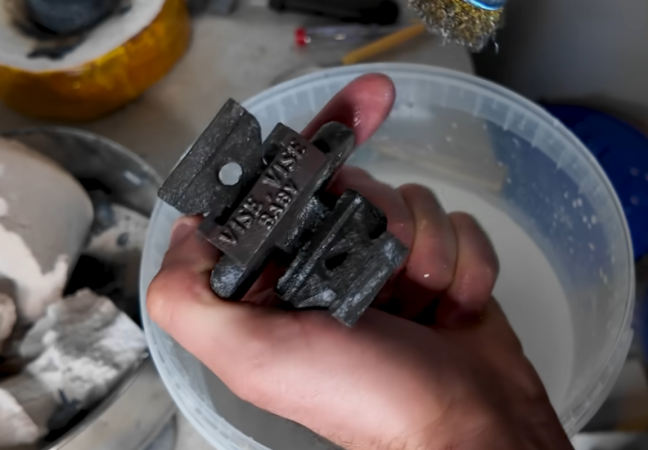
In the past, [Shake the Future] has made a few other things with this setup like an aluminum pencil with a graphite core. This time, though, he’s stepping up the complexity a bit with a working tool. He’s decided to build a miniature bench vice, which uses a screw to move the jaws. He didn’t cast the screw, instead using a standard size screw and nut, but did cast the two other parts of the vice. He first 3D prints the parts in order to make a mold that will withstand the high temperatures of the molten metal. With the mold made he can heat up the iron in the microwave and then pour it, and then with some finish work he has a working tool on his hands.

A microwave isn’t the only kitchen appliance [Shake the Future] has repurposed for his small metalworking shop. He also uses a standard air fryer in order to dry parts quickly. He works almost entirely from the balcony of his apartment so he needs to keep his neighbors in mind while working, and occasionally goes to a nearby parking garage when he has to do something noisy. It’s impressive to see what can be built in such a small space, though. For some of his other work be sure to check out how he makes the crucibles meant for his microwave.

Continue reading “Casting Metal Tools With Kitchen Appliances”
Medieval Iron, Survivorship Bias And Modern Metallurgy

When you hear it said that “Modern steel is disposable by design”, your ears perk up, as you just caught the unmistakable sound of faux romanticism along with ‘lost ancient technology‘ vibes. Although it happens sometimes that we did lose something important, as with for example the ancient Roman concrete that turns out to have self-healing properties as a result of so-called hot mixing, this is decidedly an exception.

We nearly lost that technology because of the technological and scientific bonfire that was the prelude to a thousand years of darkness over Europe: called the Dark Ages, Middle Ages as well as the medieval period. Thus when you come across a slideshow video with synthesized monotonal voice-over which makes the bold claim that somehow medieval iron was superior and today’s metallurgy both worse and designed to break, you really have to do a spit-take. The many corrections in the comment section further reinforces the feeling that it’s more slop than fact.

One of the claims made is that the bloomery furnace beats the blast furnace, due to beneficial additives to the iron. Considering that the video cites its sources, it’s at least worthy of a dive into the actual science here. Are modern iron and steel truly that inferior and disposable?

Continue reading “Medieval Iron, Survivorship Bias And Modern Metallurgy”

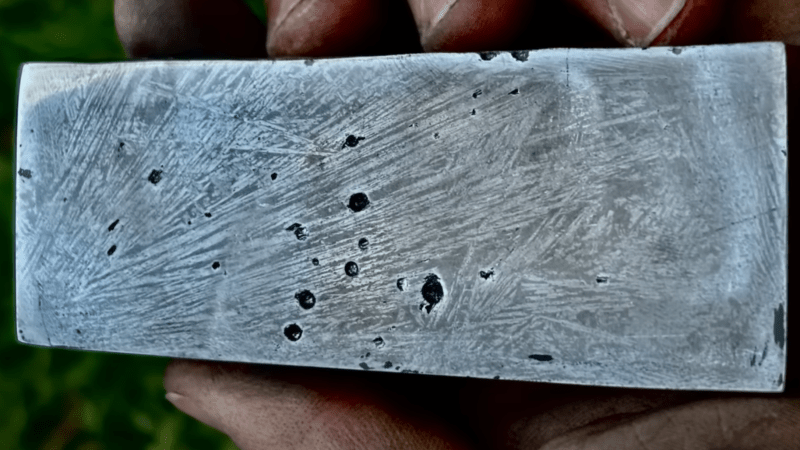
A man’s hand is shown holding a polished metal billet. The billet has a few voids in the surface, and the surface shows a pattern of lighter lines against the darker metal background.

Casting Meteorite-like Materials

From the outside, iron meteorites tend to look like formless, rusted lumps of metal, which is why museums often polish and etch sections to show their interior structure. This reveals their Widmanstätten patterns, a latticework structure of parallel iron-nickel intermetallic crystals which forms over millions of years of very slow solidification. Inspired by this, [Electron Impressions] created his own metal composition which forms similar patterns on a much-faster-than-geological time scale.

Witmanstätten patterns form when a meteorite colliding with a planet launches molten iron and nickel into space, where they very slowly solidify. As the mixture cools, it first forms a stable phase called Taenite, then begins to precipitate another phase called Kamacite. Kamacite forms needle-shaped crystals, which when polished show up against the Taenite background. However, such needle-shaped growth only becomes noticeable at a cooling rate of a few degrees per million years, so it’s not really a practical way to make the pattern. Continue reading “Casting Meteorite-like Materials”

Electrical Steel: The Material At The Heart Of The Grid

When thoughts turn to the modernization and decarbonization of our transportation infrastructure, one imagines it to be dominated by exotic materials. EV motors and wind turbine generators need magnets made with rare earth metals (which turn out to be not all that rare), batteries for cars and grid storage need lithium and cobalt, and of course an abundance of extremely pure silicon is needed to provide the computational power that makes everything work. Throw in healthy pinches of graphene, carbon fiber composites and ceramics, and minerals like molybdenum, and the recipe starts looking pretty exotic.

As necessary as they are, all these exotic materials are worthless without a foundation of more familiar materials, ones that humans have been extracting and exploiting for eons. Mine all the neodymium you want, but without materials like copper for motor and generator windings, your EV is going nowhere and wind turbines are just big lawn ornaments. But just as important is iron, specifically as the alloy steel, which not only forms the structural elements of nearly everything mechanical but also appears in the stators and rotors of motors and generators, as well as the cores of the giant transformers that the electrical grid is built from.

Not just any steel will do for electrical use, though; special formulations, collectively known as electrical steel, are needed to build these electromagnetic devices. Electrical steel is simple in concept but complex in detail, and has become absolutely vital to the functioning of modern society. So it pays to take a look at what electrical steel is and how it works, and why we’re going nowhere without it.

Continue reading “Electrical Steel: The Material At The Heart Of The Grid”

When Is Damascus Steel Not From Damascus?

If you grow up around a working blacksmith’s forge, there are a few subjects related to metalwork on which you’ll occasionally have a heated discussion. Probably the best known is the topic of wrought iron, a subject I’ve covered here in the past, and which comes from the name of a particular material being confused with a catch-all term of all blacksmith-made items. I’ve come to realise over recent years that there may be another term in general use which is a little jarring to metalwork pedants, so-called Damascus steel. Why the Syrian capital should pop up in this way is a fascinating story of medieval metalworking, which can easily consume many days of research.

Damascus? Where’s That?

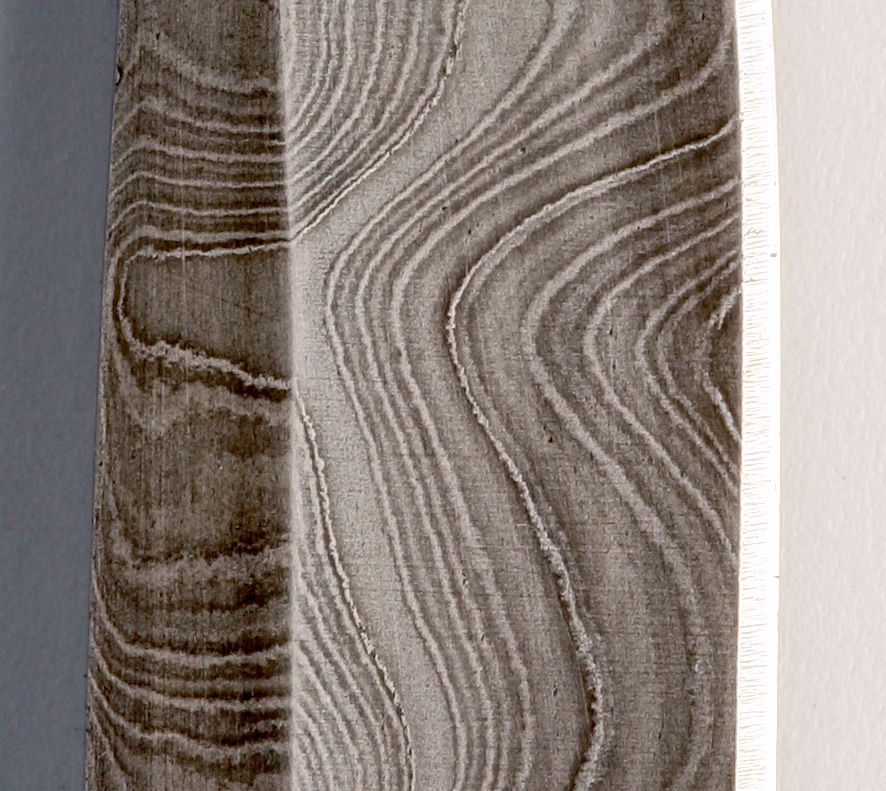
A section of a knife blade with various silver grey and black layered patterns in the metal.
The banded pattern of the laminate formed from pattern welded layers of differing steels in a modern Damascus steel knife. “DamaszenerKlinge” by Soerfm

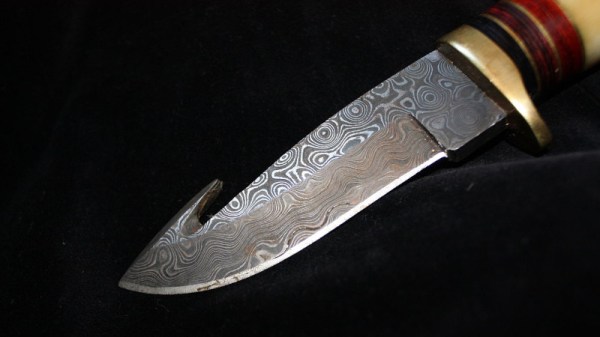
The Damascus steel you’ll see in YouTube videos, TV shows, and elsewhere is a steel with complex bands and striations on its surface. It’s often used in knife blades, and it will usually have been chemically treated to enhance the appearance of the patterns. It’s a laminate material made by pattern welding layers of different steels together, and it will usually have been worked and folded many times to produce a huge number of very thin layers of those steels. Sometimes it’s not made from sheets or ingots of steel but from manufactured steel products such as chains, in an attempt to produce a result with more unusual patterns. Continue reading “When Is Damascus Steel Not From Damascus?”

Iron Nitrides: Powerful Magnets Without The Rare Earth Elements

Since their relatively recent appearance on the commercial scene, rare-earth magnets have made quite a splash in the public imagination. The amount of magnetic energy packed into these tiny, shiny objects has led to technological leaps that weren’t possible before they came along, like the vibration motors in cell phones, or the tiny speakers in earbuds and hearing aids. And that’s not to mention the motors in electric vehicles and the generators in wind turbines, along with countless medical, military, and scientific uses.

These advances come at a cost, though, as the rare earth elements needed to make them are getting harder to come by. It’s not that rare earth elements like neodymium are all that rare geologically; rather, deposits are unevenly distributed, making it easy for the metals to become pawns in a neverending geopolitical chess game. What’s more, extracting them from their ores is a tricky business in an era of increased sensitivity to environmental considerations.

Luckily, there’s more than one way to make a magnet, and it may soon be possible to build permanent magnets as strong as neodymium magnets, but without any rare earth metals. In fact, the only thing needed to make them is iron and nitrogen, plus an understanding of crystal structure and some engineering ingenuity.

Continue reading “Iron Nitrides: Powerful Magnets Without The Rare Earth Elements”

The Cost Of Moving Atoms In Space; Unpacking The Dubious Claims Of A $10 Quintillion Space Asteroid

The rest of the media were reporting on an asteroid named 16 Psyche last month worth $10 quintillion. Oddly enough they reported in July 2019 and again in February 2018 that the same asteroid was worth $700 quintillion, so it seems the space rock market is similar to cryptocurrency in its wild speculation. Those numbers are ridiculous, but it had us thinking about the economies of space transportation, and what atoms are worth based on where they are. Let’s break down how gravity wells, distance, and arbitrage work to figure out how much of this $10-$700 quintillion we can leverage for ourselves.

The value assigned to everything has to do with where a thing is, AND how much someone needs that thing to be somewhere else. If they need it in a different place, someone must pay for the transportation of it.

In international (and interplanetary) trade, this is where Incoterms come in. These are the terms used to describe who pays for and has responsibility for the goods between where they are and where they need to be. In this case, all those materials are sitting on an asteroid, and someone has to pay for all the transport and insurance and duties. Note that on the asteroid these materials need to be mined and refined as well; they’re not just sitting in a box on some space dock. On the other end of the spectrum, order something from Amazon and it’s Amazon that takes care of everything until it’s dropped on your doorstep. The buyer is paying for shipping either way; it’s just a matter of whether that cost is built into the price or handled separately. Another important term is arbitrage, which is the practice of taking a thing from one market and selling it in a different market at a higher price. In this case the two markets are Earth and space.

Continue reading “The Cost Of Moving Atoms In Space; Unpacking The Dubious Claims Of A $10 Quintillion Space Asteroid”