The Other Way To Brick A Mac Classic

Why would you build a mini Mac Classic using LEGO and a Raspberry Pi? Well, why wouldn’t you?

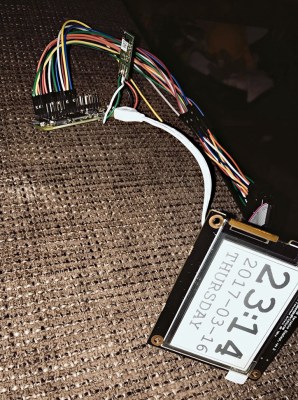
[Jannis Hermanns] couldn’t find a reason to control this outburst of nostalgia for the good old days of small, expensive computers and long hours spent clawing through the LEGO bin to find The Perfect Piece to finish a build. It turns out that the computer part of this replica was the easy part — it’s just an e-paper display driven by a Raspberry Pi Zero. Building the case was another matter, though.



After a parti-colored prototype with whatever bricks he had on hand, a session of LEGO Digital Designer led him to just the right combination of bricks to build an accurate case, almost. It turns out that the stock selection of bricks in LDD won’t allow for the proper proportions for the case, so he ordered the all-white bricks and busted out the Dremel. LEGO purists may want to avert their eyes from the ABS gore within, but in the end the case worked out and the whole build looks great.

Fancy a full-size Mac Classic reboot? How about this iPad docking station? Or if tiny and nostalgic is really your thing, this retro-future terminal build is pretty keen too.

[via r/raspberry_pi]

LEGO Liquid Handler And Big Biology

A career as a lab biologist can take many forms, but the general public seems to see it as a lone, lab-coated researcher sitting at a bench, setting up a series of in vitro experiments by hand in small tubes or streaking out a little yeast on an agar plate. That’s not inaccurate at all – all of us lab rats have done time with a manual pipettor while trying to keep track of which tube in the ice bucket gets which solution. It’s tedious stuff.

But because biology experiments generally scale well, and because more data often leads to better conclusions, life science processes can quickly grow beyond what can be handled manually. I’ve seen this time and again in my 25 years in science, from my crude grad school attempts to miniaturize my assays and automate data collection to the multi-million dollar robotic systems I built in my career in the pharmaceutical industry. Biology can get pretty big in a hurry. Continue reading “LEGO Liquid Handler And Big Biology”

Microfluidic LEGO Bricks

Years ago, prototyping microfluidic systems was a long, time-intensive task. With inspiration from DIY PCB fabrication techniques, that time is now greatly reduced. However, even with the improvements, it still takes a full day to go from an idea to a tangible implementation. However, progress creeps in this petty pace from day to day, and in accordance, a group of researchers have found a way to use 3D printed molds to create microfluidic LEGO bricks that make microfluidic prototyping child’s play.

For the uninitiated, microfluidics is the study and manipulation of very small volumes of water, usually a millionth of a liter and smaller (nL-pL). Interestingly, the behavior of fluids at small scales differs greatly from its larger scale brethren in many key ways. This difference is due to the larger role surface tension, energy dissipation, and fluidic resistance play when distances and volumes are minimized.

By using 3D printed molds to create microfluidic bricks that fit together like LEGOs, the researchers hope to facilitate medical research. Even though much research relies on precise manipulation of minuscule amounts of liquid, most researchers pipette by hand (or occasionally by robot), introducing a high level of human error. Additionally, rather than needing multiple expensive micropipettes, a DIY biohacker only needs PDMS (a silicon-based chemical already used microfluidics) and 3D printed molds to get started in prototyping biological circuits. However, if you prefer a more, ahem, fluid solution, we’ve got you covered.

[via Adafruit]

Self-lacing LEGO shoe

Self-Lacing LEGO Power Shoe

Here’s a blast from the past, or future, reminiscent of the self-lacing shoes from Back to the Future Part II. [Vimal Patel] made his own self-lacing shoe using LEGO “bolted” to the shoe’s sole. We think these are cooler than the movie version since we get to see the mechanism in action, urging it on as the motor gets loaded down pulling the laces for that last little bit of tightness.

The electronics are all LEGO’s Power Functions parts. A Dremel was used to make holes in the soles to hot glue LEGO pieces for four attachment points. The attachment points are permanent but the rest can be easily removed. In case you want to look them up or make your own, he’s using the using the 8878 rechargeable LiPo battery box, the 88003 L-motor, the 8884 IR receiver, and the 8885 IR remote control. That’s right, these shoes are laced up under command of an IR remote control, well, provided the battery box is powered on. There’s a 1:24 worm gear reduction to get the needed torque.

This was a quick build for [Patel], done over two afternoons. He initially tried with the winding axle behind the heel but that didn’t work well so he moved the axle adjacent to the laces instead, which works great as you can see in the video after the break.

Continue reading “Self-Lacing LEGO Power Shoe”

Lego Boosts Their Robotic Offering

Kids often have their first exposure to robots in school using Lego Mindstorm kits. Now Lego is rolling out Boost — a robotic kit targeting all Lego builders from 7 years old and up. The kit is scheduled to be on the market later this year (it appeared at the recent CES) and will sell for about $160.

[The Brothers Brick] had a chance to try the kit out at CES (see the video below) and you might find their review interesting. The kit provides parts and instructions to build five different models: a cat, a robot, a guitar, a 3D printer, and a tracked vehicle. You can check out the official page, too.

Continue reading “Lego Boosts Their Robotic Offering”

LEGO Strain Wave Gear Is Easy On The Eyes

We are continually amazed by the things people do with LEGO and Technics, especially those that require incredible engineering skill. There’s an entire community based around building Great Ball Contraptions, which are LEGO Rube Goldberg machines that move tiny basketballs and soccer balls from one place to another. Except for a few rules about the input and output, the GBC horizons are boundless.

Famed GBC creator [Akiyuki] recently built a GBC module that’s designed to show the movement of strain wave gear systems. These types of gear systems are used in industrial applications where precision is vital. Strain wave gears are capable of reducing gear ratios in a small footprint.

Continue reading “LEGO Strain Wave Gear Is Easy On The Eyes”

Laser Cut LEGO In MDF

It’s hard not to be a fan of LEGO. The humble plastic bricks from Denmark enabled many a young engineer to bring their architectural and mechanical fantasies to life. But one limitation was that you were stuck using the bricks LEGO designed. Thankfully, [John Sokol] has come up with a way to laser cut his own LEGO-compatible bricks, and provided the tools so you can do the same.

After hacking an OpenSCAD script to generate just the top pins of the block, [John] exported an SVG into Inkscape so that he could scale the pins properly before exporting a final PNG for the lasercutter. Using RDWorks, [John] was able to find an engraving setting that worked well with dry-erase whiteboard MDF — an unusual material for a brick, but functional nonetheless. The key here is that the engraving setting takes away just enough material to create a raised pin on the part, without cutting all the way through the MDF or burning the surface.

Despite some damage when removing the work piece from the laser cutter, the part mates up well with the official LEGO brand parts. We’d be interested to see how the MDF cut parts hold up over time compared to real LEGO bricks made in ABS, which seem to last forever.

This isn’t the first make-your-own-LEGO hack we’ve seen – maybe you’d like to 3D print your own bricks on a printer made of LEGO?