Digital Tuner Reverse Engineering

hvr-1600-i2c-sniffing

Hackaday alum [Ian Lesnet] tipped us off about some reverse engineering of the HVR-1600, an analog and digital television encoder/tuner. The project was spawned when [Devin] noticed his Hauppauge HVR-1600 didn’t tune channels in Linux quite as well as it did in Windows. He had a hunch this was due to improper initialization settings for either the tuner chip or the demodulator.

To fix this he used two test points on the board to tap into the I2C bus. Using a logic analyzer he captured the command traffic from the bus while running Linux, then while running Windows. By filtering the results with a bit of Perl, and comparing them by using diff, he tracks down and finds the variation in the commands being sent by the two drivers. After a bit of poking around in the Linux source and making the necessary changes, he improved the tuning ability of the Linux package.

[Devin’s] work looks simple enough, and it is. The difficult part of this process is being smart enough to know what you’re looking for, and what you’ve got once you’ve found it.

Head-mounted Computer With Linux, WiFi

hmdlinux

Most wearable computers we’ve seen feature a head-mounted display tethered to a small PC system in a backpack or worn on a belt. Here’s a slick little system that does away with the cord, fitting the entire system in the glasses.

[Pascal Brisset’s] WXHMD is based on the tiny Gumstix Overo Fire computer-on-module which features a beefy, 3D-capable OMAP processor that runs Linux. The Gumstix is interfaced with a Vuzix VR920 head-mounted display that includes a three-axis accelerometer and compass. Tying these together is a custom video digital-to-analog converter board of [Pascal’s] own design, created using direct-to-PCB inkjet printing techniques. For less than $1,000 total in parts, the result is a spatially aware six ounce computer, with display and battery and all, that fits neatly over the bridge of one’s nose.

It’s a fantastic hack and a nicely documented project, though even the device’s creator himself questions whether having a pair of microwave transceivers and a LiPo battery strapped directly over one’s eyes and brain is such a good idea.

[thanks w3pt]

10gui: Multi-touch For All Ten Digits

10gui-multitouch-for-10-digits

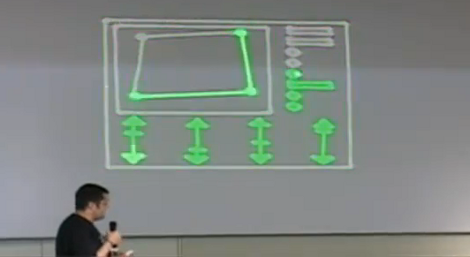
The race for the next revolutionary input design is an ongoing event. [Clayton Miller’s] newest offering in the contest is a multitouch concept that separates the display from the screen and is meant to utilize all fingers. His video explanation includes a description of the physical input device, a software implementation, and a demonstration of how a finished system will work. After the break we’ll look at the hardware, the software, and the concept video. Continue reading “10gui: Multi-touch For All Ten Digits”

Hulu Desktop For Linux . . . Finally

hulu

The folks over at Hulu Labs have been busy it seems, as they have just released a version of their desktop client for Linux. Windows and OSX versions of the desktop client have been out for some time now, but Linux has been left in the dark. Functionality wise, it operates and plays videos identically to its counterparts. The Linux version can also be controlled via an IR remote. We certainly are excited to add this to our entertainment systems. The release is a bit of a surprise, but a welcome change to the usual treatment of Linux, and it’s nice to see the mainstream start to recognize it. Plus, this is just more ammunition for getting rid of those monthly cable/satellite subscriptions.

Microsoft Unveils Open Source Multi Core OS

group (Custom)

A new operating system, code named Barrelfish is being developed by Microsoft research labs and ETH Zurich in Switzerland. This operating system is being built with multi core operations foremost in priority. It is supposed to be extremely scalable and able to function on a very wide range of hardware. You can download the current snapshot of it on their site and dig into the source code, released under a 3-clause BSD style license. If you would like to learn the primary differences between this OS and Windows or Linux, you can read this PDF.

[via Engadget]

With Zipit, Who Needs A Netbook?

[youtube=http://www.youtube.com/watch?v=x_LrI2g2VT8]

[Hunter Davis] keeps rolling out the hacks for the Zipit. In the past he showed us how to run DOSbox, and then how to get NES emulation working on this tiny device. Now he’s got Linux kernel 2.6.29 running Fluxbox with mouse (newly added), audio, and WiFi functionality. Follow his step-by-step flashing instructions to load the kernel into the Zipit. Once flashed, a partitioned microSD card servers as the filesystem and swap.

Who needs a 10.1 inch screen or an Atom processor when you can get this 2.8″ QVGA beauty with an XScale processor for around $40?

[Thanks Matt]

Toilet And Figlet

toilet_and_figlet

We thought [Kristofer’s] Tech Tip about using figlet with scripts was kind of fun. It’s a throwback to the days of logging onto a BBS and being greeted by a vertically scrolling ASCII art image that had been meticulously hand crafted (although a lot of the coolest stuff was actually ANSI art). No hand crafting here, just feed (or pipe) your text to figlet and it outputs the message in ASCII style letters.

When we went to try install this in Ubuntu, the toilet package was suggested. This one’s worth checking out too. It works in much the same way as figlet but uses extended characters and has a lot more color and font settings:

hackaday_toilet

Give these packages a try and make character art cool again!