Mining And Refining: Cobalt, The Unfortunately Necessary Metal

The story of humankind is largely a tale of conflict, often brought about by the uneven distribution of resources. For as long as we’ve been down out of the trees, and probably considerably before that too, our ancestors have been struggling to get what they need to survive, as often as not at the expense of another, more fortunate tribe. Food, water, land, it doesn’t matter; if They have it and We don’t, chances are good that there’s going to be a fight.

Few resources are as unevenly distributed across our planet as cobalt is. The metal makes up only a fraction of a percent of the Earth’s crust, and commercially significant concentrations are few and far between, enough so that those who have some often end up at odds with those who need it. And need it we do; what started in antiquity as mainly a rich blue pigment for glass and ceramics has become essential for important industrial alloys, high-power magnets, and the anodes of lithium batteries, among other uses.

Getting access to our limited supply of cobalt and refining it into a useful metal isn’t a trivial process, and unfortunately its outsized importance to technological society forces it into a geopolitical role that has done a lot to add to human misery. Luckily, market forces and new technology are making once-marginal sources viable, which just may help us get the cobalt we need without all the conflict.

Continue reading “Mining And Refining: Cobalt, The Unfortunately Necessary Metal”

Mining And Refining: Lithium, Powering The Future With Brine

Many years ago, I read an article about the new hotness: lithium batteries. The author opened with what he no doubt thought was a clever pop culture reference by saying that the mere mention of lithium would “strike fear in the hearts of Klingons.” It was a weak reference to the fictional “dilithium crystals” of Star Trek fame, and even then I found it a bit cheesy, but I guess he had to lead with something.

Decades later, a deeper understanding of the lore makes it clear that a Klingon’s only fear is death with dishonor, but there is a species here on earth that lives in dread of lithium: CEOs of electric vehicle manufacturing concerns. For them, it’s not the presence of lithium that strikes fear, but the relative absence of it; while it’s the 25th most abundant element in the Earth’s crust, and gigatons are dissolved into the oceans of the world, lithium is very reactive and thus tends to be diffuse, making it difficult to obtain concentrated in the quantities their businesses depend on.

As the electric vehicle and renewable energy markets continue to grow, the need for lithium to manufacture batteries will grow with it, potentially to the point where demand outstrips the mining industry’s production capability. To understand how that imbalance may be possible, we’ll take a look at how lithium is currently mined, as well as examine some new mining techniques that may help fill the coming lithium gap.

Continue reading “Mining And Refining: Lithium, Powering The Future With Brine”

Lithium: What Is It And Do We Have Enough?

Lithium (from Greek lithos or stone) is a silvery-white alkali metal that is the lightest solid element. Just one atomic step up from Helium, this magic metal seems to be in everything these days. In addition to forming the backbone of many kinds of batteries, it also is used in lubricants, mood-stabilizing drugs, and serves as an important additive in iron, steel, and aluminum production. Increasingly, the world is looking to store more and more power as phones, solar grids, and electric cars continue to rise in popularity, each equipped with lithium-based batteries. This translates to an ever-growing need for more lithium. So far production has struggled to keep pace with demand. This leads to the question, do we have enough lithium for everyone?

It takes around 138 lbs (63 kg) of 99.5% pure lithium to make a 70 kWh Tesla Model S battery pack. In 2016, OICA estimated that the world had 1.3 billion cars in use. If we replace every car with an electric version, we would need 179 billion pounds or 89.5 million tons (81 million tonnes) of lithium. That’s just the cars. That doesn’t include smartphones, laptops, home power systems, massive grid storage projects, and thousands of other products that use lithium batteries.

In 2019 the US Geological Survey estimated the world reserves of identified lithium was 17 million tonnes. Including the unidentified, the estimated total worldwide lithium was 62 million tonnes. While neither of these estimates is at that 89 million ton mark, why is there such a large gap between the identified and estimated total? And given the general rule of thumb that the lighter a nucleus is, the more abundant the element is, shouldn’t there be more lithium reserves? After all, the US Geological Survey estimates there are around 2.1 billion tonnes of identified copper and an additional 3.5 billion tonnes that have yet to be discovered. Why is there a factor of 100x separating these two elements?

Continue reading “Lithium: What Is It And Do We Have Enough?”

Turn Off Those Batteries With Their Protection Chip

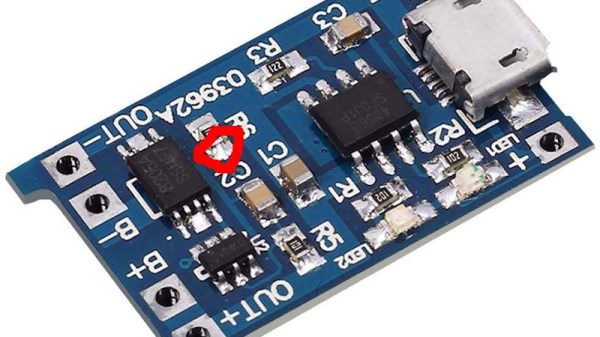
It should be a feature of every device powered by a lithium-ion battery, that it has a protection chip on board that automatically disconnects it should it go out of its safe voltage range. A chip most often used for this purpose in single-cell applications is the Fortune Semiconductor DW01, and [Oliver] shares a tip for using this chip to power down the battery. The DW01 has a CS, or current sense pin, which if taken high momentarily will put the chip into an off state until the battery is disconnected.

Looking at the DW01 datasheet we can see that this would work, but we can’t help having a few questions. The CS pin is a safety sensor pin, providing over current, short circuit, and reverse polarity detection. It’s the kind of pin one might mess with only when one is absolutely certain it’s not likely to trigger a dangerous fault condition, so a bit of care should be required. However, we can see that leaving its resistor in place and supplying it a momentary logic level through another resistor should work. We’d be interested in the views of any readers with more experience in the world of lithium battery protection on this hack.

Meanwhile, a good read for any reader should be our look last year at lithium-ion safety.

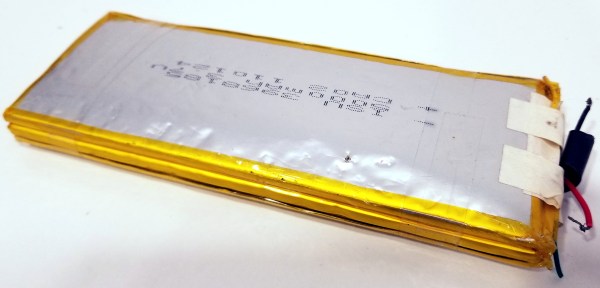
pierced puffed exposed leads lithium ion battery

Lessons In Li-Ion Safety

If you came here from an internet search because your battery just blew up and you don’t know how to put out the fire, then use a regular fire extinguisher if it’s plugged in to an outlet, or a fire extinguisher or water if it is not plugged in. Get out if there is a lot of smoke. For everyone else, keep reading.

I recently developed a product that used three 18650 cells. This battery pack had its own overvoltage, undervoltage, and overcurrent protection circuitry. On top of that my design incorporated a PTC fuse, and on top of that I had a current sensing circuit monitored by the microcontroller that controlled the board. When it comes to Li-Ion batteries, you don’t want to mess around. They pack a lot of energy, and if something goes wrong, they can experience thermal runaway, which is another word for blowing up and spreading fire and toxic gasses all over. So how do you take care of them, and what do you do when things go poorly?

Continue reading “Lessons In Li-Ion Safety”

Better Battery Management Through Chemistry

The lead-acid rechargeable battery is a not-quite-modern marvel. Super reliable and easy to use, charging it is just a matter of applying a fixed voltage to it and waiting a while; eventually the battery is charged and stays topped off, and that’s it. Their ease is countered by their size, weight, energy density, and toxic materials.

The lithium battery is the new hotness, but their high energy density means a pretty small package that can get very angry and dangerous when mishandled. Academics have been searching for safer batteries, better charge management systems, and longer lasting battery formulations that can be recharged thousands of times, and a recent publication is generating a lot of excitement about it.

Consider the requirements for a battery cell in an electric car:

  • High energy density (Lots of power stored in a small size)
  • Quick charge ability
  • High discharge ability
  • MANY recharge cycles
  • Low self-discharge
  • Safe

Lithium ion batteries are the best option we have right now, but there are a variety of Li-ion chemistries, and depending on the expected use and balancing and charging, different chemistries can be optimized for different performance characteristics. There’s no perfect battery yet, and conflicting requirements mean that the battery market will likely always have some options.

Continue reading “Better Battery Management Through Chemistry”

Electric Drift Trike Needs Water Cooling

Electric vehicles of all types are quickly hitting the market as people realize how inexpensive they can be to operate compared to traditional modes of transportation. From cars and trucks, to smaller vehicles such as bicycles and even electric boats, there’s a lot to be said for simplicity, ease of use, and efficiency. But sometimes we need a little bit more out of our electric vehicles than the obvious benefits they come with. Enter the electric drift trike, an electric vehicle built solely for the enjoyment of high torque electric motors.

This tricycle is built with some serious power behind it. [austiwawa] constructed his own 48V 18Ah battery with lithium ion cells and initially put a hub motor on the front wheel of the trike. When commenters complained that he could do better, he scrapped the front hub motor for a 1500W brushless water-cooled DC motor driving the rear wheels. To put that in perspective, electric bikes in Europe are typically capped at 250W and in the US at 750W. With that much power available, this trike can do some serious drifting, and has a top speed of nearly 50 kph. [austiwawa] did blow out a large number of motor controllers, but was finally able to obtain a beefier one which could handle the intense power requirements of this tricycle.

Be sure to check out the video below to see the trike being test driven. The build video is also worth a view for the attention to detail and high quality of this build. If you want to build your own but don’t want to build something this menacing, we have also seen electric bikes that are small enough to ride down hallways in various buildings, but still fast enough to retain an appropriate level of danger.

Continue reading “Electric Drift Trike Needs Water Cooling”