FAT Support For Any Microcontroller

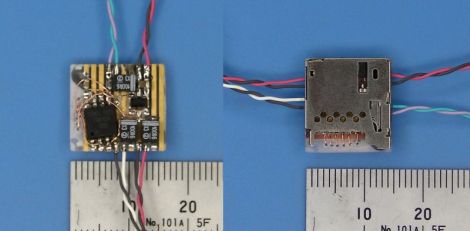
[Rahul Sapre] sent us a guide to porting EFSL to any microcontroller (PDF). The Embedded Filesystems Library adds FAT support to C compiled microcontrollers. It is targeted at the AVR line of chips but can be adapted to any architecture that works with a C compiler. [Rahul’s] guide will take you through the process of adapting the latest stable 0.2.8 version to new hardware by using a PIC uC as the working example. The non-stable development branch of EFSL is working toward multiple-platform support so consider lending a hand if this interests you.

STM8S-Discovery: Microcontrollers Reach A New Low

A complete microcontroller development kit for little more than the cost of a bare chip? That’s what STMicroelectronics is promising with their STM8S-Discoveryseven dollars gets you not only a board-mounted 8-bit microcontroller with an decent range of GPIO pins and functions, but the USB programmer/debugger as well.

The STM8S microcontroller is in a similar class as the ATmega328 chip on latest-generation Arduinos: an 8-bit 16 MHz core, 32K flash and 2K RAM, UART, SPI, I2C, 10-bit analog-to-digital inputs, timers and interrupts and all the usual goodness. The Discovery board features a small prototyping area and throws in a touch-sense button for fun as well. The ST-LINK USB programmer/debugger comes attached, but it’s easy to crack one off and use this for future STMicro-compatible projects; clearly a plan of giving away the razor and selling the blades.

The development tools are for Windows only, and novice programmers won’t get the same touchy-feely community of support that surrounds Arduino. But for cost-conscious hackers and for educators needing to equip a whole classroom (or if you’re just looking for a stocking stuffer for your geeky nephew), it’s hard to argue with seven bucks for a full plug-and-play setup.

[thanks Billy]

Review: Mbed NXP LPC1768 Microcontroller

mbed is a next-generation 32-bit microcontroller platform. It’s a prototyping and teaching tool somewhat along the lines of Arduino. On steroids. With claws and fangs. Other contenders in this class include the MAKE Controller, STM32 Primer and Primer 2, Freescale Tower, and Microchip’s PIC32 Starter Kit. The mbed hardware has a number of advantages (and a few disadvantages) compared to these other platforms, but what really sets it apart is the development environment: the entire system — editor, compiler, libraries and reference materials — are completely web-based. There is no software to install or maintain on the host system.
Continue reading “Review: Mbed NXP LPC1768 Microcontroller”

CNC Hot Wire Cutter From Scanners

hot-wire-cutter-from-scanners

[Raul] built a CNC hot wire cutter that he uses for cutting shapes out of foam. His device uses two flat bed scanners to provide two planes of motion. One scanner arm has the foam mounted on it and provides the Y-axis movement. The other scanner has the hot wire mounted on it and provides the X-axis movement. The cutting wire is mounted on a flexed bow made from heavy gauge coat hanger wire.

He tapped into the logic board of one scanner to gain access to the motor movements. The other is connected through a couple of H-bridges. Both are controlled by an Atmel AVR ATmega128 which in turn takes its commands from a connection with a computer printer port. A python program uses vector graphic files in SVG format and traces the outline for cutting.

We’ve got a video of this in action after the break. At our request, [Raul] took some time to post a set of pictures and make comments on them. Thanks for the hard work and great job! Continue reading “CNC Hot Wire Cutter From Scanners”

Snega2usb Preorder Now Available

[youtube=http://www.youtube.com/watch?v=ySs4cRVzPAY]

We’ve been watching the development of the snega2usb since it’s debut on Hackaday. Now it’s grown up and is ready to be manufactured. In the low quality video above [Matthias] shows some of the latest high quality additions to the board. It now has a case, shiny new firmware,  production made PCB, and game pad ports.  The snega2usb is shipping this December for those who preorder now.

Connect A PS/2 Keyboard To A Microcontroller

[youtube=http://www.youtube.com/watch?v=vfIiLE0BhE8]

The guys at Nerdkits have put together this tutorial on connecting a PS/2 keyboard to a microcontroller. Though this tutorial is written for one of the kits they sell, you should be able to apply this to pretty much any microcontroller. It is also a lesson in using interrupts instead of polling. They have several pre built examples ready to download as well as source code for the basic setup.

[via HackedGadgets]

Tool Tip: Microcontroller Timer Calculator

uC_timer_calculator

In life and embedded systems timing is everything. Give [Frank’s] web-based timer calculator a try. Set your system clock resolution (in hertz making sure you account for any system clock divider), select your timer resolution and prescaler, then calculate based on desired ticks, overflows, or real time. He’s built this with the AVR chips in mind but it should be handy for any family of microcontrollers.

Of course none of this is rocket science, but if you’re trying to use one timer for two differently synchronized events this can save you a lot of trial and error time.