Burn Music On To Anything!

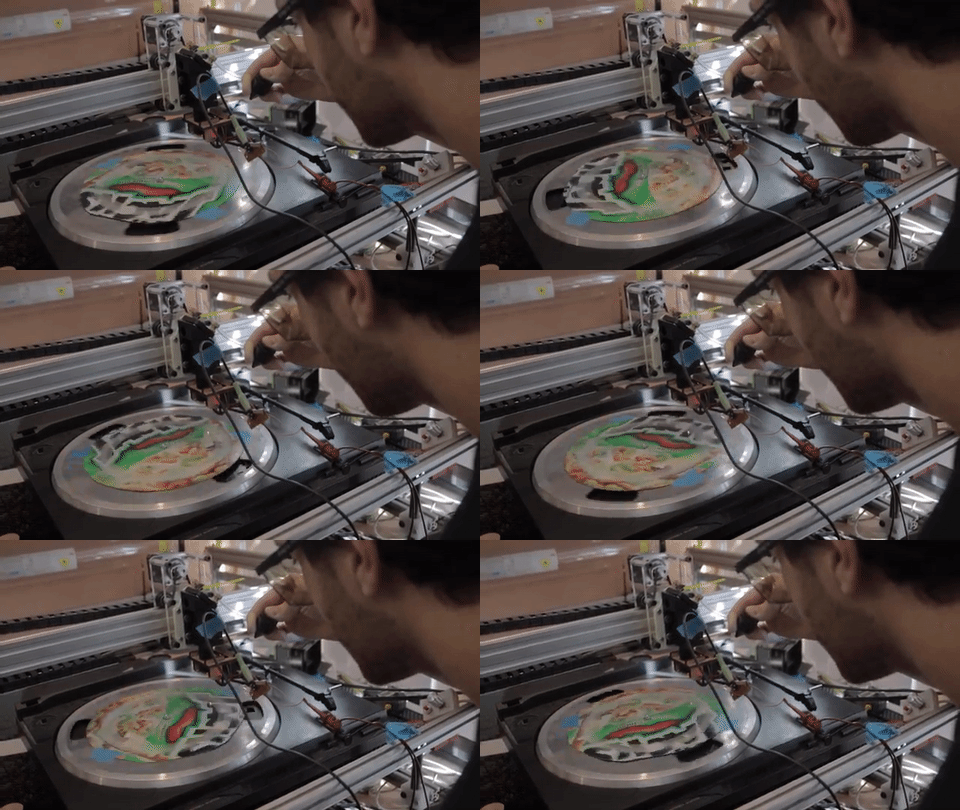
If at first you don’t succeed, try, try, and try again. This is especially true when your efforts involve a salvaged record player, a laser cutter, and He-Man. Taking that advice to heart, maniac maker extraordinaire [William Osman] managed to literally burn music onto a CD.

Considering the viability of laser-cut records is dubious — especially when jerry-built — it took a couple frustrating tests to finally see results, all the while risking his laser’s lens. Eventually, [Osman]’s perseverance paid off. The lens is loosely held by a piece of delrin, which is itself touching a speaker blaring music. The vibrations of the speaker cause the lens to oscillate the focal point of the laser into a wavelength that is able to be played on a record player. You don’t get much of the high-end on the audio and the static almost drowns out the music, but it is most definitely a really shoddy record of a song!

Vinyl aficionados are certainly pulling their hair out at this point. For the rest of us, if you read [Jenny’s] primer on record players you’ll recognize that a preamplifier (the ‘phono’ input on your amp) is what’s missing from this setup and would surely yield more audible results.

Continue reading “Burn Music On To Anything!”

Annoy Your Neighbors With MIDI Musical Siren

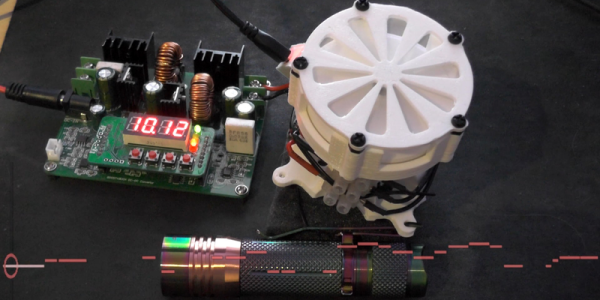
[Yannick], aka [Gigawipf] brings us this (mostly) musical delicacy: a 3D-printed siren that’s driven by a brushless quadcopter motor, and capable of playing (mostly) any music that you’ve got the MIDI score for. This is a fantastic quickie project for any of you out there with a busted quad, or even some spare parts, and a 3D printer. Despite the apparent level of difficulty, this would actually be a great quickie weekend build.

Continue reading “Annoy Your Neighbors With MIDI Musical Siren”

Ardu McDuino Plays The Bagpipes

To “pipe in” the new year, [John] decided to build a bagpipe-playing robot. Unlike other instrument-playing robots that we’ve seen before, this one is somewhat anatomically correct as well. John went the extra mile and 3D printed fingers and hands to play his set of pipes.

The brains of the robot are handled by an Arduino Mega 2560, which drives a set of solenoids through a driver board. The hands themselves are printed from the open source Enabling the Future project which is an organization that 3D prints prosthetic hands for matched recipients, especially people who can’t otherwise afford prosthetics. He had to scale up his hands by 171% to get them to play the pipes correctly, but from there it was a fairly straightforward matter of providing air to the bag (via a human being) and programming the Arduino to play a few songs.

The bagpipe isn’t a particularly common instrument (at least in parts of the world that aren’t Scottish) so it’s interesting to see a robot built to play one. Of course, your music-playing robot might be able to make music with something that’s not generally considered a musical instrument at all. And if none of these suit your needs, you can always build your own purpose-built semi-robotic instrument as well.

Continue reading “Ardu McDuino Plays The Bagpipes”

MIDI DAC For Vintage Synth Hacks

A lot of classic synthesizers rely on analog control voltages to vary parameters; this is a problem for the modern musician who may want to integrate such hardware with a MIDI setup. For just this problem, [little-scale] has built a MIDI-controllable DAC for generating control voltages.

It’s a simple enough build – a Teensy 2 is used to speak USB MIDI to a laptop. This allows the DAC to be used with just about any modern MIDI capable software. The Teensy then controls a Microchip MCP4922 over SPI to generate the requisite control voltages. [little-scale]’s video covers the basic assembly of the hardware on a breadboard, and goes on to demonstrate its use with a performance using the MIDI DAC to control a Moog Mother 32 synth. [little-scale] has also made the code available, making it easy to spin up your own.

We can see this project being indispensable to electronic musicians working with banks of modular synths, making it much easier to tie them in with automation in their DAW of choice. This isn’t the first MIDI interfacing hack we’ve seen either – check out this setup to interface an iPad to guitar pedals.

Continue reading “MIDI DAC For Vintage Synth Hacks”

Mechano-Robotic Flute Made From An Old Shotgun

If you take an object and turn it into something else, does that constitute a hack?  Can a musical robot call to question the ethics of firearms exports? If you take a disabled shotgun and turn it into a flute, does it become an art piece? Deep questions indeed — and deliberately posed by [Constantine Zlatev] along with his collaborators [Kostadin Ilov] and [Velina Ruseva].

The Last Gun — a mechano-robotic flute, as [Zlatev] calls it — is built from recovered industrial parts, played using compressed air, and controlled by an Arduino and Raspberry Pi. After graphing the annual arms exports from the United States, the installation plays a mournful tune for each year that they rise, and a jubilant theme for each year they fall.

Continue reading “Mechano-Robotic Flute Made From An Old Shotgun”

Maglev Drummer Needs To Be Seen And Heard

Sometimes Hackaday runs in closed-loop mode: one hacker makes something, we post it, another hacker sees it and makes something else, and we post it, spiraling upward to cooler and cooler hacks. This is one of those times.

One of our favorite junk-sound-artists and musical magicians, [Gijs Gieskes], made this magnetic-levitation, rubber-band, percussive zither thing after seeing our coverage of another magnetic levitation trick. Both of them simply have a Hall sensor controlling a coil, which suspends a magnet in mid-air. It’s a dead-simple circuit that we’ll probably try out as soon as we stop typing.

But [Gijs] took the idea and ran with it. What looks like a paperclip dangles off the magnets, and flails wildly around with its tiny steel arms. These hit a zither made of rubber bands with a bamboo skewer as a bridge, pressing down on a piezo. The rest is cardboard, copper-clad, and some ingenuity. Watch it work in the video embedded below.

Continue reading “Maglev Drummer Needs To Be Seen And Heard”

The Nest: Album Release Hidden In A Rock

First there were vinyl records, then came cassettes, CDs, those failed audio-on-DVD formats, and then downloads. To quote the band, [Bateleur], “you can’t pay someone to take a CD these days.” So how do you release your new album? By hiding a Raspberry Pi in a semi-transparent fake rock on a mountainous cliff, and requiring a secret whistle to enable it, naturally.

Once activated, you’ll be able to plug into the USB port and download the album, or sit there on a remote hillside cliff overlooking the ocean and enjoy the new tunes. Because there’s a headphone jack in the rock, naturally. Besides being a cool hack, we think that putting people in the right physical and mental space for a serious listening is brilliant. Watch the video embedded below for an idea of the making of and a view from the site.

Continue reading “The Nest: Album Release Hidden In A Rock”