Retrotechtacular: Oh Boy! We’re Radio Engineers!

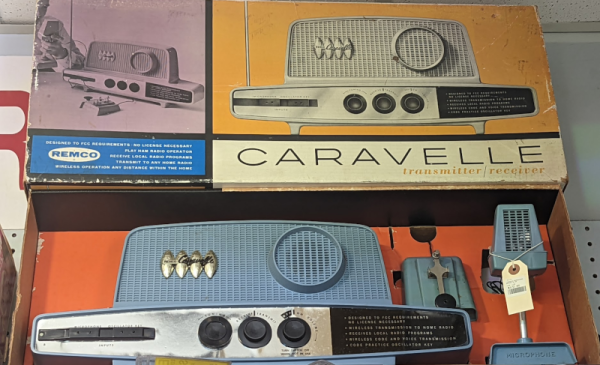
It is a shame that there are fewer and fewer “nerd stores” around. Fry’s is gone. Radio Shack is gone. But the best ones were always the places that had junk. Silicon valley was great for these places, but they were everywhere. Often, they made their money selling parts to the repair trade, but they had a section for people like us. There’s still one of these stores in the Houston, Texas area. One of the two original Electronic Parts Outlets, or EPO. Walking through there is like a museum of old gear and parts and I am not ashamed to confess I sometimes drive the hour from my house just to wander its aisles, needing to buy absolutely nothing. It was on one of those trips that I spied something I hadn’t noticed before. A Remco Caravelle transmitter/receiver.

The box was clearly old and the styling of the radio was decidedly retro. You can tell it wasn’t catering to the modern market because it mentions: “play ham radio operator” which would surely mystify most of today’s kids. The unit was an AM receiver and a transmitter, complete with a morse code key and microphone. You can see a contemporary commercial for a similar unit from Remco, in the video below.

Continue reading “Retrotechtacular: Oh Boy! We’re Radio Engineers!”

2022 Hackaday Prize: Boondock Echo Connects Your Radios With The Cloud

[Mark J Hughes] volunteers as a part of a local community fire watch which coordinates by radio. The La Habra Heights region of Los Angeles is an area of peaks and valleys, which makes direct radio connections challenging. Repeaters work well for range improvement, but in such areas, there is no good place to locate these. [Mark] says that during an emergency (such as a wildfire) the radio usage explodes, with him regularly tracking as many as eight radio frequencies and trying to make sense of it, whilst working out how to send the information on and to whom.

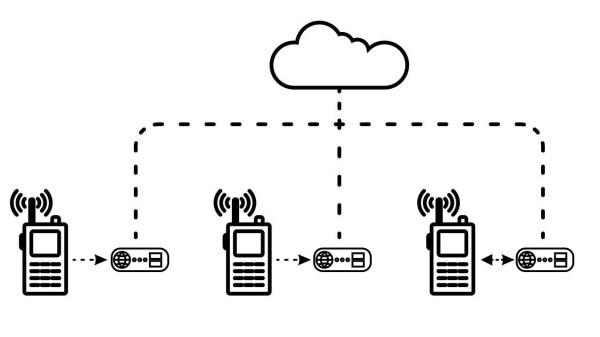
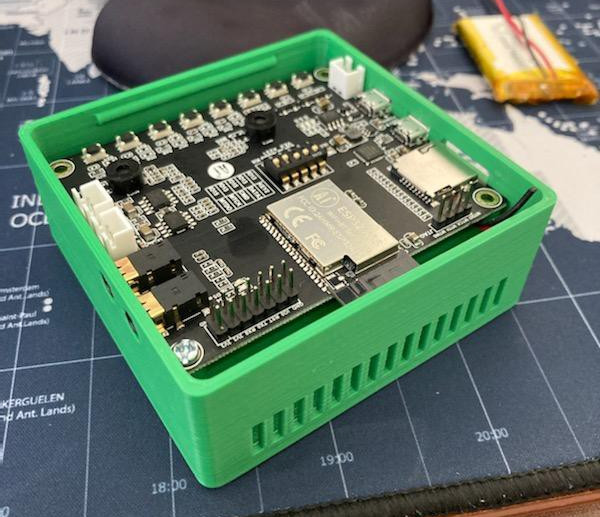
This led him together with collaborator [Kaushlesh Chandel] to create Project Boondock Echo, to help alleviate some of the stress of it all. The concept is to use a cheap Baofeng radio to feed into a gateway based around an ESP32 audio development kit. Mount this in a box with a LiPo based power supply, and you’ve got yourself a movable radio-to-cloud time-shift audio recorder.

By placing one or more of these units in the properties of several of the community group radio operators, all messages can be captured to an audio file, tagged with the radio frequency and time of transmission, and uploaded to a central server. From there they can be retrieved by anybody with access, no matter the physical location, only an internet connection is needed.

The next trick that can be performed, is to reverse the process and queue up previous recordings, and send it back over the cloud to remote locations for re-transmission via radio into the field. This is obviously a massive asset, because wherever there is some urbanization, there is likely an internet connection. With the addition of a Boondock Echo unit, anyone that has a receiver within a few miles can be fully connected with what’s going on outside the range of direct radio communications.

Source for the ESP32’s firmware as well as the web side of things can found on the project Boondock Echo GitHub, complete with some STLs for a 3D printed box to sit it in. Like always, there’s more than one way to solve a particular problem. Here’s an amateur radio repeater based using an RTL-SDR and a Raspberry Pi.

Reverse Engineering A Phased Array System Reveals Surprising Details

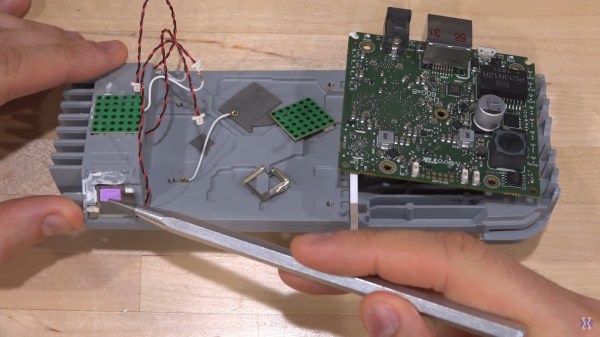
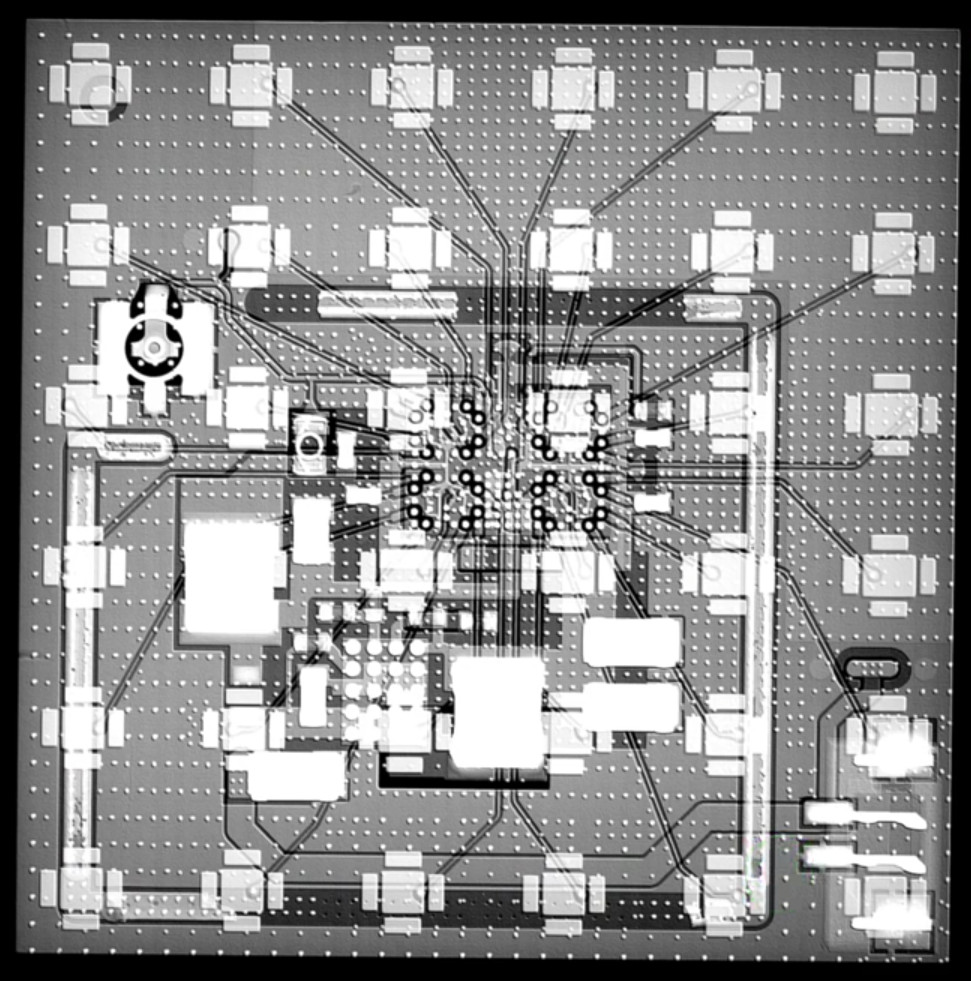
The term “phased array” has been around for a long time, but in recent years we’ve heard more and more about the beam shaping that’s possible with phased array antennae. In the video below the break, [The Signal Path] breaks down a Qualcomm 60GHz WiGig unit, and does a deep dive, even looking at the bare silicon and an x-ray of an antenna.

An X-Ray of the antenna shows the intricate design

Some fascinating highlights include how not only the data signal is sent to the antennae through a standard coaxial cable, but so are control signals and a base clock frequency. [The Signal Path] explains how the manufacturer chose to use what’s called a SuperHeterodyne (aka “superhet”) architecture, which is not all that different from those used in traditional amateur radio transceivers. In theory, anyway.

Another element that is discussed is how the PCB’s themselves are used as waveguides, inductors, and transmission line matches, among other countless little hacks to fit a rather complex system into a truly diminutive space.

If you’re not familiar the concept behind phased arrays, check out this article we published in 2019 that shows how phased arrays can steer a beam without any moving parts. It’s quite fascinating!

Continue reading “Reverse Engineering A Phased Array System Reveals Surprising Details”

Bringing Some Discipline To An SDR Transmitter

The proliferation of software-defined radio (SDR) technology has been a godsend for RF hobbyists. SDR-based receivers and transmitters have gotten so cheap that you’ve probably got a stick or two lying around your bench right now — we can see three from where we sit, in fact.

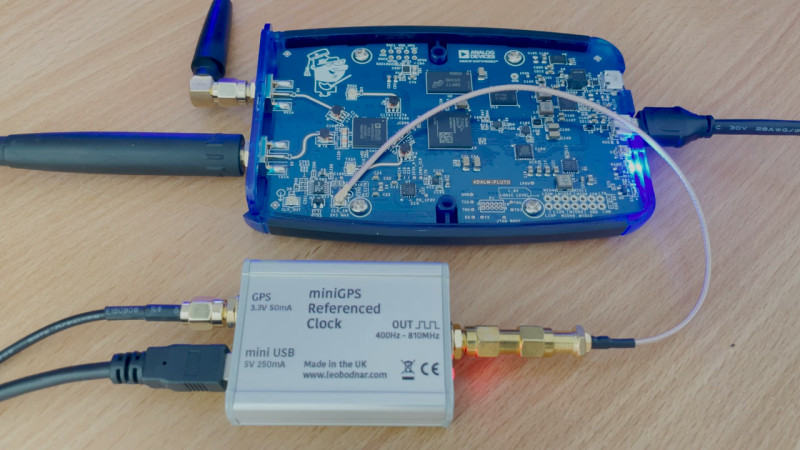
But cheap comes at a price, usually in the form of frequency stability, which can be prohibitive in some applications — especially amateur radio, where spectrum hygiene is of the utmost concern. So we were pleased to see [Tech Minds] tackle the SDR frequency stability problem by using a GPS-disciplined oscillator. The setup uses an ADALM-PLUTO SDR transceiver and a precision oscillator from Leo Bodnar Electronics. The oscillator can be programmed to output a rock-solid, GPS-disciplined signal over a wide range of frequencies. The Pluto has an external oscillator input that looks for 40 MHz, which is well within the range of the GPSDO.

Setup is as easy as plugging the oscillator’s output into the SDR’s external clock input using an SMA to UFL jumper, and tweaking the settings in the SDR and oscillator. Not all SDRs will have an external clock input, of course, so your mileage may vary. But if your gear is suitably equipped, this looks like a great way to get bang-on frequency — the video below shows just how much the undisciplined SDR can drift.

Like any good ham, [Tech Minds] is doing his bit to keep his signals clean and on target. His chief use case for this setup will be to work QO-100, amateur radio’s first geosynchronous satellite repeater. We’ve got to say that we hams living on the two-thirds of the globe not covered by this satellite are just dying to get a geosynchronous bird (or two) of our own to play with like this.

Continue reading “Bringing Some Discipline To An SDR Transmitter”

Pocket Radio Powered By Tiny Microcontroller

Before the days of MP3 players and smartphones, and even before portable CD players, those of us of a certain age remember that our cassette players were about the only way to take music on-the-go. If we were lucky, they also had a built-in radio for when the single tape exhausted both of its sides. Compared to then, it’s much easier to build a portable radio even though cassettes are largely forgotten, as [wagiminator] shows us with this radio design based on an ATtiny.

The build is about as compact as possible, with the aforementioned ATtiny 402/412 as its core, it also makes use of an integrated circuit FM tuner,  an integrated audio amplifier with its own single speaker, and a small OLED display. The unit also boasts its own lithium-polymer battery charger and its user interface consists of only three buttons, plenty for browsing radio stations and controlling volume.

The entire build fits easily in the palm of a hand and is quite capable for a mobile radio, plus all of the schematics and code is available on the project page. While it doesn’t include AM capability, just the fact that FM is this accessible nowadays when a few decades ago it was cutting-edge technology is quite remarkable. If you’re looking for an even smaller FM receiver without some of the bells and whistles of this one, take a look at this project too.

Long-Distance Text Communication With LoRa

Affordable and reliable cell phones have revolutionized the way we communicate over the last two decades or so, and this change was only accelerated by the adoption of the smartphone. This is all well and good if you’re living in a place with cellular infrastructure, but if you’re in more remote areas you’ll have to be a little more inventive. This text-based communications device, for example, lets you send text messages without all of that cumbersome infrastructure.

While [Arthur] didn’t create this project specifically for off-grid use, it’s an interesting project nonetheless. The devices use a physical QWERTY keyboard and a small screen, reminiscent of BlackBerry devices from the late 2000s (partially because they are actually using BlackBerry keyboards). One of the other goals for this project was low power consumption, and between polling the keyboard, the memory LCDs, and receiving and transmitting messages using LoRa, [Arthur] was able to get the current draw down to 12 mA.

Between the relatively common nRF52840 and SX1262 chips, plus the fact that [Arthur] made the schematics available, this makes for an excellent off-grid device for anyone who likes to drive off into the wilderness or lives far enough outside of town that cell phone reception is a concern.

Looking for something a little easier to put together before your upcoming camping trip? This similarly styled LoRa communicator from [MSG] uses off-the-shelf modules to greatly reduce the part count. Another option for off-grid communications is to use existing smartphones paired with a LoRa network like we saw in this project.

Multiband Crystal Radio Set Pulls Out All The Stops

Most crystal radio receivers have a decidedly “field expedient” look to them. Fashioned as they often are from a few turns of wire around an oatmeal container and a safety pin scratching the surface of a razor blade, the whole assembly often does a great impersonation of a pile of trash whose appearance gives little hope of actually working. And yet work they do, usually, pulling radio signals out of thin air as if by magic.

Not all crystal sets take this slapdash approach, of course, and some, like this homebrew multiband crystal receiver, aim for a feature set and fit and finish that goes way beyond the norm. The “Husky” crystal set, as it’s called by its creator [alvenh], looks like it fell through a time warp right from the 1920s. The electronics are based on the Australian “Mystery Set” circuit, with modifications to make the receiver tunable over multiple bands. Rather than the traditional galena crystal and cat’s whisker detector, a pair of1N34A germanium diodes are used as rectifiers — one for demodulating the audio signal, and the other to drive a microammeter to indicate signal strength. A cat’s whisker is included for looks, though, mounted to the black acrylic front panel along with nice chunky knobs and homebrew rotary switches for band selection and antenna.

As nice as the details on the electronics are, it’s the case that really sells this build. Using quarter-sawn oak salvaged from old floorboards. The joinery is beautiful and the hardware is period correct; we especially appreciate the work that went into transforming a common flat washer into a nickel-plated escutcheon for the lock — because every radio needs a lock.

Congratulations to [Alvenh] for pulling off such a wonderful build, and really celebrating the craftsmanship of the early days of radio. Need some crystal radio theory before tackling your build? Check out [Greg Charvat]’s crystal radio deep dive.