24 Hours Of Le Airplanes

There’s no more famous road endurance race than the 24 Hours of Le Mans, where teams compete to see how far they can drive in a single 24-hour window. The race presents unique challenges not found in other types of racing. While RC airplanes may not have a similar race, [Daniel] a.k.a. [rctestflight] created a similar challenge for himself by attempting to fly an RC airplane non-stop for as long as he could, and a whole host of interesting situations cropped up before and during flight.

In order for an RC plane to fly for an entire day, it essentially needs to be solar powered. A large amount of strategy goes into a design of this sort. For one, the wing shape needs to be efficient in flight but not reduce the amount of area available for solar panels. For another, the start time of the flight needs to be balanced against the position of the sun in the sky. With these variables more or less fixed, [Daniel] began his flight.

It started off well enough, with the plane in an autonomous “return to home” mode which allowed it to continually circle overhead without direct human control. But after taking a break to fly it in FPV mode, [Daniel] noticed that the voltage on his battery was extremely high. It turned out that the solar charge controller wasn’t operating as expected and was shunting a large amount of solar energy directly into the battery. He landed and immediately removed the “spicy pillow” to avoid any sort of nonlinear event. With a new battery in the plane he began the flight again.

Even after all of that, [Daniel] still had some issues stemming from the aerodynamic nature of this plane specifically. There were some issues with wind, and with the flight controller not recognizing the correct “home” position, but all in all it seems like a fun day of flying a plane. If your idea of “fun” is sitting around and occasionally looking up for eight and a half hours. For more of [Daniel]’s long-term autonomous piloting, be sure to take a look at his solar tugboat as well.

Continue reading “24 Hours Of Le Airplanes”

Scratch-Built RC Excavator Is A Model Making Tour De Force

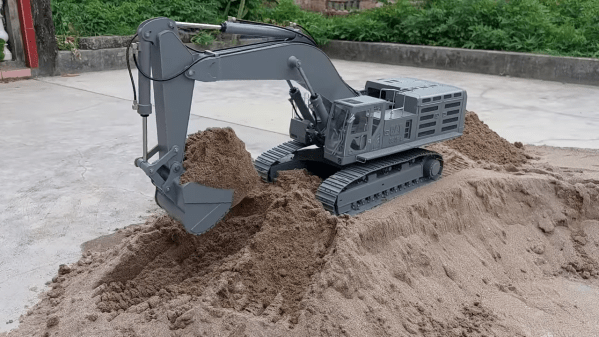
Some projects just take your breath away with their level of attention to detail. This scratch-built RC-controlled model excavator is not only breathtaking in its detail, but also amazing for the materials and tools used to create it.

We’ve got to be honest, we’ve been keeping an eye on the progress [Vang Hà] has been making on this build for a few weeks now. The first video below is a full tour of the finished project, which is painstakingly faithful to the original, a Caterpiller 390F tracked excavator. As impressive as that is, though, you’ve got to check out the build process that starts with fabricating the tracks in the second video below. The raw material for most of the model is plain gray PVC pipe, which is sliced and diced into flat sheets, cut into tiny pieces using a jury-rigged table saw, and heat formed to create curved pieces. Check out the full playlist for a bounty of fabrication delights, like tiny hinges and working latches.

We can’t possibly heap enough praise onto [Vang Hà] for his craftsmanship, but that’s not all we love about this one. There are tons of helpful tips here, and plenty of food for thought for more practical builds. We’re thinking about that full set of working hydraulic cylinders that operates the boom, the dipper, and the bucket, as well as the servo-operated hydraulic control valves. All of it is made from scratch, of course, and mostly from PVC. Keep that in mind for a project where electric motors or linear actuators just won’t fill the bill.

If this construction technique seems familiar to you, it could because we featured a toolbox made out of similarly processed PVC pipes back in June.

Continue reading “Scratch-Built RC Excavator Is A Model Making Tour De Force”

Small Combat Robots Pack A Punch In Antweight Division

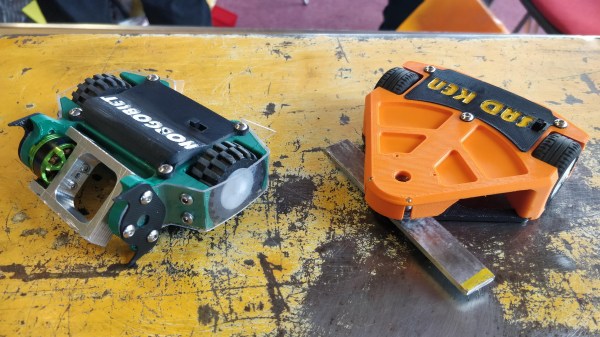
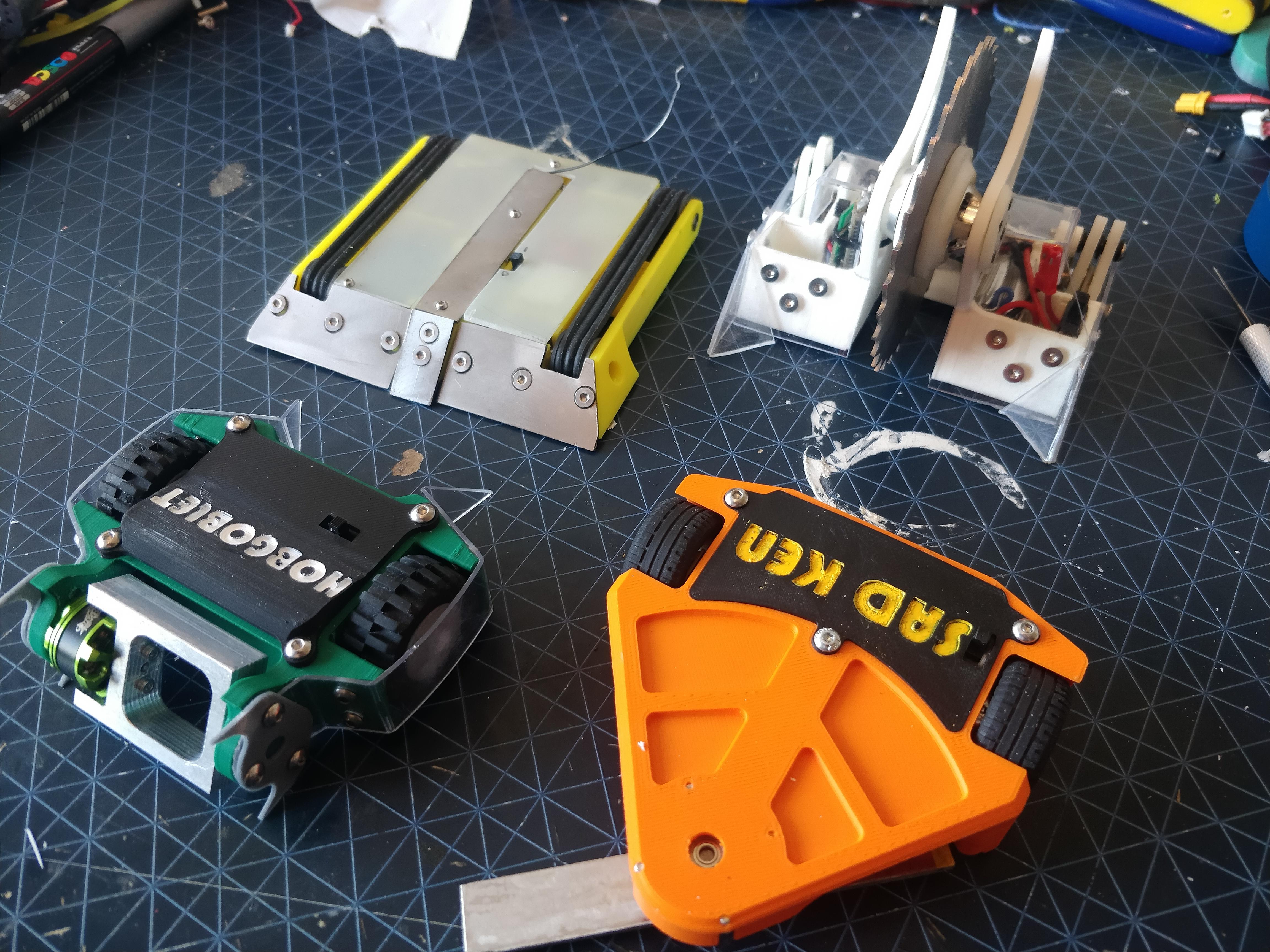
Two robots enter, one robot leaves! Combat robotics are a fantastic showcase of design and skill, but the mechanical contenders don’t have to be big, heavy, and expensive. There is an Antweight division for combat robots in which most contenders weigh a mere 150 grams, and [Harry Makes Things] shows off four participants for Antweight World Series (AWS) 64.

Clockwise: ReLoader, Shakma, Sad Ken, and HobGoblet antweight combat robots.

Each of them have very different designs, and there are plenty of photos as well as insightful details about what was done and how well it worked. That’s exactly the kind of detail we love to read about, so huge thanks to [Harry] for sharing!

In combat robotics, contenders generally maneuver their remote-controlled machines to pin or immobilize their opponent. This can happen as a result of damaging them to the point that they stop functioning, but it can also happen by rending them helpless by working some kind of mechanical advantage. Continue reading “Small Combat Robots Pack A Punch In Antweight Division”

Autogyro Models Are Hard — Even For [Peter Sripol]

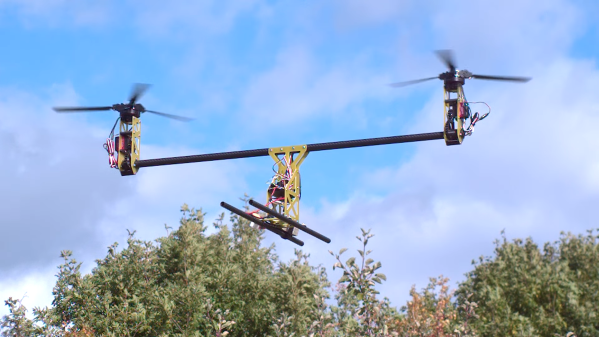
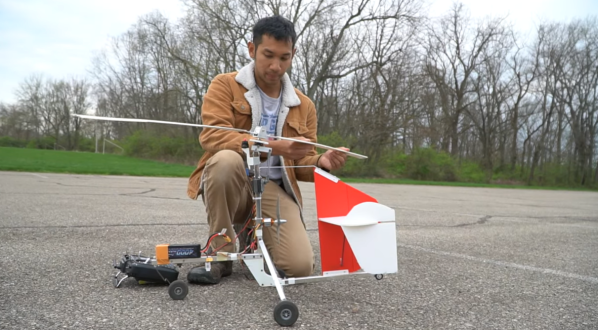
Aviation consists of two major groups. Airplane enthusiasts, and helicopter enthusiasts. The two groups rarely get along, each extolling the virtues of their chosen craft. Somewhere in between are autogyro folks. People who like vehicles that blend the best (or worst) of both airplanes and helicopters. Aviation master [Peter Sripol] has dipped his toes into the autogyro world, but not without some trouble.

Autogyros are propelled by a propeller, like a plane. They also have a tail section that works similar to a fixed-wing aircraft. That’s where the similarities end though. Lift for autogyros comes in the form of a rotating set of blades, much like a helicopter. Autogyro rotors aren’t powered during flight. They utilize autorotation. The blades freewheel, spun by the air as the craft moves forward.

[Peter] recently got his hands on a full-scale autogyro. So it made sense to build a model to help learn to fly. This isn’t [Peter’s] first attempt with autogyro models. He’s built a few in the past, with limited success. This time he started from scratch and ran into even more problems!

Continue reading “Autogyro Models Are Hard — Even For [Peter Sripol]”

Tracked RC Vehicle Is (Mostly) 3D Printed

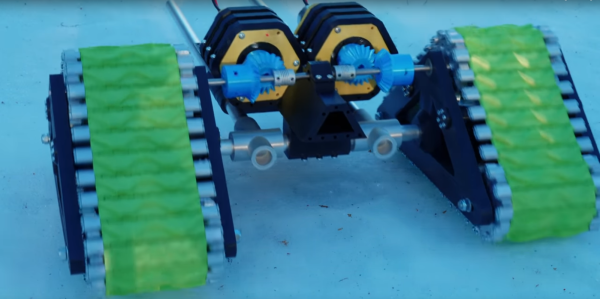
While wheels might seem like a foundational technology, they do have one major flaw: they typically need maintained roads in order to work. Anyone who has experience driving a Jeep or truck off-road likely knows this first-hand. For those with extreme off-road needs the track is often employed. [Let’s Print] is working on perfecting his RC tracked vehicle to take advantage of these perks using little more than 3D printed parts and aluminum stock.

This vehicle doesn’t just include the 3D printed tracks, but an entire 3D printed gearbox and drivetrain to drive them. Each track is driven by its own DC motor coupled to a planetary gearbox to give each plenty of torque to operate in snow or mud. The gearbox is mated to a differential which currently shares a shaft, which means that steering is currently not possible. The original plan was to have each motor drive the tracks independently but a small mistake in the build meant that the shaft needed to be tied together. [Let’s Print] has several options to eventually include steering, including an articulating body or redesigning the drivetrain to be able to separate the shaft.

While this vehicle currently has no wheels in order to improve traction, [Let’s Print] does point out that a pair of wheels could complement this vehicle when he finished the back half of it since wheels have a major advantage over tracks when it comes to steering. A vehicle with both could have the advantages of both, so we’re interested to see where this build eventually goes.

Thanks to [Joonas] for the tip!

Continue reading “Tracked RC Vehicle Is (Mostly) 3D Printed”

A Ryobi belt sander with remote control car parts

Boring Belt Sander Is RC Racer In Disguise

As a child, [David Windestal] already knew that a belt sander was the perfect motor for a banging radio-controlled car. Many years later, the realization of that dream is everything he could have hoped for.

The core of this project is a battery-powered belt sander by a well known manufacturer of gnarly yellow power tools. With an eye for using bespoke 3D printed parts, the conversion appeared straightforward – slap on (or snap on) a pre-loved steering mechanism, add a servo for controlling the sander’s trigger, and that’s pretty much job done. Naturally the intention was to use sandpaper as tread, which is acceptable for outdoor use but not exactly ideal for indoors. A thermoplastic polyurethane (TPU) tread was designed and printed for playtime on the living room floor, where sandpaper may be frowned upon.

The finished product is a mean looking toy with plenty of power. What we really like most about this hack is the commitment to the aesthetics. It’s seriously impressive to see a belt sander so convincingly transformed into a three-wheeler radio-controlled car. The final iteration is also completely reversible, meaning that your belt sander can keep on sanding two by fours on the job site. All the printed parts snap snug into place and are mostly indistinguishable from the stock sander.

Speaking of reversible, there were just a couple of issues with the initial design, if you catch our drift. We won’t spoil what happens, but make sure to watch the video after the break for the full story.

If this hack has whet your appetite for more quirky tool hacks, make sure to check out our coverage of the angle grinder turned slimline belt sander. Or if you can’t get enough of RC, then check out this remote controlled car with active suspension.

Continue reading “Boring Belt Sander Is RC Racer In Disguise”

RC Snowmobile Makes Tracks On Ice

With all the futuristic technology currently at our disposal, it seems a little bizarre that most passenger vehicles are essentially the same thing that they were a century ago. Four wheels, a motor, and some seats would appear to be a difficult formula to beat. But in the 3D printing world where rapid prototyping is the name of the game, some unique vehicle designs have been pushed out especially in the RC world. One of the latest comes to us from [RCLifeOn] in the form of a single-wheeled RC snowmobile.

While not a traditional snowmobile with tracks, this one does share some similarities. It has one drive wheel in the back printed with TPR for flexibility and it also includes studs all along its entire circumference to give it better traction on ice. There are runners in the front made from old ice skates which the vehicle uses for steering, and it’s all tied together with an RC controller and some lithium batteries to handle steering and driving the electric motor.

There were some design flaws in the first iteration of this vehicle, including a very large turning radius, a gearing setup with an unnecessarily high torque, and a frame that was too flexible for the chain drive. [RCLifeOn] was also testing this on a lake which looked like it was just about to revert to a liquid state which made for some interesting video segments of him retrieving the stuck vehicle with a tree branch and string. All in all, we are hopeful for a second revision in the future when some of these issues are hammered out and this one-of-a-kind vehicle can really rip across the frozen wastes not unlike this other interesting snowmobile from a decade ago.

Continue reading “RC Snowmobile Makes Tracks On Ice”