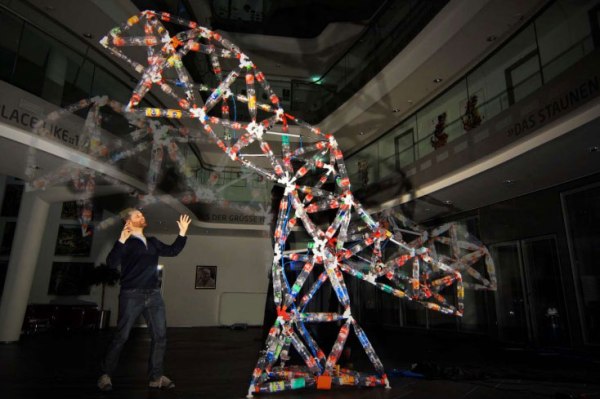
When you think about the materials for your next large dancing robot build, soda bottles might not be the first thing that springs to mind. But they could work, according to TrussFab, a project from a group of students at the Hasso Plattner Instituit. Their system uses empty coke bottles and 3D printed connectors to build large structures, modeled in software that checks their load balance and safety. The team has modeled and built designs up to 5 meters high. Now, the project has taken a step further by adding linear actuators and hinges to the mix so you can create things that move, including a 4-meter high animatronic robot.
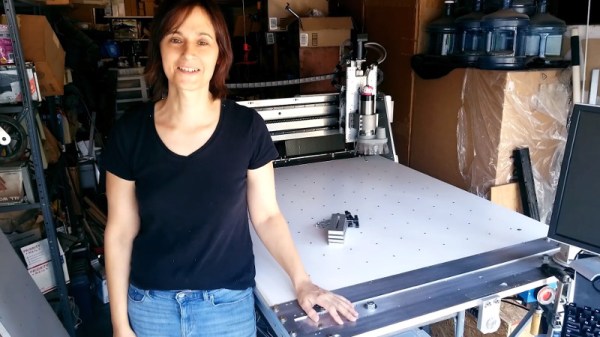
CNC really is a game changer when it comes to machining. If your motor skills or ability to focus aren’t all there, you don’t need to worry – the computer will handle the manual task of machining for you! These builds are popular for DIYers to undertake, as they enable the production of all manner of interesting and advanced parts at home once they’re up and running. However, parts to build a CNC machine can get spendy; [Brenda] decided to take a recycling-based approach to her build instead (Youtube link).
The build uses motion parts from an old silicon wafer fabrication machines, an IKEA table for the work surface, and a scavenged computer to run the show. Control is via the popular LinuxCNC software, a viable candidate for anyone doing a similar build at home. In a neat twist, the holes for hold-downs on the work table were drilled by the machine itself!
Overall it’s a tidy build, broken up over a series of videos that each go into great detail on the work involved. Interested in your own bargain CNC build? Check out this $400 setup.
When that fateful morning comes that your car no longer roars to life with a quick twist of the key, but rather groans its displeasure at the sad state of your ride’s electrical system, your course is clear: you need a new battery. Whether you do it yourself or – perish the thought – farm out the job to someone else, the end result is the same. You get a spanking new lead-acid battery, and the old one is whisked away to be ground up and turned into a new battery in a nearly perfect closed loop system.
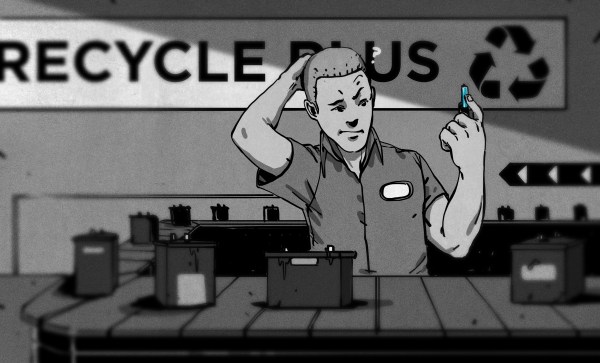
Contrast this to what happens to the battery in your laptop when it finally gives up the ghost. Some of us will pop the pack open, find the likely one bad cell, and either fix the pack or repurpose the good cells. But most dead lithium-based battery packs are dropped in the regular trash, or placed in blue recycling bins with the best of intentions but generally end up in the landfill anyway.
Why the difference between lead and lithium batteries? What about these two seemingly similar technologies dictates why one battery can have 98% of its material recycled, while the other is cheaper to just toss? And what are the implications down the road, when battery packs from electric vehicles start to enter the waste stream in bulk?
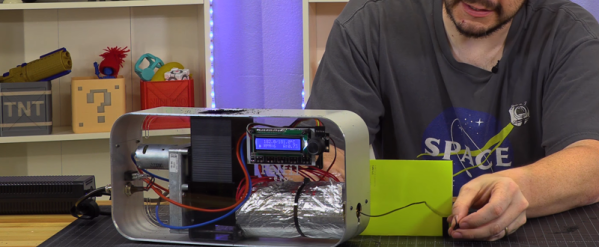
Ask anyone with a 3D printer what they make the most. They’ll probably say “trash.” There are extra pieces, stuff that oozes out of the extruder, support material, parts that didn’t stick to the bed, or just parts that needed a little tweaking to get right. No matter what you do, you are going to wind up with a lot of scraps. It would be great if you could recycle all this, and [3D Printing Nerd] looks at the FelFil Evo Filament extruder that promises it can do just that. You can see the video below.
As you’d expect, the device is a motorized auger that extrudes filament through a hot end not dissimilar to your printer’s hot end. You have to run a bag of special material through it first to clean out the plastic path. After that, you can create filament from standard pellets or pieces of old plastic.
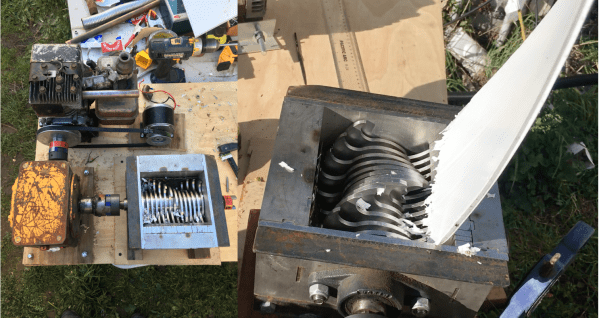
The idea is to mimic the metabolism of a living organism and design something that can break down garbage into both useful stuff and fuel for itself. [Sam] is confident that since humans figured out how to make plastic, we can figure out a system to metabolize it. His proof-of-concept plan is to break down waste into combustible, gaseous fuel and use that fuel to power a small engine. The engine will power an open-source plastic shredder and turn a generator that powers an open-source plastic pellet printer like the SeeMeCNC Part Daddy.
Shredding plastic for use as a biomass requires condensing out the tar and hydrocarbons. This process leaves carbon monoxide and hydrogen syngas, which is perfect for running a Briggs & Stratton from Craigslist that’s been modified to run on gaseous fuel. Condensation is a nasty process that we don’t advise trying unless you know what you’re doing. Be careful, [Sam], because we’re excited to watch this one progress. You can watch it chew up some plastic after the break.
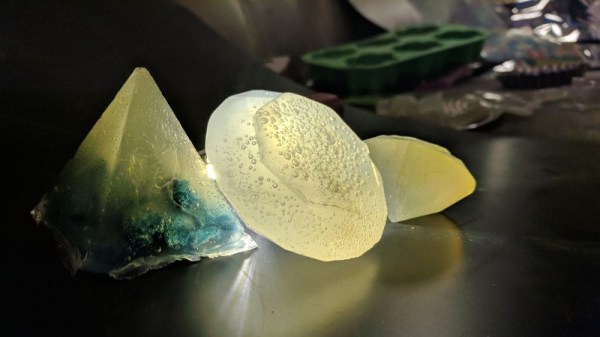
The process starts by combining the EPS styrofoam with a solvent called D-limonene. This was specifically chosen due to its low toxicity and ease of use. The solvent liquifies the solid foam and the air bubbles are then allowed to make their way out of the solution. If it’s desired to create a coloured end product, it’s noted that this can be achieved by using other plastic items to provide colour at this stage, such as a red Solo cup.
It’s a slow process thanks to the choice of solvent, but it makes the process much more palatable to carry out in the average home lab setup. It’s possible to then perform casting operations or further work with the recovered material, which could have some interesting applications. It’s not the first plastics recycling project we’ve seen, either – check out this full setup.
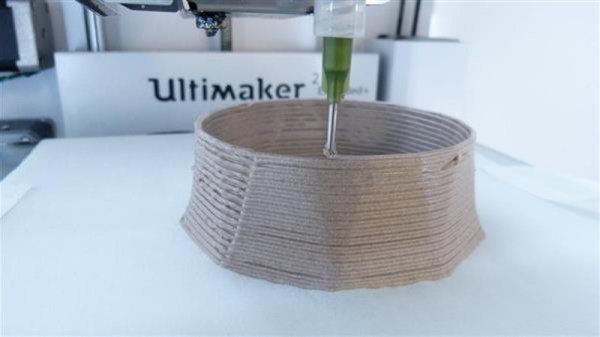
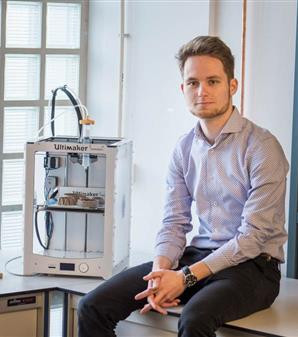
What do you get when you combine oven-baked mussels and sugar beets in a kitchen blender? No, it isn’t some new smoothie cleanse or fad diet. It’s an experimental new recyclable 3D printing material developed by [Joost Vette], an Industrial Design Engineering student at Delft University of Technology in the Netherlands. While some of the limitations of the material mean it’s fairly unlikely you’ll be passing over PLA for ground-up shellfish anytime soon, it does have a few compelling features worth looking into.
Joost Vette
For one thing, it’s completely biodegradable. PLA is technically biodegradable as it’s usually made primarily of cornstarch, but in reality, it can be rather difficult to break down. Depending on the conditions, PLA could last years exposed to the elements and not degrade to any significant degree. But [Joost] says his creation degrades readily when exposed to moisture; so much so that he theorizes it could have applications as a water-soluble support material when printing with a multiple extruder machine.
What’s more, after the material has been dissolved into the water, it can be reconstituted and put back into the printer. Failed prints could be recycled directly back into fresh printing material without any special hardware. According to [Joost], this process can be repeated indefinitely with no degradation to the material itself, “A lot of materials become weaker when recycled, this one does not.”
So how can you play along at home? The first challenge is finding the proper ratio between water, sugar, and the powder created by grinding up mussel shells necessary to create a smooth paste. It needs to be liquid enough to be extruded by the printer, but firm enough to remain structurally sound until it dries out and takes its final ceramic-like form. As for the 3D printer, it looks like [Joost] is using a paste extruder add-on for the Ultimaker 2, though the printer and extruder combo itself isn’t going to be critical as long as it can push out a material of the same viscosity.