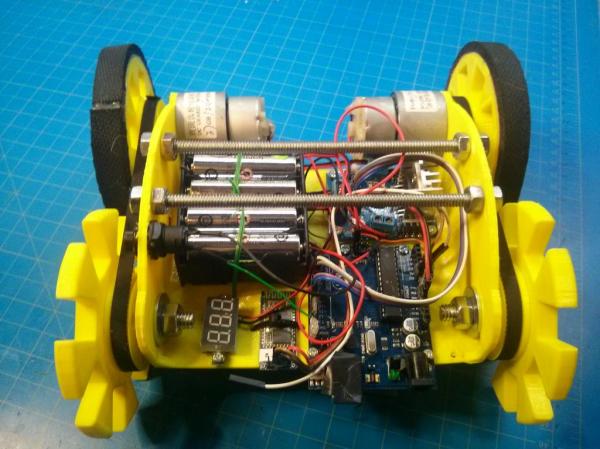
While building a robot (nearly) from scratch isn’t easy, it needn’t be a lengthy process. Is it possible to build a bot in a single day? With some musical motivation (a 10 hour loop of the A-Team theme song), [Tyler Bletsch] answers with a resounding ‘yes’ in the shape of his little yellow robot that he built for a local robotics competition.
Designing and fabricating on the fly, [Bletsch] used Sketchup to design the chassis, and OpenSCAD to model the wheels while the former was being 3D printed. Anticipating some structural weakness, he designed another version that could bolt to wood if the original failed, but the addition of some metal support rods provided enough stability. Mouse pad material gave the wheels ample traction. An Arduino with the L298 control module receives input via an HC-06 Bluetooth board. Eight AA batteries provide 12V of power to two Nextrox mini 12V motors with an integrated voltmeter to measure battery life.
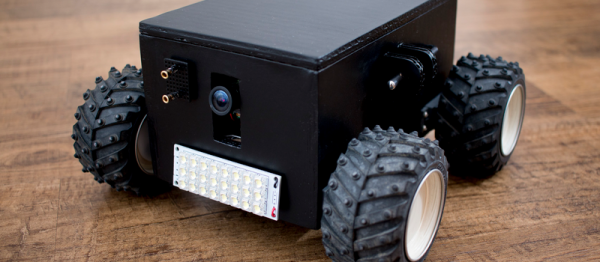
[Miloslav Stibor] may have built Mimobot 2.1 out of cardboard so that it’s not very heavy, but the robot is absolutely no lightweight. Read through his logs (in Czech, or in translation) and you’ll see what we mean.
Our favorite feature is the recharging dock and docking connectors, made respectively out of spring-loaded rivet ferrules and copper-tape-covered cardboard. The video found on that page is also absolutely brilliant: watch in awe as it climbs over children’s books, pulls a wooden train, or scales a mountain of pillows.
We wrote [Miloslav] and asked about the continuous-rotation servos, because they ran so smoothly at low speeds. He replaced the potentiometer with a pair of “carefully matched” 2.2 k resistors, and drives them with a PWM signal. Sounds easy, and obviously works very well. We were always under the impression that it was a little bit more complicated to get proportional control of hobby servos. We’ll have to experiment.
The wheels and lightweight frame (made of “military grade” cardboard — saturated with a wood/paper glue) make it entirely capable in living-room environments covered in cables or rugs, which is something we can’t say about our purchased vacuum-cleaner-bot. And the cell-phone remote interface that lets him control the onboard camera and its elevation and lighting. Driving the thing around with the phone control looks fun.
In short, if you build small robots, give this one a look. Something very much like this is now on our short must-build list. And we can’t wait to see Mimobot v3!
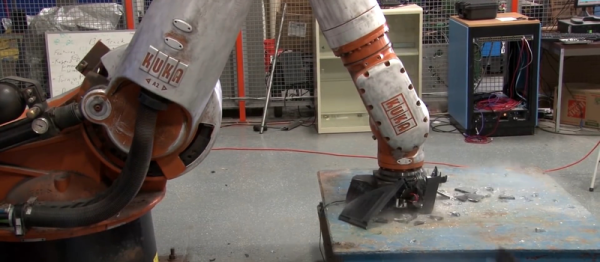
We’re not sure we condone this at all. CRT monitors are virtually extinct, and here we have some folks just smashing them up for no good reason. That said, it’s kinda cool to see large industrial robots in motion, so we can’t really blame them. (Video embedded below.)
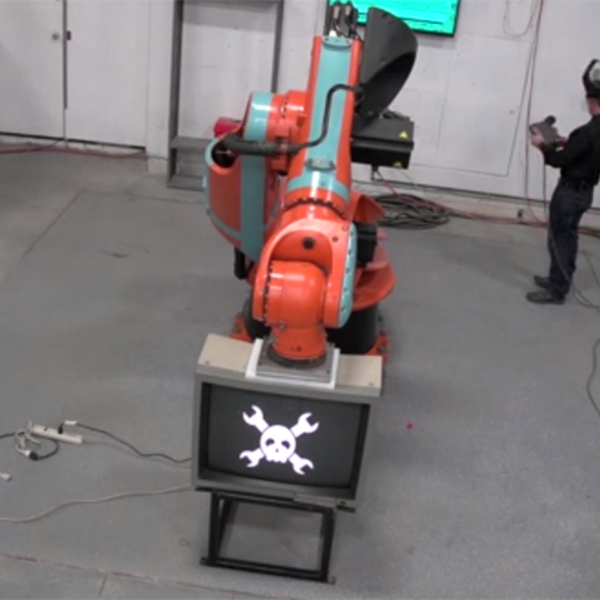
We’ve covered the [Geek Group] crushing TVs with their robot arm before although that first try was more like a fail, in the sense that the TV was only partly smashed. At the time, we joked that it was because they had a Jolly Wrencher holding the CRT together. But it could have been that the robot arm simply lacked the requisite grunt.
This time they came to it with a stronger robot arm, and removed the Jolly Wrencher from the screens. These folks aren’t scientists — changing two variables at once leaves the experiment inconclusive. But they do smash things. So that’s a success, right?
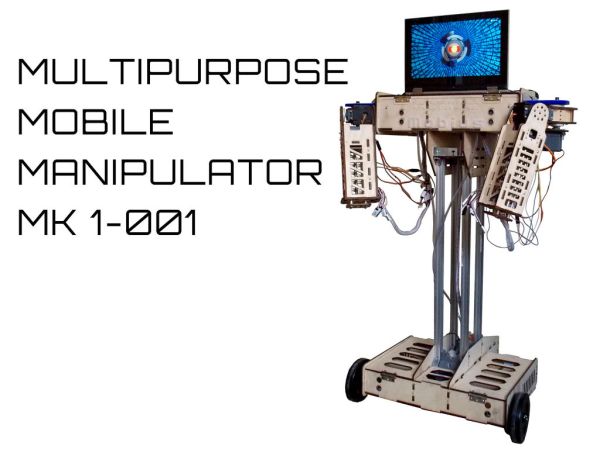
As the cost of almost every technology comes falling down, from electronics to batteries to even tools like 3D printers, the cost to build things formerly out of reach of most of us becomes suddenly very affordable. At least, that’s what [John Choi] has found by building a completely DIY general purpose robot for around $2000.
OK, so $2000 isn’t exactly “cheap” but considering that something comparable (like Baxter) costs north of what a new car would cost means that [John] has dropped the price for a general-purpose robot by an order of magnitude. And this robot doesn’t skimp on features, either. It has a platform that allows it to navigate rooms, two manipulating limbs with plenty of servos, a laptop “head” that allows for easy interface, testing, and programming, and an Arduino Mega that allows it to interface with any sensors or other hardware with ease. It’s also modular so it can be repaired and transported easily, and it uses open source software and open hardware so it’s easy to build on.
This robot is an impressive piece of work that should help bring this technology to more than just high-end factories and research labs. They’ve already demonstrated the robot watering plants, playing the piano, picking things up, and many other tasks. We’d say that they’re well on their way to their goal of increasing the number of students and hobbyists who have access to this technology. If the $2k price tag is still too steep, though, there are other ways of getting into robotics without diving headfirst into a Baxter-like robot.
Even the city’s welcome sign is held high by two prosthetic arms.
In the show Full Metal Alchemist, there’s a city called Rush Valley whose main and only business are the high performance prostheses called Automail. Engineers roam the street in Rush Valley; the best have their own shop like that of the high-end clothiers in Saville Row. Of course; it’s all fantasy set in a slightly ridiculous Japanese cartoon, but while walking through this year’s Maker Faire I began to wonder if is a future that may come to be.
The problem with prosthetics is the sheer variety of injuries, body types, and solutions needed. If an injury is an inch higher or an inch lower it can have a big effect on how a prosthetic will interact with the limb. If the skin is damaged or the nerves no longer function a different type of prosthesis will be needed. Some prostheses are to replace a lost limb, others are to assist an ailing body in order to return it to normal function. More than a few are simply temporary aides to help the body along in its healing efforts. Unfortunately, this means that it’s often the case that larger companies only sell the prostheses people are most likely to need; the rarer cases are often left without a solution.
The e-Nable project doesn’t mess around.
However, we see hackers stepping up and not just working on the problems, but solving them. One of our semifinalists last year, openbionics, inspired one of the projects we’ll be talking about later. There are robotic legs. We met a guy at MRRF who has been 3D printing hands for his son from the E-nable project.
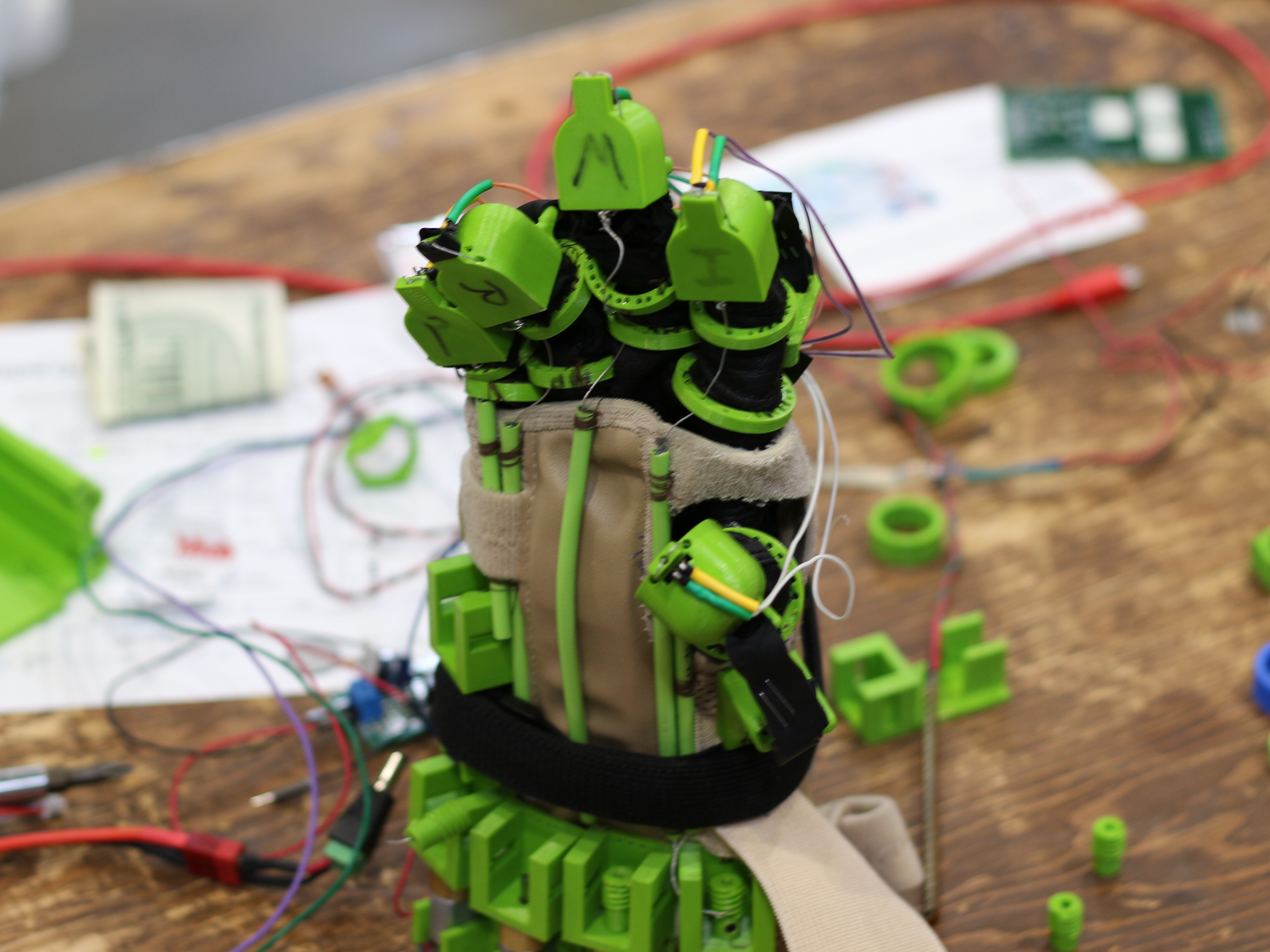
Along these lines, we saw two really cool projects at Maker Faire this year: The first is the Motor-Assistive Glove, or MAG. MAG is designed to help people with Peripheral Neropathy regain some use of their hands while they go through the lengthy road to recovery. Perhipheral Neuropathy is a disease, usually resulting from diabetes, toxin exposure, or infection, where the nerves are damaged in such a way that typically the hands and feet are no longer mobile or feel sensation in a useful way. Once the disease is in full swing, a previously able person will find themselves unable to do simple things like hold a can of soda or grasp a doorknob firmly enough to open it.
The Motor Assistive Glove
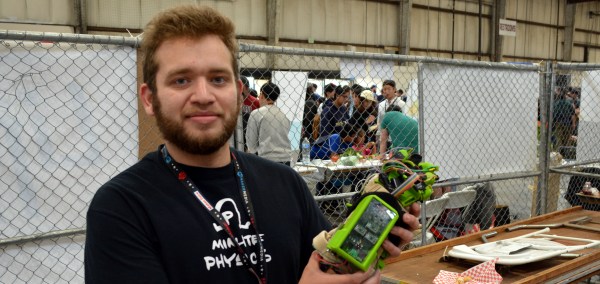
We had a chance to interview one of the members of the MAG team, [Victor Ardulov], which you can see in the following video. [Victor] and his group started a research project at the University of Santa Cruz to develop the Motor-Assistive Glove. The concept behind it is simple. People with Peripheral Neuropathy typically have some movement in their hands, but no strength. The MAG has some pressure sensors at the tips of the fingers. When the user puts pressure on the pad; the glove closes that finger. When the pressure is off; the glove opens. The concept is simple, but the path to something usable is a long one.
Harvard University has had the flying robot insect market covered for a long time. However, their robot bee, while cool, was starting to bum them out. They wanted to put the battery and brain on the robocritter and have it fly around without a tether. Technology just wasn’t moving fast enough for them, so they’ve picked a different bug, this time a moth.
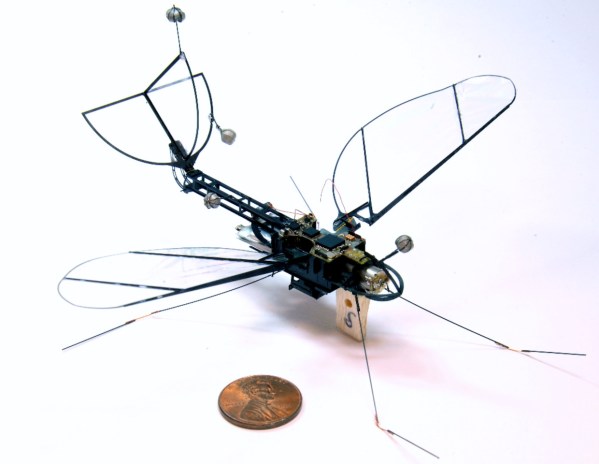
The Wyss Institute for Biologically Inspired Engineering at Harvard University is known for its Flying Winged Micro Air Vehicles or FWMAV. Which is a pretty good example of what happens when you let engineers name things. This FWMAV, weighs in at a hefty 3grams and has a 16mm wingspan. It also has propulsion, sensors, communication, brains, and power on board. Pretty impressive, the heaviest item is the motor!
The moth can produce 4g of thrust, and they’ve shown it capable of staying aloft once launched with a small catapult. Since they’ve proven that it can at least fly, the next steps are to figure out the dynamics of moth-based flight. Right now it stays pointed in the right direction with a very tiny tail fin like on an airplane. Real moths manage this feat with independent wing control, which the robot doesn’t have yet.
It will be a while before a we’ll see robot moths bumping into our computer monitors a night, stealing our passwords, but it’s a really cool exercise in robot miniaturization.
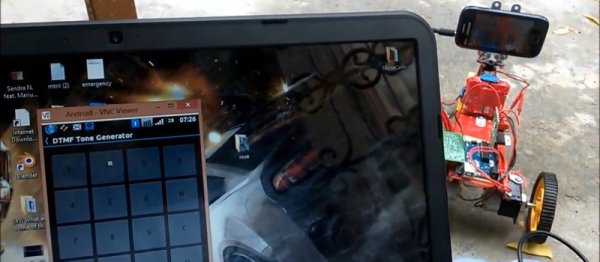
Sometimes you start building, and the project evolves. Layers upon layers of functionality accrue, accrete, and otherwise just pile up. Or at least we’re guessing that’s what happened with [Varun Kumar]’s sweet “Surveillance Car Controlled by DTMF“.
In case you haven’t ever dug into not-so-ancient telephony, Dual-tone, multi-frequency signalling is what made old touch-tone phones work. DTMF, as you’d guess, encodes data in audio by playing two pitches at once. Eight tones are mapped to sixteen numbers by using a matrix that looks not coincidentally like the old phone keypad (but with an extra column). One pitch corresponds to a column, and one to a row. Figure out which tones are playing, and you’ve decoded the signal.
Anyway, you can get DTMF decoder chips for pennies on eBay, and they make a great remote-control interface for a simple robot, which is presumably how [Varun] got started. And then he decided that he needed a cell phone on the robot to send back video over WiFi, and realized that he could also use the phone as a remote controller. So he downloaded a DTMF-tone-generator app to the phone, which he then controls over VNC. Details on GitHub.