Drawn In By The Siren’s Song

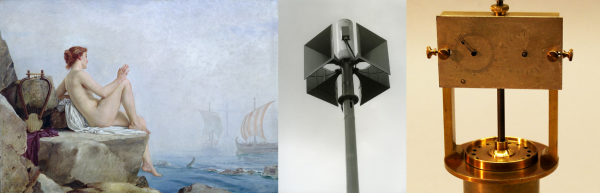
When I say “siren” what do you think of? Ambulances? Air raids? Sigh. I was afraid you were going to say that. We’ve got work to do.

You see, the siren played an important role in physics and mathematics about 150 years ago. Through the first half of the 1900s, this fine apparatus was trivialized, used for its pure noise-making abilities. During the World Wars, the siren became associated with air raids and bomb shelters: a far cry from its romantic origins. In this article, we’re going to take the siren back for the Muses. I want you to see the siren in a new light: as a fundamental scientific experiment, a musical instrument, and in the end, as a great DIY project — this is Hackaday after all.

Continue reading “Drawn In By The Siren’s Song” →

Cyborg Photosynthetic Bacteria!

This is weird science. Researchers at Lawrence Berkeley National Laboratory have taken some normal bacteria and made them photosynthetic by adding cadmium sulfide nanoparticles. Cadmium sulfide is what makes the garden-variety photoresistor work. That’s strange enough. But the bacteria did the heavy lifting — they coated themselves in the inorganic cadmium — which means that they can continue to grow and reproduce without much further intervention.

Bacteria are used as workhorses in a lot of chemical reactions these days, and everybody’s trying to teach them new tricks. But fooling them into taking on inorganic light absorbing materials and becoming photosynthetic is pretty cool. As far as we understand, the researchers found a chemical pathway into which the electrons produced by the CdS would fit, and the bacteria took care of the rest. They still make acetic acid, which is their normal behavior, but now they produce much more when exposed to light.

If you want to dig a little deeper, the paper just came out in Science magazine, but it’s behind a paywall. But with a little searching, one can often come up with the full version for free. (PDF).

Or if you’d rather make electricity, instead of acetic acid, from your bacteria be our guest. In place of CdS, however, you’ll need a fish. Biology is weird.

Headline images credit: Peidong Yang

Molecular Motor Drives Nano Submarine

Technology keeps making things smaller, but this is ridiculous. Scientists at Rice University in Houston have just made a tiny submarine with a molecular motor. They call it a unimolecular submersible nanomachine (USN), because it is composed of a single molecule made up of 244 atoms. The really smart bit comes from how it is driven: when the molecule absorbs a photon of light, one of the bonds that holds it together becomes more flexible, and the tail spins a quarter of a rotation to attach to another atom and reach the preferred lower energy state. This motion moves the molecule, and the process repeats. This happens millions of times a second.

I wouldn’t put down a deposit on a nanosub quite yet, though: the motion is random, as there is no way to steer the molecule at present. The researchers figured out that it behaves this way by analyzing the way that the molecule diffuses, because these molecules diffuse 25 per cent quicker with the light source than without.  Nope, not very practical, but it is a neat bit of molecular hackery.

Citizen Scientist: Forrest Mims

Before the modern notion of the citizen scientist lies the earlier ideal of the independent scientist. Scientists outside of the academic community but engaging with it. These days citizen scientists are often seen as valuable assistants in the scientific process, helping collect and process data in a quantity which would be otherwise intractable.

In the past however, independent scientists had a far more central role. Galileo, Kepler, Darwin and Hooke were all self funded at various points in their careers. More recently independent scientist Peter Mitchell won the Nobel prize for Chemistry in 1978 for his foundational research into cell biochemistry and the development of the chemiosmotic hypothesis.

Sadly, peer-reviewed scientific contributions by scientists un-sponsored by a research organization are now few and far between. In this short series we hope to highlight the efforts of these lone researchers with particular reference to the tools they’ve had to hack together on a budget in their scientific quests (if you know an independent researcher you think we should feature, please comment below!).

In Hacker circles Forrest Mims is perhaps best known for his series of electronics books and the unforgeable Atari Punk Console. But it’s his ability to engage with the scientific community as an independent researcher through a series of well thought out scientific articles that interests us here. Contributions made all the more significant by his lack of formal scientific training.

Continue reading “Citizen Scientist: Forrest Mims” →

Teeny Tiny Very Small – Atomic Resolution And The Home Hobbyist

Atoms are small. Really small. You just won’t believe how minusculely microscopically mindbogglingly small they are. I mean you may think it’s a short way down the road to the chemist’s, but that’s just peanuts to atoms.

Atoms really are small. The atomic radius of a carbon atom is on the order of 0.1 nanometers, that’s 0.0000001 millimeters. It’s hard to grasp how fantastically small this is compared to objects we generally encounter, but as a starting point I’d recommend looking at the “Powers of Ten” video found below whose ability to convey the concept has been unrivaled since it was published in 1977.

The term nanometer might be most familiar from the semiconductor industry, and its seemingly unstoppable march to smaller feature sizes. Feature sizes currently hover somewhere around the 10 nanometer mark. So while these multi-billion dollar facilities can achieve 10nm precision it’s somewhat surprising that sub-nanometer feature size positioning, and fabrication techniques are available at relatively low cost to the hacker hobbyist.

In this article we’re going to review some of the amazing work demonstrated by hobbyists in the area of the very very small through use of cutting edge, but low cost techniques.

Continue reading “Teeny Tiny Very Small – Atomic Resolution And The Home Hobbyist” →

Demonstrating Science At Harvard University

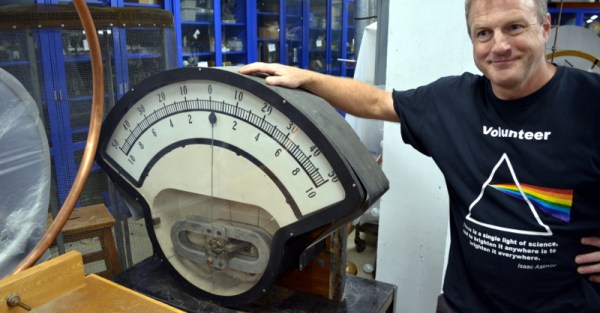
What if there was a job where you built, serviced, and prepared science demonstrations? This means showing off everything from principles of physics, to electronic theory, to chemistry and biology. Would you grab onto that job with both hands and never let go? That was my reaction when I met [Dan Rosenberg] who is a Science Lecture Demonstrator at Harvard University. He gave me a tour of the Science Center, as well as a behind the scenes look at some of the apparatus he works with and has built.

Continue reading “Demonstrating Science At Harvard University” →

Caption CERN Contest – Dr. Frankenstein Would Be Proud

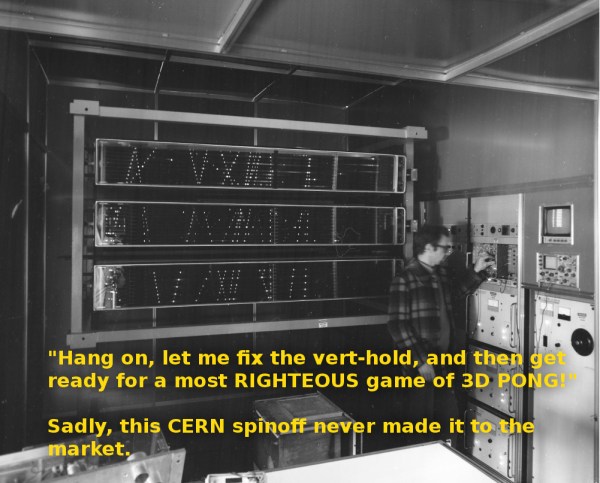
Week 16 of the Caption CERN Contest just flew by, but not without sparking some cosmic comic genius in the minds of everyone who wrote a comment. Thanks to everyone who entered! If you followed last week’s blog post, you already know that this image isn’t an early POV display, or some sort of strange data display technique. It’s actually a spark chamber. Spark chambers use high voltage and noble gases to create a visible trail of cosmic rays. Since this image is dated 1979, well after spark chambers were used for hard science, we’re guessing it was part of a demonstration at CERN’s labs.

The Funnies:

  • “Here we see Doug playing a Massively multiplayer Pong game against his peers in the next building over.” – [John Kiniston]
  • “It said “Would you like to play a game?” and I said yes. Are those missile launch tracks?”- [jonsmirl]
  • “Before Arduino you needed a whole room full of equipment to blink LEDs!” – [mjrippe]

After two weeks as a runner-up, this week’s winner is The Green Gentleman with “‘Hang on, let me fix the vert-hold, and then get ready for a most RIGHTEOUS game of 3D PONG!’ Sadly, this CERN spinoff never made it to the market”

We’re sure [The Green Gentleman] will be very courteous to his fellow hackers in sharing his new Bus Pirate From The Hackaday Store! Congratulations [The Green Gentleman]!

Week 17

cern-17-smCoils, gleaming metal, giant domes, now this is a proper mad scientist image! The CERN scientists in this image seem to be working on a large metal device of some sort. It definitely looks like an electrode which would be at home either at CERN or the well equipped home lab of one Dr. Frankenstein’s. We don’t have a caption, but we do have a rough date of August, 1961. What is happening in this image? Are these scientists setting up an experiment, or plotting world domination?

You tell us!

This week we’re giving away a Logic Pirate from The Hackaday Store.

Add your humorous caption as a comment to the contest log. Make sure you’re commenting on the contest log, not on the contest itself.

As always, if you actually have information about the image or the people in it, let CERN know on the original image discussion page.

Good Luck!