SDR Is At The Heart Of This Soup-Can Doppler Radar Set

Want to explore the world of radar but feel daunted by the mysteries of radio frequency electronics? Be daunted no more and abstract the RF complexities away with this tutorial on software-defined radar by [Luigi Cruz].

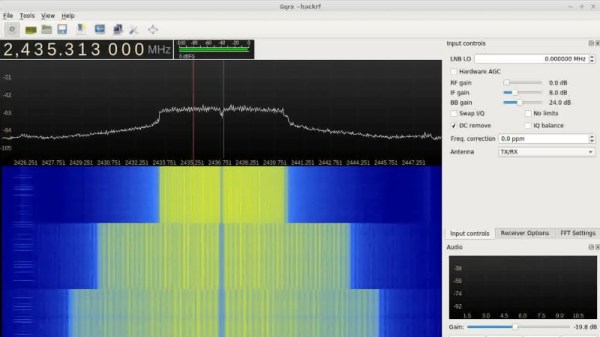
Taking inspiration from our own [Gregory L. Charvat], whose many radar projects have graced our pages before, this plunge into radar is spare on the budgetary side but rich in learning opportunities. The front end of the radar set is almost entirely contained in a LimeSDR Mini, a software-defined radio that can both transmit and receive. The only additional components are a pair of soup can antennas and a cheap LNA for the receive side. The rest of the system runs on GNU Radio Companion running on a Raspberry Pi; the whole thing is powered by a USB battery pack and lives in a plastic tote. [Luigi] has the radar set up for the 2.4-GHz ISM band, and the video below shows it being calibrated with vehicles passing by at known speeds.

True, the LimeSDR isn’t exactly cheap, but it does a lot for the price and lowers a major barrier to getting into the radar field. And [Luigi] did a great job of documenting his work and making his code available, which will help too. Continue reading “SDR Is At The Heart Of This Soup-Can Doppler Radar Set”

All The Goodies You Need For Your RTL-SDR

When the RTL2832-based USB digital TV sticks were revealed to have hidden capabilities that made the  an exceptionally cheap software-defined radio receiver, it was nothing short of a game-changing moment for the home radio experimenter. The RTL might not be the best radio available, but remains a pretty good deal for only $10 from your favourite online supplier.

Having bought your RTL SDR, you will soon find yourself needing a few accessories. A decent antenna perhaps, an HF upconverter, and maybe an attenuator. To help you, [IgrikXD] has come up with a repository containing open-source implementations of all those projects and more. There’s an HF upconverter handily in both SMD and through-hole versions, as well as a wideband active antenna. A resonant antenna for a single band will always out-perfom a wideband device if your interest lies on only one frequency, but when your receiver has such a wide range as that of the RTL it’s irresistible to look further afield so the wideband antenna is a useful choice.

The RTL SDR is a device that just keeps on giving, and has featured innumerable times here since since its first appearance a few years ago. Whether you are into passive radar or using it to decode data from RF-equipped devices it’s the unit of choice, though we rather like it as a piece of inexpensive test equipment.

Via Hacker News.

Header image: Joeceads [CC BY-SA 4.0].

Revive That Old Analog Cell Phone With SDR

With the latest and greatest 5G cellular networks right around the corner, it can be difficult to believe that it wasn’t so long ago that cell phones relied on analog networks. They aren’t used anymore, but it might only take a visit to a swap meet or flea market to get your hands on some of this vintage hardware. Of course these phones of a bygone era aren’t just impractical due to their monstrous size compared to modern gear, but because analog cell networks have long since gone the way of the floppy disk.

But thanks to the efforts of [Andreas Eversberg] those antique cell phones may live again, even if it’s only within the radius of your local hackerspace. His software allows the user to create a functioning analog base station for several retro phone networks used in Europe and the United States, such as AMPS, TACS, NMT, Radiocom, and C450. You can go the old school route and do it with sound cards and physical radios, or you can fully embrace the 21st century and do it all through a Software Defined Radio (SDR); in either event, calls to the base station and even between multiple mobile devices is possible with relatively inexpensive hardware.

[Andreas] has put together exceptional documentation for this project, which starts with a walk through on how you can setup your DIY cell “tower” with traditional radios. He explains that amateur radios are a viable option for most of the frequencies used, and that he had early success with modifying second-hand taxi radios. He even mentions that the popular BaoFeng handheld radios can be used in a pinch, though not all the protocols will work due to distortion in the radio.

If you want to take the easy way out, [Andreas] also explains how to replace the radios with a single SDR device. This greatly simplifies the installation, and turns a whole bench full of radios and wires into something you can carry around in your pack if you were so inclined. His software has specific options to use the LimeSDR and LimeSDR-Mini, but you should be able to use other devices with a bit of experimentation.

We’ve previously reviewed the LimeSDR-Mini hardware, as well as covered its use in setting up DIY GSM networks.

Drone + Ground Penetrating Radar = Mine Detector?

Most civilized nations ban the use of landmines because they kill indiscriminately, and for years after they are planted. However, they are still used in many places around the world, and people are still left trying to find better ways to find and remove them. This group is looking at an interesting new approach: using ground-penetrating radar from a drone [PDF link]. The idea is that you send out a radio signal, which penetrates into the ground and bounces off any objects in there. By analyzing the reflected signal, so the theory goes, you can see objects underground. Of course, it gets a bit more complicated than that (especially when signals get reflected by the surface and other objects), but it’s a well-established technique even though this is the first time we’ve seen it mounted on a drone. It’s a great idea: the drone allows you to have the transmitting and receiving antennas separated with both mounted on pole extensions, meaning that the radio platform can move. Combined with a pre-planned flight, and we’re looking at a system that can fly over an area, scan what is under the ground, and store the data for analysis.

[Via RTL-SDR]

Continue reading “Drone + Ground Penetrating Radar = Mine Detector?”

Studying Airplane Radio Reflections With SDR

A property of radio waves is that they tend to reflect off things. Metal surfaces in particular act as good reflectors, and by studying how these reflections work, it’s possible to achieve all manner of interesting feats. [destevez] decided to have some fun with reflections from local air traffic, and was kind enough to share the results.

The project centers around receiving 2.3 GHz signals from a local ham beacon that have been reflected by planes taking off from the Madrid-Barajas airport. The beacon was installed by a local ham, and transmits a CW idenfication and tone at 2 W of power.

In order to try and receive reflections from nearby aircraft, [destevez] put together a simple but ingenious setup.

ADS-B data was plotted on a map and correlated with the received reflections.

A LimeSDR radio was used, connected to a 9 dB planar 2.4 GHz WiFi antenna. This was an intentional choice, as it has a wide radiation pattern which is useful for receiving reflections from odd angles. A car was positioned between the antenna and the beacon to avoid the direct signal overpowering reflected signals from aircraft.

Data was recorded, and then compared with ADS-B data on aircraft position and velocity, allowing recorded reflections to be matched to the flight paths of individual flights after the fact. It’s a great example of smart radio sleuthing using SDR and how to process such data. If you’re thirsty for more, check out this project to receive Russian weather sat images with an SDR.

[Thanks to Adrian for the tip!]

SDR processed call sign and message

Using AI To Pull Call Signs From SDR-Processed Signals

AI is currently popular, so [Chirs Lam] figured he’d stimulate some interest in amateur radio by using it to pull call signs from radio signals processed using SDR. As you’ll see, the AI did just okay so [Chris] augmented it with an algorithm invented for gene sequencing.

Radio transmitting, receiving, and SDR hardwareHis experiment was simple enough. He picked up a Baofeng handheld radio transceiver to transmit messages containing a call sign and some speech. He then used a 0.5 meter antenna to receive it and a little connecting hardware and a NooElec SDR dongle to get it into his laptop. There he used SDRSharp to process the messages and output a WAV file. He then passed that on to the AI, Google’s Cloud Speech-to-Text service, to convert it to text.

Despite speaking his words one at a time and making an effort to pronounce them clearly, the result wasn’t great. In his example, only the first two words of the call sign and actual message were correct. Perhaps if the AI had been trained on actual off-air conversations with background noise, it would have been done better. It’s not quite the same issue, but we’re reminded of those MIT researchers who fooled Google’s Inception image recognizer into thinking that a turtle was a gun.

Rather than train his own AI, [Chris’s] clever solution was to turn to the Smith-Waterman algorithm. This is the same algorithm used for finding similar nucleic acid sequences when analyzing genes. It allowed him to use a list of correct call signs to find the best match for what the AI did come up with. As you can see in the video below, it got the call signs right.

Continue reading “Using AI To Pull Call Signs From SDR-Processed Signals”

BladeRF 2.0 Micro Is Smaller, More Powerful

When it was launched in 2013, the BladeRF was one of the most powerful of the new generation of Software Defined Radios. Now, Nuand, the producers of the BladeRF are looking to up the ante again with the BladeRF 2.0 Micro. This new version has a huge list of changes and improvements, including a more bad-ass FPGA processor and support for receiving and transmitting from 47 MHz all the way up to 6 GHz, with 2x MIMO support and an impressive 56 Mhz of bandwidth. It also retains backwards compatibility with the original BladeRF, meaning that any software written to support it (which most SDR packages do) will just work with the new device.

Continue reading “BladeRF 2.0 Micro Is Smaller, More Powerful”