360 Degree Video For Next-to-nothing

[Luis], a regular Hackaday reader, sent in some info about his 360 degree video experiments. He wanted a cheap device to use with a video camera, producing video that can be displayed using a free Flash software library.

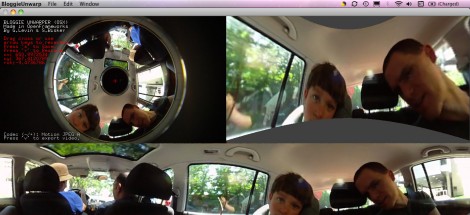
The hardware consists of a mirrored light bulb, a square of glass, and some threaded rod. The camera lens attaches to the glass with the rod right in the middle. The lens will capture a donut image reflected in the mirror of the bulb. [Luis] then processes the result and uses Ryubin’s Flash Panorama to handle playback. He’s posted two clips as examples, the first of an “Existentialist Suburb Walker” and the second is some test footage while setting up for a shot. You can click-and-rotate the video while it’s playing to look around the area.

This could produce some great driving videos, without the need for multiple cameras. [Luis] does point out some problems with oscillation as the mirror on the end of a rod will amplify the effect of movement on the image.

Beauty In Destruction

[youtube=http://www.youtube.com/watch?v=QfDoQwIAaXg]

This is not a hack. In fact it’s a promotional montage for a collection of scientific equipment that few of us could likely afford. But like yesterday’s giant marionettes over Berlin, sometimes even a costly and delicately-orchestrated achievement transcends its own not-a-hack-ness, fulfilling our brains’ lust for wonderment all the same.

Kurzzeit of Germany produces ballistics measurement equipment. The video depicts various combinations of projectiles and targets at up to one million frames per second, revealing unexpected beauty in hitherto unseen phenomena, and is the best damn ten minutes you will waste on the internet all day!

Sticky Light

light

With the availability of webcams and projectors, multitouch and interactive demos have become increasingly popular because they’re so easy. Students at the University of Tokyo took a new approach that uses lasers instead. They created Sticky Light, which uses mirrors, a laser, and a single photodetector. Unlike camera-tracking setups, this system requires no visual processing. The laser moves around and bumps into dark objects, sticking to them. It can follow drawings on the table or objects in space, such as shirt designs. They also created a few basic games and a demo that makes sounds based on the movement of the spots. Video of the project after the break.

Continue reading “Sticky Light”

Music Visualizer (oscilloscope)

musicscopetv

The Music visualizer is actually a second build based on an earlier design[Thanks Roger]. The build was influenced by Zyra’s How to make an oscilloscope out of a television. The hack is quite simple, patch the output of an amplifier into the vertical deflection coils of the CRT. This is a good use for that old TV you may have laying around  but don’t want to recycle it just yet. While on the subject we had covered the Mac SE/30 audio visualizer in 2006. For those looking for something a little more hard core, here is a bit about Homemade cathode ray tubes.

Propeller-based Terminal

pocketerm

[Vince Briel] has created an embedded device based on the Parallax Propeller chip that acts as a serial terminal. It takes input from a standard PS/2 keyboard and outputs color VGA. It also has a second serial port to connect to a PC for debugging or programming. He is selling kits and has the schematics available. The board has a lot of hacking potential and it could easily be made into a video game or a Wikipedia browser.

[via RetroThing]

AR Flash Library Released

[youtube http://www.youtube.com/watch?v=CMpJLTU9qCA%5D

[onezerothrice] has been working hard on creating ARtisan, a flash library for bringing augmented reality to the browser. His goal in creating the library was to make AR projects quicker and easier to develop. The library can provide the location, size, and rotation of multiple markers on screen with little work from the developer. It is licensed under the GPL and comes bundled with Papervision3D, another flash library for manipulating objects in 3 dimensions. He has posted several demos with source and accompanying video.

Gimbal Camera Stabilizer

steadycam

Professional cameramen use steadicams to make their shots look smooth and clean. However, their prices are generally way too high for an indie’s budget. Previous attempts have tried adding a counterweight and moving the camera away from the hands. [YB2Normal] took a different method and used a bob and gimbal to hold the camera upright. The gimbal is free to rotate along 3 axes, so the camera can stay in place. The whole thing cost less than $15. The first video he made with he mount is after the break.

[youtube http://www.youtube.com/watch?v=nXB0ncUQLn4%5D

Related: Building a Snorricam

[via Gizmodo]