Glasses Frames Crafted Out Of Wood

Most glasses and sunglasses on the market make use of metal or plastic frames. It’s relatively easy to create all manner of interesting frame geometries, tolerances can be easily controlled for fitting optical elements, and they’re robust materials that can withstand daily use. Wood falls short on all of these measures, but that doesn’t mean you can’t use it to make a beautiful pair of glasses.

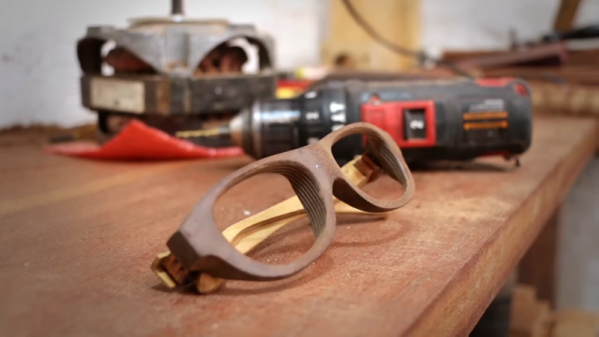
ZYLO is a company making wooden eyewear, and this video from [Paide] shows the build process in detail. Modern tools are used to make things as efficient as possible. Parts are lasercut and engraved to form the main part of the frames as well as the temples (the arms that sit over the ears to hold them on your face). A special jig is used to impart a curve on the laminated wood parts before further assembly is undertaken. Metal pre-fabricated hinges and screws are used to bolt everything together like most other modern sunglasses, but there’s significant hand finishing involved, including delicate inlays and highlighting logo features.

In contrast, Manuel Arroyave works very differently in the creation of his Cedoro glasses. Sheets are first laminated together, before the shape is roughed out by a special horizontal axis milling setup. Even small details like the hinges are delicately hand-crafted out of wood and fitted with tiny wooden dowels.

It goes to show that there’s always more than one way to get a job done. We’re tempted to break out the laser cutter and get started on some custom shades ourselves. Perhaps though, you’re too tired to put your sunglasses on by yourself? Nevermind, there’s a solution for that, too. Video after the break.

Continue reading “Glasses Frames Crafted Out Of Wood”

Make Your Own Dowels At Home

Dowels are a useful woodworking technology making it easy to connect several pieces of timber, particularly with the aid of adhesive. However, depending on where you live, it can be difficult to come by a wide variety of stock. This is particularly important if you’re concerned about appearances – cheap pine dowels could spoil the look of a delicately finished hardwood piece, for example.

Thankfully, it’s easy to make your own dowels at home. [Pask Makes] has used a simple dowel plate before, but this time, decided to build the deluxe version. A thick steel plate is drilled with a series of holes, and then mounted to a wooden block. Square stock can then be forced through the holes to produce the dowels.

[Pask] notes that there are several methods to use the dowel plate. Hammering the wood stock through the holes works best for hardwoods, while fitting the square stock into the chuck of a power drill and forcing it through while spinning gives a better finish on softer woods. There are also useful tips on how best to produce dowels, with notes on strength and grain orientation.

It’s a useful tool to have in your workshop, and means you can turn just about any wood into dowels for your woodworking projects. If you’re fresh to the world of wood, worry not – we’ve got the primer to get you started. Video after the break.

Continue reading “Make Your Own Dowels At Home”

Woodworker Goes From 3D-Printing Skeptic To Believer

If there’s one place where the old ways of doing things live a longer life than you’d otherwise expect, it’s the woodshop. Woodworkers have a way of stubbornly sticking to tradition, and that usually works out fine. But what does it take to change a woodworker’s mind about a tool that seems to have little role in the woodshop: the 3D-printer?

That’s the question [Marius Hornberger] asked himself, and at least for him, there are a lot of woodworking gadgets that can be 3D-printed. [Marius] began his journey into additive manufacturing three years ago as a skeptic, not seeing how [Benchy] and friends could be of any value to his endeavors. But as is often the case with a tool that can build almost anything, all it takes is a little ingenuity to get started. His first tool was a pair of soft jaws for his bench vise. This was followed by a flood of useful doodads, including a clever center finder for round and square stock, custom panels for electrical switches, and light-duty pulleys for some of the machines he likes to build. But [Marius] obviously has an issue with dust, because most of his accessories have to do with helping control it in the shop. The real gem of this group is the hose clamp for spiral-reinforced vacuum hose; standard band clamps don’t fit well on those, but his clamps have an offset that straddles the wire for a neat fit. Genius!

[Marius] has kindly made all his models available on Thingiverse, so feel free to dig in and start kitting out your shop. Once you do maybe you can start building cool things like his all-wood scissors lift.

Continue reading “Woodworker Goes From 3D-Printing Skeptic To Believer”

Gorgeous Bartop Arcade Build Is A Cut Above

At this point we’ve seen a good number of desktop-sized arcade cabinets, and while they’ve naturally all been impressive in their own ways, they do tend to follow a pretty familiar formula. Cut the side panels out of MDF (or just buy a frame kit), stick a Raspberry Pi and an old LCD monitor in there, and then figure out how to control the thing. Maybe a couple strategically placed stickers and blinking LEDs to add a few extra horsepower, but nothing too surprising.

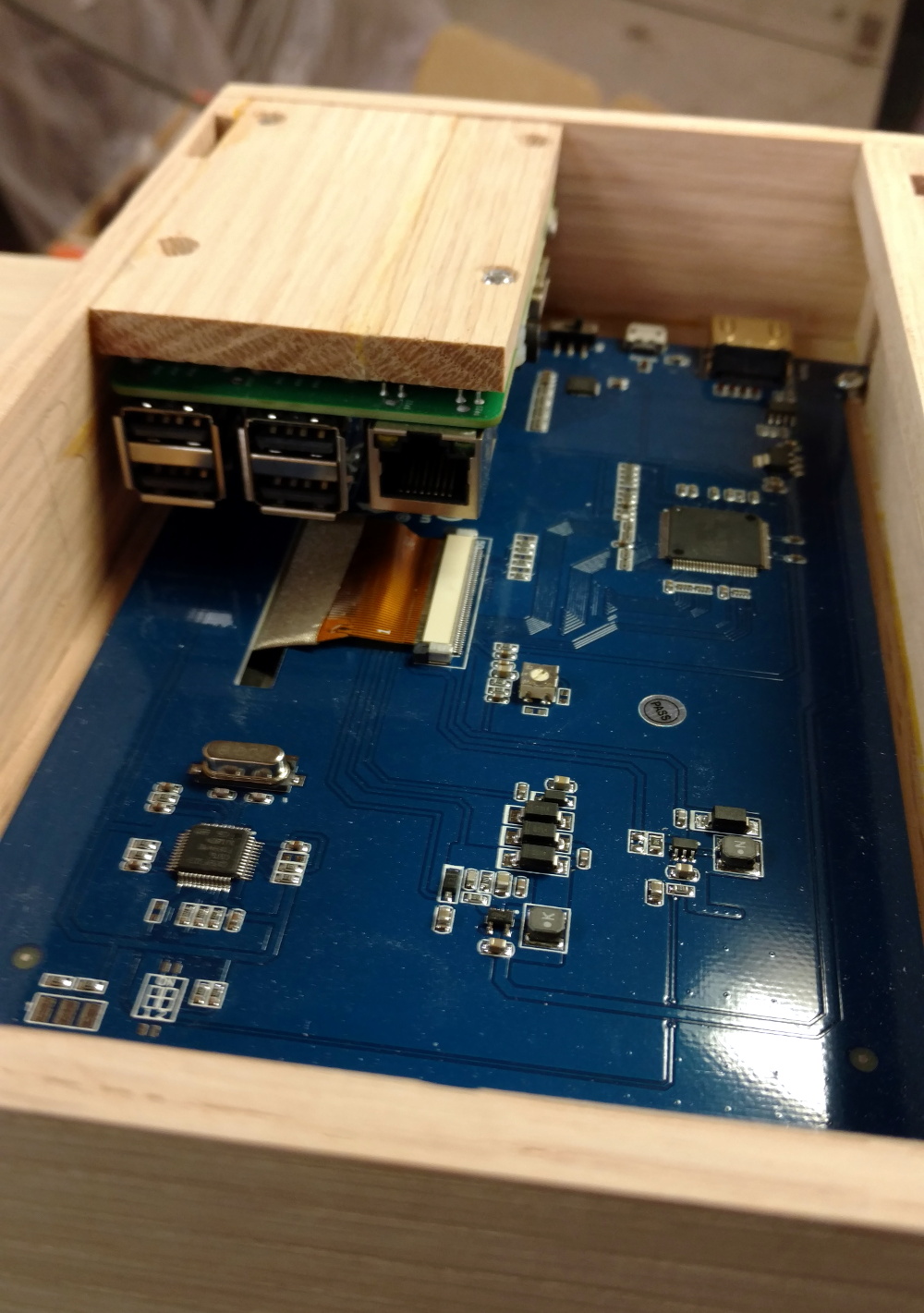
[Andy Riley] had seen plenty of builds like that, and he wasn’t having any of it. With the heart of an old laptop and bones made of IKEA cutting boards, his build is proof positive that there’s always more than one way to approach a problem that most would consider “solved” already. From the start, he set out to design and build a miniature arcade cabinet that didn’t look and feel like all the other ones he’d seen floating around online, and we think you’ll agree he delivered in a big way.

Powering the arcade with an old laptop is really a brilliant idea, especially since you can pick up older models for a song now that they’re considered nearly disposable by many users. As long as it doesn’t have a cracked display, you’ll get a nice sized LCD panel and potentially a rather powerful computer to drive it. Certainly the graphical capabilities of even the crustiest of used laptops will run circles around the Raspberry Pi, and of course it opens the possibility of playing contemporary PC games. As [Andy] shows in his detailed write-up, using a laptop does take more custom work than settling for the Pi, but we think the advantages make a compelling case for putting in the effort.

Of course, that’s only half the equation. Arguably the most impressive aspect of this build is the cabinet itself, which is made out of a couple IKEA bamboo cutting boards. [Andy] used his not inconsiderable woodworking skills, in addition to some pretty serious power tools, to turn the affordable kitchen accessories into a furniture-grade piece that really stands out from the norm. Even if you aren’t normally too keen on working with dead trees, his step-by-step explanations and pictures are a fascinating look at true craftsman at work.

If you’re more concerned with playing Galaga than the finer points of varnish application, you can always just turbocharge the old iCade and be done with it. But we think there’s something to be said for an arcade cabinet that could legitimately pass as a family heirloom.

Printed Parts Turn Ruler Into Marking Gauge

For Hackaday readers who spend more time with a soldering iron than a saw, a marking gauge is a tool used to put parallel lines on a piece of wood (and occasionally metal or plastic) for cutting. The tool is run across the edge of the piece to be marked, and an adjustment allows the user to set how far in the line will be made. As an example, if you wanted to cut a board into smaller strips, a marking gauge would be an ideal choice for laying out your lines ahead of time.

But as with many niche tools, it’s not something you’re going to use every day. For [chaosbc], this meant he wanted to see if he could come up with a DIY solution on the cheap. Plus he could have it in hand now, rather than waiting for it to take the slow boat from overseas. With the addition of a few clever 3D printed components, he was able to turn his trusty aluminum ruler into a serviceable marking gauge for the cost of filament and a few bits of hardware.

The general design of a marking gauge is fairly simple: there’s a block that rides up and down a graduated shaft (known as the headstock) which allows you to set the depth of the line, and then a piece on the end which holds your marking tool. The marking tool could be a blade if you’re working with something soft enough, but for wood is usually going to be a pencil.

[chaosbc] provides all the STL files for his DIY marking gauge, though they might need adapting as they were created for his specific ruler. Luckily the parts aren’t that complex so it shouldn’t be too difficult to get it sorted out. He also has a useful hint for anyone looking to duplicate his work: a few drops of super glue on the bolt used to lock down the headstock is enough to create a non-marring surface so you don’t tear up your ruler.

We’ve got a few other tips for woodworking on a budget, as well as a primer about this whole making stuff with dead trees concept.

Continue reading “Printed Parts Turn Ruler Into Marking Gauge”

Cool Tools: The Pantorouter Turns Tracing On Its Side

Not too long ago we wrote about a small CNC tool for automating certain parts of the woodworking process. At the time it seemed unusual in its intentionally limited scope but a few commenters mentioned it reminded them of another device, [Matthias]’s Pantorouter. It didn’t take much investigation to see that the commenters were right! The MatchSticks device does feel a bit like a CNC version of the Pantorouter, and it seemed like it was more than worth of a post by itself. The Pantorouter is a fascinating example of another small manual-but-automated tool for optimized for accelerating and improving certain woodworking operations.

Continue reading “Cool Tools: The Pantorouter Turns Tracing On Its Side”

Behold A DIY, Kid-Friendly Table Saw

The “table saw” swaps the saw for a nibbler; here it is cutting corrugated cardboard in a manner much like the saw it replaces.

“Kid-friendly table saw” seems like either a contradiction, a fool’s errand, or a lawsuit waiting to happen; but this wooden table saw for kids actually fits the bill and shows off some incredible workmanship and attention to detail as well. The project works by using not a saw blade, but a nibbler attached to a power drill embedded inside.

Unsurprisingly, the key to making a “table saw” more kid-friendly was to remove the saw part. The nibbler will cut just about any material thinner than 3 mm, and it’s impossible for a child’s finger to fit inside it. The tool is still intended for supervised use, of course, but the best defense is defense in depth.

The workmanship on the child-sized “table saw” is beautiful, with even the cutting fence and power switch replicated. It may not contain a saw, but it works in a manner much like the real thing. The cutting action itself is done by an economical nibbler attachment, which is a small tool with a slot into which material is inserted. Inside the slot, a notched bar moves up and down, taking a small bite of any material with every stroke. Embedding this into the table allows for saw-like cutting of materials such as cardboard and thin wood.

The image gallery is embedded below and shows plenty of details about the build process and design, along with some super happy looking kids.

Continue reading “Behold A DIY, Kid-Friendly Table Saw”