Salvaging An Ancient, Dangerous Machine With Wood

What do you do when you have a gigantic old drum sander with a bent table? Scrapping it will give you a few cents per pound, but this machine is just too cool, and would be too useful to just throw away. That’s when inspiration strikes. To fix this old machine, [Frank Howarth] built a new bed for an old drum sander out of wood.

The machine in question is a Frank H. Clement Surface Sanding Machine from the early part of the 20th century. This machine is basically a 30 inch long, 14 inch diameter drum that’s wrapped in sandpaper. There are removable tables for this machine, and basically what we’re looking at here is a jointer that can handle 30-inch wide boards, only it’s a sander. [Frank] picked up this machine way back in 2015 from a friend for free, but everything has a cost. There’s a problem with this sander: one of the previous owners stored a heavy jointer on the table, and the hefty iron bed was bent down in the middle. This makes the vintage surface sanding machine absolutely useless for anything. A new bed would have to be constructed.

[Frank] is a master craftsman, though, and he has enough scrap wood sitting around to build just about anything. After taking some careful measurements of the frame of the sander, he cut and glued up a few large panels of a glueLam beam, salvaged from an earlier operation. This beam is tremendously strong, and resawing and gluing it up into a panel produced a very hefty board that’s perfect for the bed of a gigantic, ancient surface sanding machine.

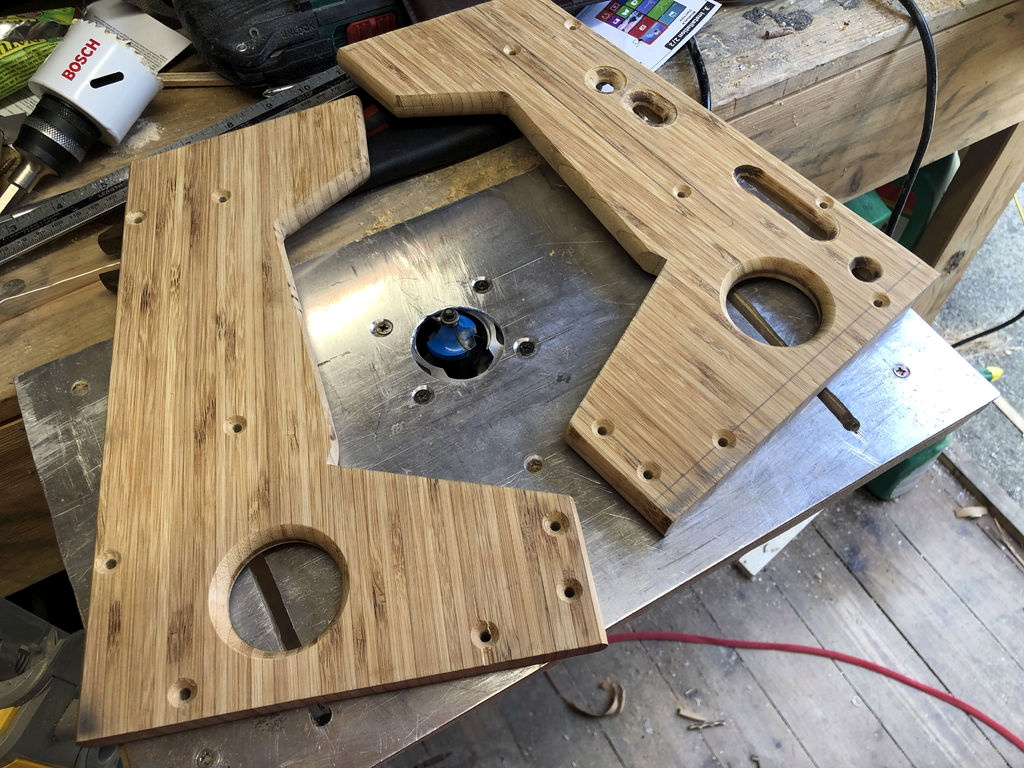
The actual fabrication of the new bed happened on [Frank]’s CNC router. The bottom of the bed was easy enough to fit to the cast iron frame, but there was an issue: because these tables are meant to butt up against a spinning drum, [Frank] needed to cut away a cove underneath the table. A CNC router can easily do this, but apparently the glueLam beam couldn’t handle it — a bit of the edge split off. These panels are basically made of glue, though, and some quick action with a few clamps saved the project.

The bed for this sander is now done, and a change in the pulley brought the speed of the drum down to something reasonable. Of course, this is a woodworking machine from the early 1900s, and safety was a secondary concern. We’re not worried, though. [Frank] still has all his fingers. A guard for the belt is in the works, though.

Continue reading “Salvaging An Ancient, Dangerous Machine With Wood”

A CNC Woodworking Tool That Does The Hard Parts

Drawn along in the wake of the 3d printing/home shop revolution has been the accessibility of traditional subtractive CNC equipment, especially routers and mills. Speaking of, want a desktop mill? Try a Bantam Tools (née Othermachine) Desktop Milling Machine or a Carvey or a Carbide 3D Nomad. Tiny but many-axis general purpose mill? Maybe a Pocket NC. Router for the shop? Perhaps a Shapeoko, or an X-Carve, or a ShopBot, or a… you get the picture. [Rundong]’s MatchSticks device is a CNC tool for the shop and it might be classified as a milling machine, but it doesn’t quite work the way a more traditional machine tool does. It computer controls the woodworker too.

Sample joints the MatchSticks can cut

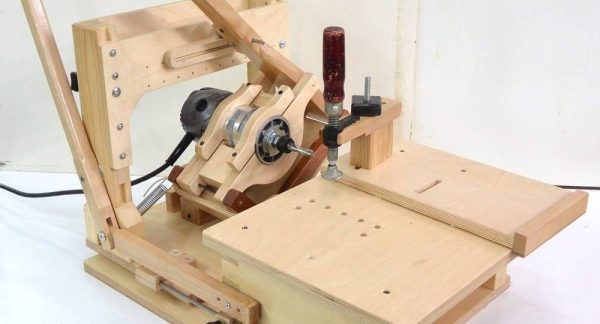
At a glance MatchSticks probably looks most similar to a Pocket NC with a big Makita router sticking out the side. There’s an obvious X-axis spoilboard with holes for fixturing material, mounted to a gantry for Z-axis travel. Below the big friendly handle on top is the router attached to its own Y-axis carriage. The only oddity might be the tablet bolted to the other side. And come to think of it the surprisingly small size for such an overbuilt machine. What would it be useful for? MatchSticks doesn’t work by processing an entire piece of stock at once (that what you’re for, adaptable human woodworker) it’s really a tool for doing the complex part of the job – joinery – and explaining to the human how to do the rest.

The full MatchSticks creation flow goes like this:

  1. Choose a design to make on the included interface and specify the parameters you want (size, etc).
  2. The MatchSticks tool will suggest what material stocks you need, and then ask you to cut them to size and prepare them using other tools.
  3. For any parts which require CNC work the tool will help guide the user to fixture the stock to its bed, then do the cutting itself.
  4. Once everything is ready for final assembly the MatchSticks will once again provide friendly instructions for where to pound the mallet.

In this way [rundong], [sarah], [jeremy], [ethan], and [eric] were able to build a much smaller machine tool without sacrificing much practical functionality. It’s almost software-like in it’s focus on a singular purpose. Why reinvent what the table saw can do when the user probably already has access to a table saw that will cut stock better? MatchSticks is an entire machine bent around one goal, making the hard stuff easier.

It’s worth noting that MatchSticks was designed as an exploration into computer/human interaction for the ACM Conference on Human Factors in Computing Systems so it’s not a commercial product quite yet (we’re eagerly waiting!). For a much more in depth look at the project and its goals and learnings the full research paper is available here. Their intro video is down after the break.

Thanks [ethan] for the tip!

Continue reading “A CNC Woodworking Tool That Does The Hard Parts”

Every Shop Needs A Giant Wooden Utility Knife

Generally speaking, we don’t cover that many woodworking projects here at Hackaday. What’s the point? It’s bad enough that wood reminds us of the outside world, but it hardly ever blinks, and forget about connecting it to Wi-Fi. This doesn’t seem to bother you fine readers, so we have to assume most of you feel the same way. But while we might not always “get” large woodworking projects around these parts, we’re quite familiar with the obsession dedication required to work on a project for no other reason than to say you managed to pull it off.

On that note, we present the latest creation of [Paul Jackman], a supersized replica of a Stanley utility knife made entirely out of wood. All wooden except for the blade anyway, which is cut from 1/8″ thick knife steel. That’s right, this gigantic utility knife is fully functional. Not that we would recommend opening too many boxes with it, as you’re likely to open up an artery if this monster slips.

We can’t imagine there are going to be many others duplicating this project, but regardless [Paul] has done a phenomenal job documenting every step of the build on his site. From cutting the rough shape out on his bandsaw to doing all painstaking detail work, everything is clearly photographed and described. After the break there’s even a complete build video.

The most interesting part has to be all of the little internal mechanisms, each one carefully reproduced at perfect scale from different woods depending on the requirements of the component. For example [Paul] mentions he choose white oak for the spring due to its flexibility. Even the screw to hold the knife closed was made out of a block of wood on the lathe.

For whatever reason, people seem to enjoy building scaled up replicas of things. We’ve seen everything from LEGO pieces to gold bars get the jumbo treatment. We suppose it’s easier than the alternative: building very tiny versions of big things.

Continue reading “Every Shop Needs A Giant Wooden Utility Knife”

Putting More Tech Into More Hands: The Robin Hoods Of Hackaday Prize

Many different projects started with the same thought: “That’s really expensive… I wonder if I could build my own for less.” Success is rewarded with satisfaction on top of the money saved, but true hacker heroes share their work so that others can build their own as well. We are happy to recognize such generosity with the Hackaday Prize [Robinhood] achievement.

Achievements are a new addition to our Hackaday Prize, running in parallel with our existing judging and rewards process. Achievements are a way for us to shower recognition and fame upon creators who demonstrate what we appreciate from our community.

Fortunately there is no requirement to steal from the rich to unlock our [Robinhood] achievement, it’s enough to give away fruits of price-reduction labor. And unlocking an achievement does not affect a project’s standings in the challenges, so some of these creators will still collect coveted awards. The list of projects that have unlocked the [Robinhood] achievement will continue to grow as the Hackaday Prize progresses, check back regularly to see the latest additions!

In the meantime, let’s look at a few notable examples that have already made the list:

Continue reading “Putting More Tech Into More Hands: The Robin Hoods Of Hackaday Prize”

Box Joint Jig Does Barcodes

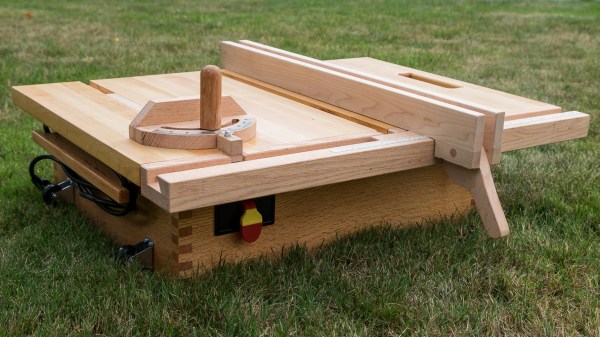
Woodworking is the fine art of turning dead tree carcasses into precision instruments. That means breaking out the saws and chisels and making many, many precise cuts over and over. If you have a table saw, every problem becomes a piece of wood, or something like that, and we’ve seen some fantastic jigs that make these precision cuts even easier. We’ve never seen something like this, though. It’s a box joint jig for a table saw, it’s automated, and it puts barcodes on boxes.

[Ben] built this box joint jig a few years ago as a computer-controlled device that slowly advances a piece of wood on a sled, allowing him to create precise, programmable box joints. The design is heavily influenced from [Matthias Wandel]’s screw advance box joint jig, but instead of wood gears (heh), [Ben] is using the Internet of Things. Or a Raspberry Pi, stepper motor, and a few LEDs. Same difference.

Although [Ben]’s previous box joints were all the same size, a programmable box joint jig can do some weird-looking joints. That’s where [Ben] got the idea to encode a barcode in walnut. After using a web app to create a barcode that encodes the number 255 — this is important for later — [Ben] programmed his jig to cut a few slots.

The box was finished as you would expect, but there’s a neat addition to the top. It’s a combination lock that opens when the combination is set to 255. It’s brilliant, and something that could be done with some handsaws and chisels, but this jig makes it so easy it’s hard to think the jig wasn’t explicitly designed for this project.

Illuminated Bread For A Cookie Cutter World

Just in case you thought your eyes were playing tricks on you, we’d like to confirm right from the start that what you are looking at is a loaf of bread with internal LED lighting. Why has this bread been internally lit? We can’t really say. But what we can do is pass on the fascinating process that took an unremarkable piece of stale bread and turned it into an exceptional piece of stale bread.

As demonstrated by [The Maker Monster], working with stale bread is basically like working with wood. Wood that you can dip in soup, granted, but wood nonetheless. The process of electrifying the loaf starts with cutting it down the length on a bandsaw, and then hollowing it out with a rotary tool. This creates a fairly translucent shell that’s basically just crust.

You’re probably wondering how you keep a bread-light from getting moldy, and thankfully [The Maker Monster] does address that issue. The bread shell is completely coated with shellac, which creates a hard protective layer that will not only prevent decay but should give it some added strength. In the video it looks like only one coat is applied, but if we had to guess, a few coats would be necessary to really seal it up. Coating it with epoxy wouldn’t be a terrible idea either.

While the shellac dries on the bread, he gets to work on the lighted base (bet you never imagined you’d read a sentence like that), which is really just a sanded piece of wood with a standard LED strip stuck too it. It’s very understated, but of course the glowing loaf really draws the eye anyway. All that’s left is to glue the bread down to the base, and proudly display your creation at your next dinner party.

We can’t say that an electric ciabatta is in the cards for Hackaday HQ; but we know that baking good bread is a science in itself, and turning the failed attempts into works of art does have a certain appeal to it.

Continue reading “Illuminated Bread For A Cookie Cutter World”

Vintage Organ Donates Parts For Two New Instruments

It’s often hard to know what to do with a classic bit of electronics that’s taking up far too much of the living room for its own good. But when the thing in question is an electronic organ from the 1970s, the answer couldn’t be clearer: dissect it for its good parts and create two new instruments with them.

Judging by [Charlie Williams]’ blog posts on his Viscount Project, he’s been at this since at least 2014. The offending organ, from which the project gets its name, is a Viscount Bahia from the 1970s that had seen better days, apparently none of which included a good dusting. With careful disassembly and documentation, [Charlie] took the organ to bits. The first instrument to come from this was based on the foot pedals. A Teensy and a custom wood case turned it into a custom MIDI controller; hear it in action below. The beats controller from the organ’s keyboard was used for the second instrument. This one appears far more complex, not only for the beautiful, hand-held wooden case he built for it, but because he reused most of the original circuitry. A modern tube amp was added to produce a little distortion and stereo output from the original mono source, with the tip of the tube just peeking above the surface of the instrument. We wish there were a demo video of this one, but we’ll settle for gazing at the craftsmanship.

In a strange bit of timing, [Elliot Williams] (no relation, we assume) just posted an Ask Hackaday piece looking for help with a replacement top-octave generator for another 1970s organ. It’s got a good description of how these organs worked, if you’re in the mood to learn a little more.

Continue reading “Vintage Organ Donates Parts For Two New Instruments”