Quirky Electric Car Rides The Rails

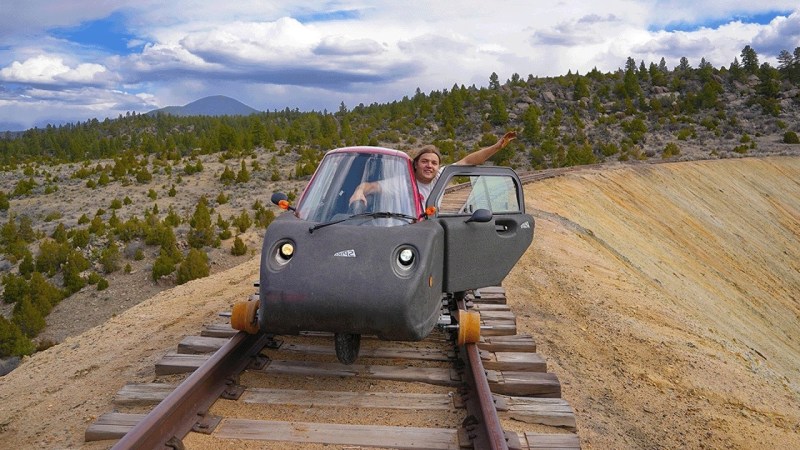
We wouldn’t be surprised if you’d never seen the Spira before. The lightweight three-wheel vehicle is closer to a go-kart than a traditional car, and that’s before you even get to the foam body panels. But even the most niche of products enjoys a certain fandom, and [Matt Spears] certainly seems to love working on his Spira. His latest video documents the new modifications he’s made to the car in an effort to ride it on abandoned railroad tracks in the western United States.

His first attempt at riding the rails worked pretty well but he hit an obstruction at high speed which destroyed his front axle and damaged a few other parts on the vehicle, which gave him a perfect excuse to make some upgrades. He swapped the old rear axle out with one from a go-kart, complete with custom wheels and a new braking system. The drivetrain received an upgrade with a 5 kW electric motor, and although [Matt] planned on casting new wheels for the higher speeds, the chemicals he needed didn’t arrive in time. So, to test the new vehicle he repurposed some old wheels just to get the Spria back out on the tracks.

The test run went so well that [Matt] ended up pushing the vehicle farther than he had ever been on this abandoned rail, including over a questionable trestle and far out into the wilderness. Hopefully we’ll see more videos of [Matt] taking this car to explore even more remote places. In the meantime, take a look at some simpler, non-electric vehicles that are often used to explore abandoned rail lines in California.

Continue reading “Quirky Electric Car Rides The Rails”

Electric Truck Sets Racing Record

The 24 Hours of Le Mans races is an extremely prestigious endurance motorsport event which attracts the best cars and drivers from around the world. It’s one of the longest-running races too, taking place once a year since 1923 (with a few obvious understandable gaps). But, like most motorsports, it’s financially out of reach for most people. One of the more popular attempts to bring racing to the masses has been the 24 Hours of Lemons races, which have price limits on vehicles to keep the barrier to entry low, and an EV truck recently entered one of these races with some interesting results.

The group behind this vehicle is called Team Arcblast, who retrofitted an old Datsun pickup truck to the extreme to enter this race. The modestly sized electric motor is installed in between the cab and the bed for easy access to the driveshaft, with the engine bay repurposed for all of the cooling and radiators needed for endurance racing like this. They’ve also equipped the truck with plenty of efficiency-increasing spoilers and other aerodynamic parts, and rebuilt the cab with not only the required roll cage and other safety equipment, but a modified driving position with steering and other components from various Miatas.

The most impressive part of this build, however, is the battery. The team invented a method of swapping out batteries quickly to avoid having to fast charge the car in the pit area. The system lets a battery slide in to the middle of the truck above the motor and quickly connect to the electrical system allowing for very quick pit stops and the ability to charge other batteries while the race goes on. All of these modifications together allowed the team to break the EV record for a Lemons race.

For a Lemons race, though, even this truck stretches the original spirit that these races were started, however impressive the build. We published a primer to these types of races a while back which includes much more affordable internal combustion options.

Thanks to [JohnU] for the tip!

Continue reading “Electric Truck Sets Racing Record”

Hydrofoil Bikes Are Harder To Build Than You Think

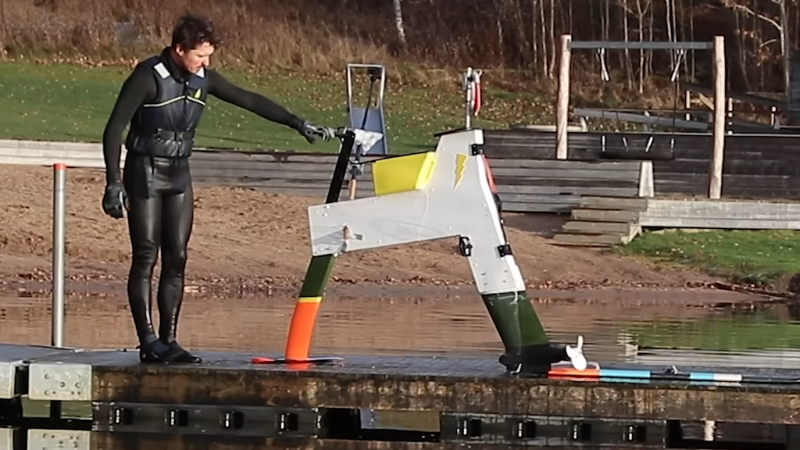
Hydrofoils are perhaps best known for their application on boring ferries and scary boats that go too fast. However, as [RCLifeOn] demonstrates, you can also use them to build fun and quirky personal watercraft. Like a hydrofoil bike! Only, there are some challenges involved.

Hydrofoils work much like airfoils in air. The shape of the foil creates lift, raising the attached vehicle out of the water. This allows the creation of a craft that can travel more quickly because the majority of its body is not subject drag from the water. The key is to design the craft such that the hydrofoils remain at the right angle and depth to keep the craft lifted out of the water while remaining stable.

The hydrofoil bike is created out of a combination of plywood, foam, and 3D printed components. It uses a powerful brushless motor for propulsion, and that’s about it. Sadly, despite the simplicity, it wasn’t an instant success. As you might expect, balancing on the bike is quite difficult, particularly when trying to get it started—as the foils need some speed to actually start generating meaningful lift.

After further research into commercial hydrofoil bikes, [RCLifeOn] realized that the buoyancy of the bike made it too hard to straddle when starting out. Some of the 3D printed foils also proved more than a little fragile. It’s back to the drawing board for now—the power system is likely up to snuff, but the dynamics of the platform need work. It’s perhaps no surprise; we’ve covered the challenges of hydrofoil stability before. If you want to go fast on water, you could go the easier route and just build an electric surfboard. Video after the break.

Continue reading “Hydrofoil Bikes Are Harder To Build Than You Think”

Scratch-built Electric Boat Shows Off Surprising Speed

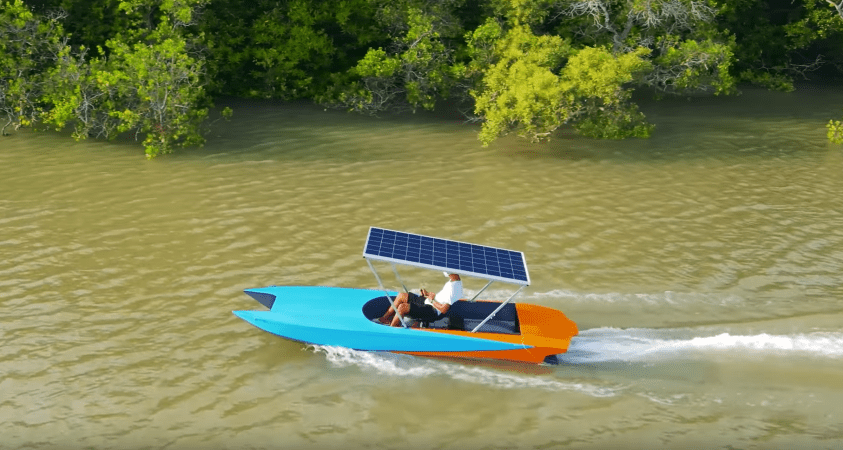
Electric cars are everywhere these days, but what about boats? Looking to go green on the water, [NASAT] put together this impressively nimble boat propelled by a pair of brushless motors.

The boat itself has a completely custom-built hull, using plywood as a mold for the ultimate fiberglass body. It’s a catamaran-like shape that seems to allow it to get on plane fairly easily, increasing its ultimate speed compared to a displacement hull. It gets up to that speed with two electric motors totaling 4 kW, mated to a belt-driven drivetrain spinning a fairly standard prop. Power is provided by a large battery, and the solar panel at the top can provide not only shade for the operator, but 300 W to charge the battery when the motors are not being used.

With the finishing touches put on, the small single-seat boat effortlessly powers around the water with many of the same benefits of an electric car: low noise, low pollution, a quiet ride, and a surprisingly quick feel. Electrification has come for other boats as well, like this sailing catamaran converted to electric-only. Even some commercial boats have begun to take the plunge.

Continue reading “Scratch-built Electric Boat Shows Off Surprising Speed”

Jettison Sails For Electric Propulsion

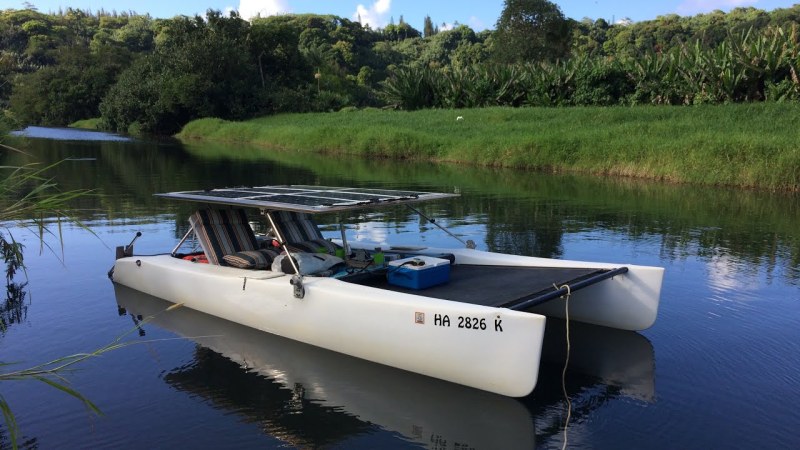
Although there are some ferries and commercial boats that use a multi-hull design, the most recognizable catamarans by far are those used for sailing. They have a number of advantages over monohull boats including higher stability, shallower draft, more deck space, and often less drag. Of course, these advantages aren’t exclusive to sailboats, and plenty of motorized recreational craft are starting to take advantage of this style as well. It’s also fairly straightforward to remove the sails and add powered locomotion as well, as this electric catamaran demonstrates.

Not only is this catamaran electric, but it’s solar powered as well. With the mast removed, the solar panels can be fitted to a canopy which provides 600 watts of power as well as shade to both passengers. The solar panels charge two 12V 100ah LifePo4 batteries and run a pair of motors. That’s another benefit of using a sailing cat as an electric boat platform: the rudders can be removed and a pair of motors installed without any additional drilling in the hulls, and the boat can be steered with differential thrust, although this boat also makes allowances for pointing the motors in different directions as well. 

In addition to a highly polished electric drivetrain, the former sailboat adds some creature comforts as well, replacing the trampoline with a pair of seats and adding an electric hoist to raise and lower the canopy. As energy density goes up and costs come down for solar panels, more and more watercraft are taking advantage of this style of propulsion as well. In the past we’ve seen solar kayaks, solar houseboats, and custom-built catamarans (instead of conversions) as well.

Continue reading “Jettison Sails For Electric Propulsion”

Electric Catamaran Sails High Seas Of Inland Canada

There are a number of plans for DIY boats available online, so [Phil] went in search of one for a custom catamaran to travel the inland waterways of Canada. But none of the plans he found had options for electric motors so he modified one popular plan to include not only that, but plenty of other unique features as well throughout a long series of videos.

This isn’t [Phil]’s first electric boat, either. His first was a monohull with a long canopy above, providing shade for the occupants and a platform to mount solar panels. But that one was top heavy and unstable, so he pivoted to this catamaran design instead which has the perk of not only stability but a small draft. The plans were modified to use a similar propulsion system, though, but mounting the heavy panels on the roof of this boat was much less problematic. The roof itself retracts, and also includes some mosquito netting to enclose the cabin. He’s also added a head which is situated inside one of the hulls and has doors which fit into the retractable roof structure as well.

For navigating the peaceful inland waterways of Canada like the famous Rideau Canal, the Trent Severn Waterway which [Phil] frequents, or even quiet Ontario lake towns like Bobcaygeon we can’t imagine a better way to go that a peaceful, small electric boat like this one.

As summer rolls around in the northern hemisphere we’ll hope to see other solar electric boats like these out on the water, like this smaller electric-assisted kayak or this much larger solar electric houseboat.

Continue reading “Electric Catamaran Sails High Seas Of Inland Canada”

Homebrew Foil And Oil Caps Change Your Guitar’s Tone

How any string instrument sounds depends on hundreds of factors; even the tiniest details matter. Seemingly inconsequential things like whether the tree that the wood came from grew on the north slope or south slope of a particular valley make a difference, at least to the trained ear. Add electronics into the mix, as with electric guitars, and that’s a whole other level of choices that directly influence the sound.

To experiment with that, [Mark Gutierrez] tried rolling some home-brew capacitors for his electric guitar. The cap in question is part of the guitar’s tone circuit, which along with a potentiometer forms a variable low-pass filter. A rich folklore has developed over the years around these circuits and the best way to implement them, and there are any number of commercially available capacitors with the appropriate mojo you can use, for a price.

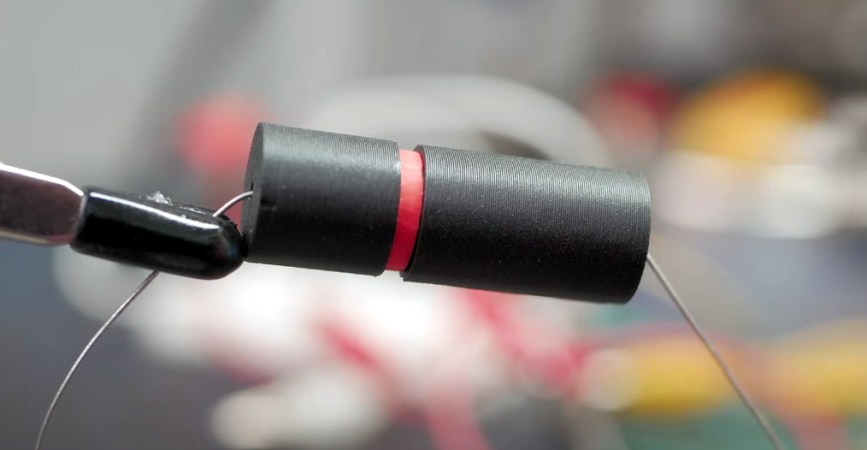
[Mark]’s take on the tone cap is made with two narrow strips of regular aluminum foil separated by two wider strips of tissue paper, the kind that finds its way into shirt boxes at Christmas. Each of the foil strips gets wrapped around and crimped to a wire lead before the paper is sandwiched between. The whole thing is rolled up into a loose cylinder and soaked in mineral oil, which serves as a dielectric.

To hold the oily jelly roll together, [Mark] tried both and outer skin of heat-shrink tubing with the ends sealed by hot glue, and a 3D printed cylinder. He also experimented with a wax coating to keep the oily bits contained. The video below shows the build process as well as tests of the homebrew cap against a $28 commercial equivalent. There’s a clear difference in tone compared to switching the cap out of the circuit, as well as an audible difference in tone between the two caps. We’ll leave the discussion of which sounds better to those with more qualified ears; fools rush in, after all.

Whatever you think of the sound, it’s pretty cool that you can make working capacitors so easily. Just remember to mark the outer foil lead, lest you spoil everything.

Continue reading “Homebrew Foil And Oil Caps Change Your Guitar’s Tone”