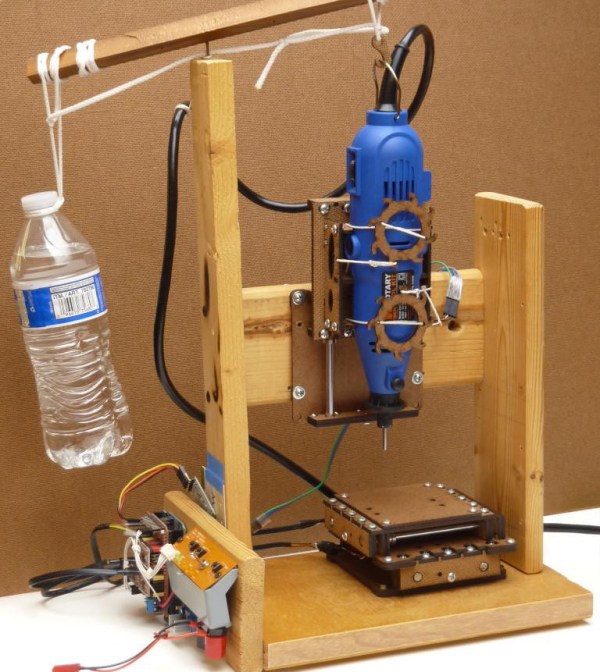
The DIY LIL CNC project is the newest member of the homebrew fabrication scene. This is a three-axis CNC mill that can be built by anyone with basic shop skills and about $700 in their pocket. Many of the materials can be acquired from the likes of Home Depot: the basic framework is assembled from Masonite, while other cost-cutting measures include the use of skate bearings and a common Dremel tool for powering the cutting bit. About half of the cost is for the HobbyCNC driver and stepper motor package that runs the show.
The instructions for the DIY LIL CNC are distributed under a Creative Commons license, allowing for modification and distribution with few restrictions. They’re well-written and quite thorough, including all patterns and a complete bill of materials with suppliers, part numbers and costs. As documented, the ’bot can produce parts up to 12 x 14 x 2 inches, but the project’s creators offer some suggestions on adapting the design for larger work. It’s not self-replicating like the RepRap aims for; you’ll need access to a laser cutter for some of the parts. If you can clear that hurdle, this looks like a great introduction to CNC production.
The folks over at Kirkham Motorsports have turned out two things of beauty. The first is a sky’s-the-limit milled aluminum car. The second is a book about the making of the car that runs $4500 per copy. Why so much for a book? The binding is milled out of a 35 pound aluminum billet.
The project spans a 2 1/2 year build cycle and showcases the gamut of craftsmanship. The extremely detailed build log is available at their website in PDF form. Of particular interest to us is Chapter 10: Milling. The sheer volume of machined parts for this roadster is mind-boggling. There’s also plenty of CNC pipe bending involved with the body work in Chapter 18.
Finish up your work this morning and spend the rest of the day with this fantasy creation. If you’ve got too much to do, why not shell out for the hard-copy version and devote your weekend to metal-working romance?
[Chris] liked Cartesian RepRap idea so much that he decided to design his master’s diploma project around it. Though it uses most of the same parts as the RepRap (even the PCBs), [Chris] has adapted it so it does milling rather than 3D printing. Most of the parts (such as the stepper motors) were harvested from old inkjet printers and typewriters. The thee-axis CNC machine can already etch and carve styrofoam at an impressively high resolution. To deal with all of the debris that comes with milling, a vacuum attachment (shown attached) was created. [Chris] is considering adapting it so it can work with wood and aluminum as well. Best of all, it uses standard G-code files, just like the RepRap. A publication by [Chris] on the project is also available through his website. No plans to release a kit have been announced yet, but we’ll wait and see. If any commenter knows of an open source CNC milling machine available as a kit, feel free to post a link to it below.
We’ve seen a lot of 3d printing lately, with the RepRap and Cupcake, both the fused deposition modeling type. We don’t often see the Inkjet method. This is a great example of one, built in someones home. Instead of laying down layers of molten plastic, he uses the inkjet system to deposit glue like substances into layers of plaster. This project is much higher resolution than the other two, as you can see in the video of it making an RC engine case below. He is currently rebuilding it to be even better and larger.
[Murray484] submitted his instructable on how to create a stepper motor controller from an old scanner. He removed the motor and controller from an old scanner then harvested the parts. He’s pretty much starting over, taking the ULN2003 chip from the scanner motor controller and putting it on a fresh board. He then wired it all up, installed the software and got it working. Finally, he built a container out of cardboard for it all. Though he could have made it nicer looking and used higher quality building materials, he was trying to make this a “green” project for the epilog laser cutter contest. He’s done a good job recycling, this could be pretty useful.
With some careful programming and probably tedious testing, [Tim] was able to get his CNC router to play [Jonathan Coulton's] “Still Alive”. He didn’t just tell the motors to spin at the correct speeds directly though. He computed the 3d vectors necessary to produce the notes. The router thinks it is just doing its job. We would love to see those vectors rendered out in 3d space. Imagine having a physical sculpture of “Still Alive” as seen by a CNC machine. This reminds us of the Obsolete Technology Band.
Robot Magazine has a great article about how to machine custom robot parts. In this article [Matt Bauer] shows the basics of making custom robot parts and skeletal brackets for his humanoid robot creations using a CNC mini-mill. He uses a custom jig overlay designed to make cutting thin sheet stock much easier and to protect his equipment. This template concept creates a platform for many other custom parts going forward. [Matt] includes the .nc g-code files as well as a “how-to” PDF in a ZIP file.
How do hardware geeks carve pumpkins? With giant home made CNC mills, that’s how. Using the open source CNC kit from Lumenlab.com, they converted a photograph into g-code, then fed it to the machine. After about 20 minutes of pumpkin drilling, they had this beautiful jack-o’-lantern. We are definitely jealous. Keep up the good work Lumenlab.
[CarlS] wanted to build a low cost x y table for display on teletoyland.com. He realized that to keep cost low, he could use hobby servos instead of stepper motors. Exact precision wasn’t a big issue here, so the hobby servos would be perfectly acceptable.
Though Linear hobby servos are available, he decided that the cost was prohibitive. He used normal hobby servos, but had to modify their internals to get the exact amount of travel necessary. Many people modify the hobby servos for continuous rotation, but this would cause a loss in the ability for exact positioning. Instead, he replaced the potentiometer that measures the position of the servo with a 10 turn potentiometer. This allowed him 10x the travel.