Distributed Censorship Or Extortion? The IoT Vs Brian Krebs

Now it’s official. The particular website that was hit by a record-breaking distributed denial of service (DDOS) attack that we covered a few days ago was that of white-hat security journalist [Brian Krebs]: Krebs on Security.

During the DDOS attack, his site got 600 Gigabits per second of traffic. It didn’t involve amplification or reflection attacks, but rather a distributed network of zombie domestic appliances: routers, IP webcams, and digital video recorders (DVRs). All they did was create HTTP requests for his site, but there were well in excess of 100,000 of these bots.

In the end, [Krebs’] ISP, Akamai, had to drop him. He was getting pro bono service from them to start with, and while they’ve defended him against DDOS attacks in the past, it was costing them too much to continue in this case. An Akamai exec estimates it would have cost them millions to continue defending, and [Brian] doesn’t blame them. But when Akamai dropped the shields, his hosting provider would get slammed. [Krebs] told Akamai to redirect his domain to localhost and then he went dark.

Continue reading “Distributed Censorship Or Extortion? The IoT Vs Brian Krebs”
Homebrew Powerwall Sitting At 20kWh

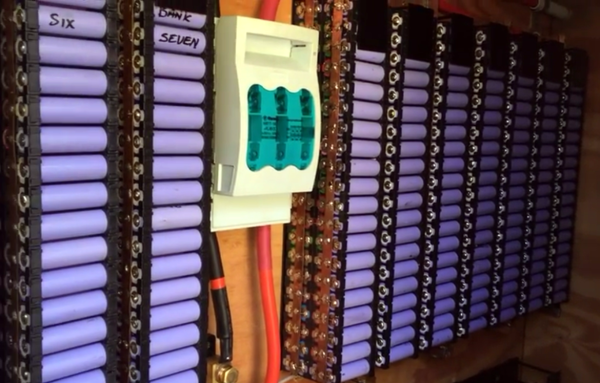
Every now and then a hacker gets started on a project and forgets to stop. That’s the impression we get from [HBPowerwall]’s channel anyway. He’s working on adding a huge number of 18650 Lithium cells to his home’s power grid and posting about his adventures along the way. This week he gave us a look at the balancing process he uses to get all of these cells to work well together. Last month he gave a great overview of the installed system.

His channel starts off innocently enough. It’s all riding small motor bikes around and having a regular good time.  Then he experiments a bit with the light stuff, like a few solar panels on the roof.  However, it seems like one day he was watching a news brief about the Powerwall (Tesla’s whole-home battery storage system) and was like, “hey, I can do that.”

After some initial work with the new substance it wasn’t long before he was begging, borrowing, and haggling for every used 18650 lithium battery cell the local universe in Brisbane, Australia could sell him. There are a ton of videos documenting his madness, but he’s all the way up to a partly off-grid house with a 20kWh battery bank, for which he has expansion plans.

There’s a lot of marketing flim flam and general technical pitfalls in the process of generating your own non-grid electricity. But for hackers in sunny areas who want to dump those rays into local storage this is an interesting blueprint to start with.

Continue reading “Homebrew Powerwall Sitting At 20kWh”

3D Printing A Stop Motion Animation

How much access do you have to a 3D printer? What would you do if you had weeks of time on your hands and a couple spools of filament lying around? Perhaps you would make a two second stop-motion animation called Bears on Stairs.

An in-house development by London’s DBLG — a creative design studio — shows a smooth animation of a bear — well — climbing stairs, which at first glance appears animated. In reality, 50 printed sculptures each show an instance of the bear’s looping ascent. The entire process took four weeks of printing, sculpture trimming, and the special diligence that comes with making a stop-motion film.

Continue reading “3D Printing A Stop Motion Animation”

Hackaday Prize Entry: Bypassing TV Broadcasting Restrictions

It’s a common problem faced by TV viewers, the programming they want to watch is being broadcast, but not to their location. TV content has traditionally been licensed for transmission by geography, and this has sometimes put viewers at odds with broadcasters.

The viewing public have not always taken this restriction of their programming choice lying down, and have adopted a variety of inventive solutions with varying degrees of legality and success. Many years ago you might have seen extreme-length UHF antennas to catch faraway transmitters, more recently these efforts have been in the digital domain. It was said in the 1990s that Sky’s Videocrypt satellite TV smart cards were cracked because German Star Trek Next Generation fans were unable to buy subscriptions for non-UK addresses, for example. You can argue in the comments over whether [Patrick Stewart] et al being indirectly responsible for a decryption coup is an urban legend, but it is undeniable that serial smart card emulators and dodgy DOS software for Sky decryption were sold all over Europe at the time.

Modern-day efforts to break the geographic wall on TV broadcasting have turned to the Internet. Services such as the ill-fated Aereo and the Slingbox set-top streaming products have taken the TV broadcast in a particular area and transported it to other locations for viewing online. But they are not the only Internet self-streaming option, if the idea of paying a subscription or tying yourself to a commercial service does not appeal then you can build an off-air streamer for yourself.

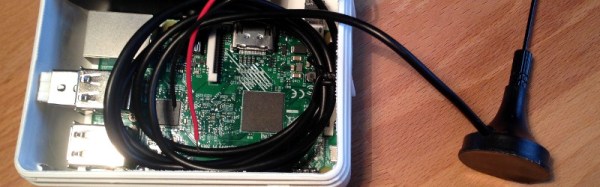
[Solenoid]’s project is an off-air streamer using a Raspberry Pi 3 with a USB DVB-T tuner. It uses Tvheadend to power the streaming, and OpenVPN to provide security. His build logs detail his efforts to ensure that power consumption is not too high and that the Pi is not running too hot, and provides instructions on how to set up and use the software. It’s not an overly complex piece of hardware, but it could provide a useful service for any of you who wish to keep up-to-date with your home TV when you are off on your travels.

Listen To The Sun, Saturn, And The Milky Way With Your Own Radio Telescope

Students from the Indian Institute of Science Education and Research combined a commercial satellite dish, a satellite finder and an Arduino, and produced a workable radio telescope. The satellite dish provides the LNB (low noise block) and the associated set-top box is used only for power.  Their LNB employs an aluminum foil shield to block extraneous signals.

In addition to the hardware, the team built Python software to analyze the data and show several practical applications. They used known geostationary satellites to calibrate the signal from the finder (digitized by the Arduino) to determine power per unit voltage. They also calculated the beam width (about 3.4 degrees) and used the sun for other calibration steps.

Continue reading “Listen To The Sun, Saturn, And The Milky Way With Your Own Radio Telescope”

808 Drum Machine In An ATTiny 14-Pin Chip

You may not know the 808 drum machine, but you have definitely heard it: the original Roland TR-808 was the first programmable drum machine and has been a mainstay of electronic music ever since. Hackers have been building their own versions of this vintage device for years, but this version from do-it-yourself synth builder [Jan Ostman] is quite remarkable.

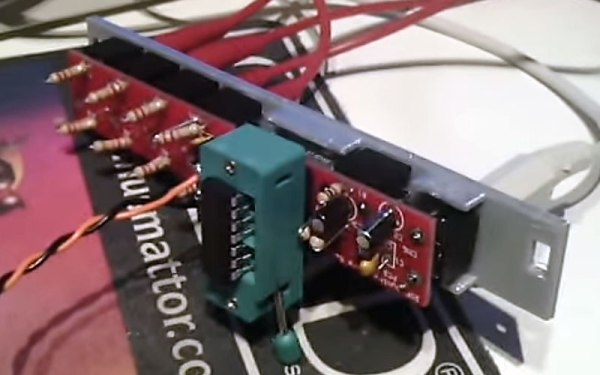
He’s packed the entire device (called the Drum8 Vintage) into a single ATtiny84 14-pin DIP package, including the samples and eight polyphonic voices, plus old-school analog CV triggers, a global tune and an analog global accent input. That won’t mean a lot to non-musicians, but suffice to say that these are the same inputs that the original TR-808 had that allowed you to do all sorts of interesting stuff to trigger and modify the drum sounds. Plus some extras.

[Jan] is offering the chip itself for $20, and has made a limited edition version that is built into a patch bay panel for that genuine hard-wired look for $99. If you want to go the home-made route and make your own, he’s released the source code and schematics for making your own. You can check out more of [Jan’s] work in this post on making your own open-source instruments from Elliot. Thanks, Jan!

SIM Card Connectors And White PCBs Make Huge LED Snowflakes Happen

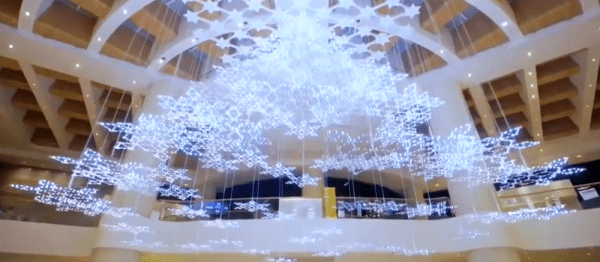
[Mike Harrison] talked about designing and building a huge scale LED lighting installation in which PCBs were used as both electrical and mechanical elements, and presented at Electromagnetic Field 2016. The project involved 84,000 RGBW LEDs, 14,000 microcontrollers and 25,000 PCBs. It had some different problems to solve compared to small jobs, but [Mike] shared techniques that could be equally applied to smaller scale projects or applications. He goes into detail on designing for manufacture and assembly, sourcing the parts, and building the units on-site.

The installation itself was a snowflake display for a high-end shopping mall in Hong Kong in the 2015 Christmas season. [Mike] wanted a small number of modular boards that could be connected together on-site to make up the right shapes. In an effort to minimize the kinds of manufacturing and parts needed, he ended up using modular white PCBs as structural elements as well as electrical. With the exception of some minor hardware like steel wire supports, no part of the huge snowflakes required anything outside of usual PCB manufacturing processes to make. The fewer suppliers, the fewer potential problems. [Mike] goes into design detail at 6:28 in the video.

For the connections between the boards, he ended up using SIM card connectors intended for cell phones. Some testing led to choosing a connector that matched up well with the thickness of a 1.6mm PCB used as a spacer. About 28,000 of them were used, and for a while in 2015 it was very hard to get a hold of that particular part, because they had cleaned everyone out! Continue reading “SIM Card Connectors And White PCBs Make Huge LED Snowflakes Happen”