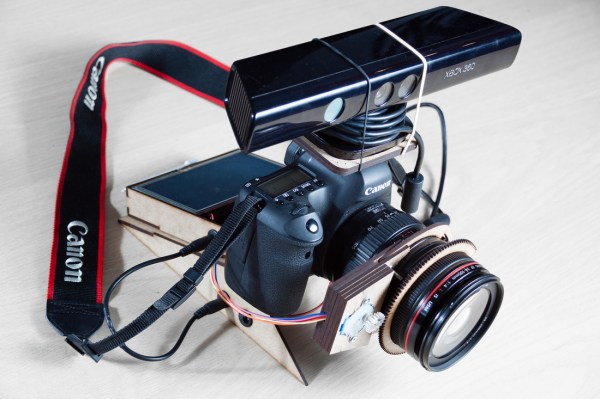
Prosumer DSLRs have been a boon to the democratization of digital media. Gear that once commanded professional prices is now available to those on more modest budgets. Not only has this unleashed a torrent of online content, it has also started a wave of camera hacks and accessories, like this automatic focus puller based on a Kinect and a Raspberry Pi.
For [Tom Piessens], the Canon EOS 5D has been a solid platform but suffers from a problem. The narrow depth of field possible with DSLRs makes it difficult to maintain focus on subjects that are moving relative to the camera, making follow-focus scenes like this classic hard to reproduce. Aiming for a better system than the stock autofocus, [Tom] grafted a Kinect sensor and a stepper motor actuator to a Raspberry Pi, and used the Kinect’s depth map to drive the focus ring. Parts are laser-cut, including a nice enclosure for the Pi and display that makes the whole thing reasonably portable. The video below shows the focus remaining locked on a selected region of interest. It seems like movement along only one axis is allowed; we’d love to see this system expanded to follow a designated object no matter where it moves in the frame.
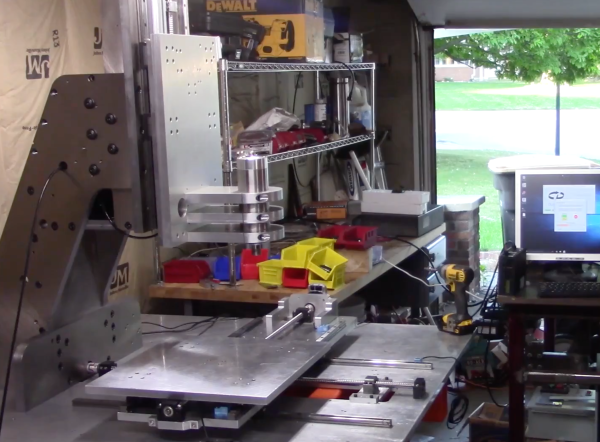
A VMC (vertical machining center) is essentially a CNC vertical milling machine on steroids. Many CNC mills are just manual milling machines that have been converted to CNC control. They work nicely, but have a number of drawbacks when it comes to real world CNC milling: manual tool changes, lack of chip collection, lack of coolant containment, and backlash issues (which a manual machinist normally compensates for).
These problems are solved with a VMC, which will usually have an automatic tool changer, and an enclosure to contain coolant and wash chips down into a collection pan. They are, however, very expensive, very big, and very heavy. Building one from scratch is a massive undertaking, but one which [Chris DePrisco] was brave enough to take on.
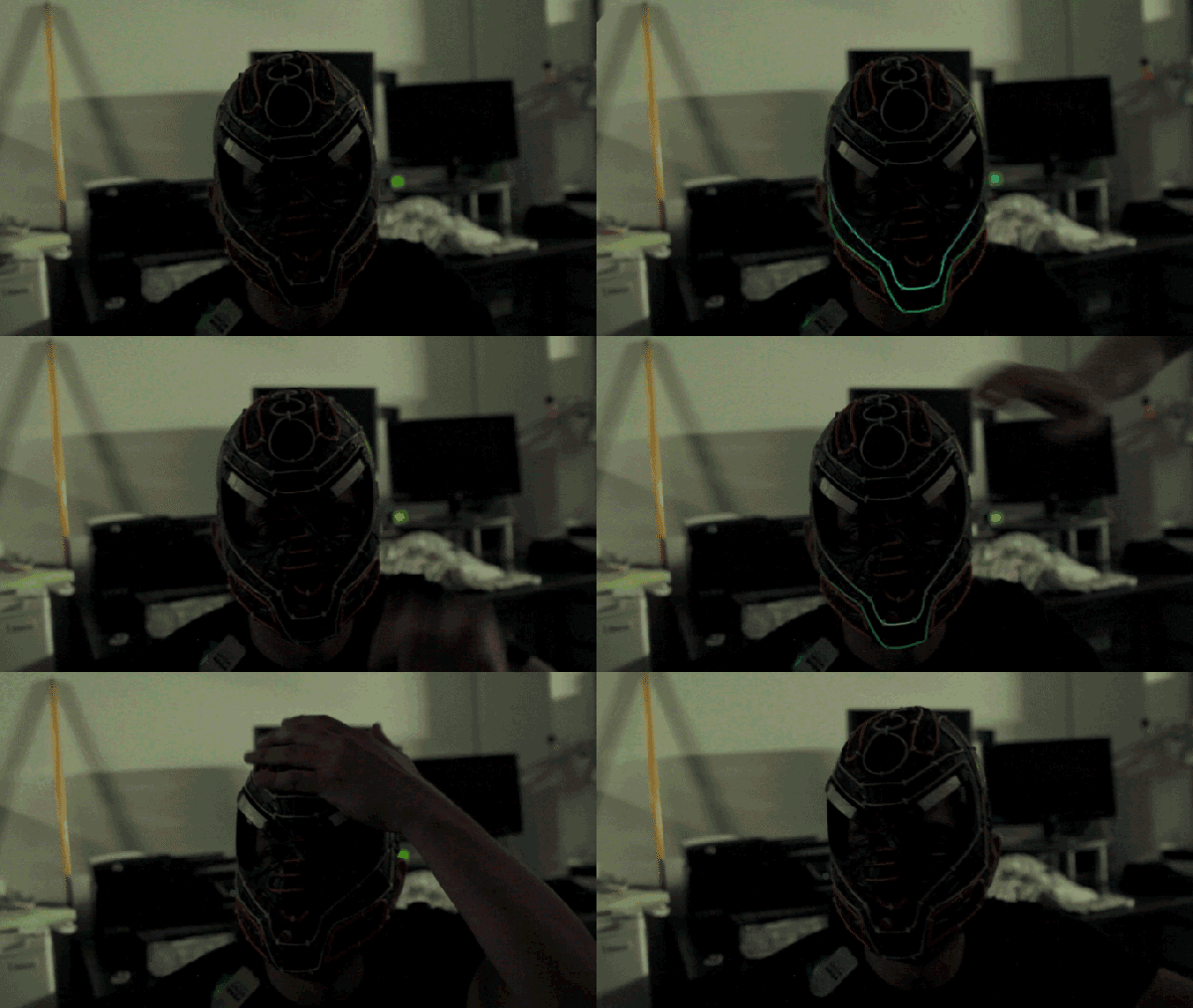
If you thought glowy wearables have had their time, guess again! After a few years designing on the side, [Josh] and [his dad] have created a nifty feature for EL wire: they’ve made it touch sensitive. But, of course, rather than simply show it off to the world, they’ve launched a Kickstarter campaign to put touch-sensitive El Wire in the hands of any fashion-inspired electronics enthusiast.
El Wire (and tape) are composed of two conducting wires separated by a phosphor layer. (Starting to sound like a capacitor?) While the details are, alas, closed for now, the interface is Arduino compatible, making it wide open to a general audience of enthusiasts without needing years of muscled programming experience. The unit itself, dubbed the Whoaboard, contains the EL Wire drivers for four channels at about 10ft of wire length.
El Wire has always been a crowd favorite around these parts (especially in Russia). We love that [Josh’s] Whoaboard takes a conventional material that might already be lying around your shelves and transforms it into a fresh new interface. With touch-sensitivity, we can’t wait to see the community start rolling out everything from costumes to glowy alien cockpits.
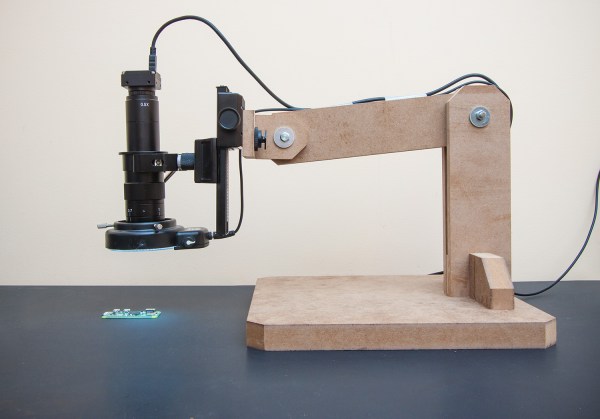
As your builds get smaller and your eyes get older, you might appreciate a little optical assistance around the shop. Stereo microscopes and inspection cameras are great additions to your bench, but often command a steep price. So this DIY PCB inspection microscope might be just the thing if you’re looking to roll your own and save a few bucks.
It’s not fancy, and it’s not particularly complex, but [Saulius]’ build does the job, mainly because he thought the requirements through before starting the build. MDF is used for the stand because it’s dimensionally stable, easy to work, and heavy, which tends to stabilize motion and dampen vibration. The camera itself is an off-the-shelf USB unit with a CS mount that allows a wide range of lenses to be fitted. A $20 eBay macro slider allows for fine positioning, and a ring light stolen from a stereo microscope provides shadow-free lighting.
We’d say the most obvious area for improvement would be a linkage on the arm to keep the plane of the lens parallel to the bench, but even as it is this looks like a solid build with a lot of utility – especially for hackers looking to age in place at the bench.
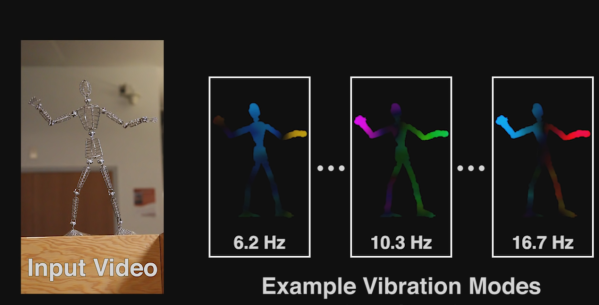
If a picture is worth a thousand words, a video must be worth millions. However, computers still aren’t very good at analyzing video. Machine vision software like OpenCV can do certain tasks like facial recognition quite well. But current software isn’t good at determining the physical nature of the objects being filmed. [Abe Davis, Justin G. Chen, and Fredo Durand] are members of the MIT Computer Science and Artificial Intelligence Laboratory. They’re working toward a method of determining the structure of an object based upon the object’s motion in a video.
The technique relies on vibrations which can be captured by a typical 30 or 60 Frames Per Second (fps) camera. Here’s how it works: A locked down camera is used to image an object. The object is moved due to wind, or someone banging on it, or any other mechanical means. This movement is captured on video. The team’s software then analyzes the video to see exactly where the object moved, and how much it moved. Complex objects can have many vibration modes. The wire frame figure used in the video is a great example. The hands of the figure will vibrate more than the figure’s feet. The software uses this information to construct a rudimentary model of the object being filmed. It then allows the user to interact with the object by clicking and dragging with a mouse. Dragging the hands will produce more movement than dragging the feet.
The results aren’t perfect – they remind us of computer animated objects from just a few years ago. However, this is very promising. These aren’t textured wire frames created in 3D modeling software. The models and skeletons were created automatically using software analysis. The team’s research paper (PDF link) contains all the details of their research. Check it out, and check out the video after the break.
If there was one book that describes what it means to be in the trenches of a cutting edge design, that book is The Soul Of a New Machine. Tracy Kidder’s Pulitzer prize-winning book has been an inspiration to thousands over the years.
Soul is the story of the creation of the Data General Eclipse MV/8000, code-named Eagle. Eagle was Data General’s first 32-bit minicomputer. If you’re not a retrocomputing aficionado, minicomputers were a major industry back in the 70’s and 80’s. Starting in 1964 with the Digital Equipment Corporation (DEC) PDP-8, minis provided a low-cost means for companies to get a computer. The only other option was a huge mainframe from companies like IBM. Minicomputers chugged along until the 1990s when microprocessor-based PCs and workstations passed them by. The market, and the industry evaporated.
Today, more than 30 years later, minicomputers are all but forgotten. Data General itself is long gone, purchased by EMC in 1999. DG’s mark on the landscape has all but been erased by the swiftly moving sands of technical progress. All except for the snapshot Kidder set down in Soul.
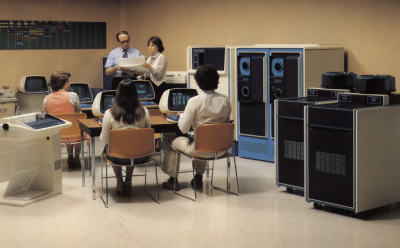
An MV/8000 installation (from DG literature)
The technical side of designing a new computer is just one part of this book. The Soul of a New Machine is three stories: the story of the engineers, the story of the managers, and the story of the machine they built. For this reason, the book has found itself on the reading list of engineering schools and management institutes alike.
The thing that makes this book appeal to the masses is Kidder’s uncanny ability to explain incredibly complex topics in layman’s terms. He manages to explain the inner workings of a 32-bit CPU, all the way down to the level of microcode. He delves into Programmable Array Logic (PALs), forerunners of the CPLD and FPGA devices you read about on our pages today. PALs were a hot new technology back in the late 70’s. They allowed the Eagle team to make changes quickly — without pulling out their wire wrapping tools.
Kidder manages to explain these things in a way that doesn’t leave the average Joe scratching their head, yet doesn’t bore the technically savvy. If he ever decides to stop writing non-fiction, Tracy Kidder would have a career writing user manuals.
The Soul of a New Machine starts in a very unlikely place – on the deck of a sailing ship during a rough storm. The scene is our introduction to the star of the book – Tom West, a manager at Data General. West is multifaceted and enigmatic to say the least. A folk guitarist who was inspired to work on electronics by the Apollo program. He was a few years too late for NASA though. Eventually he found himself travelling the world building and adjusting incredibly accurate clocks at astronomical observatories for the Smithsonian. This meandering path eventually led him to DG, where he was hired as a computer engineer and quickly worked his way up the ranks.
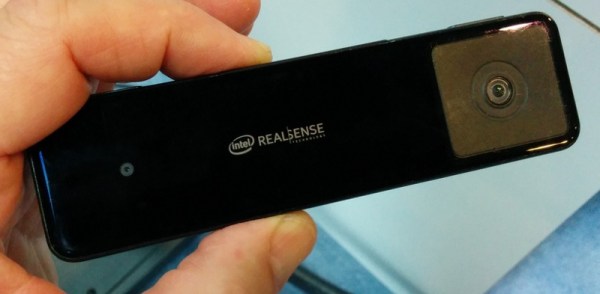
We would be more excited if we knew how much it costs, but in principle the device is super cool. From a robotics research perspective it’s a sort of perfect package. ROS is a wonderful distributed and asynchronous robotic operating system, test, and development platform. The Intel developers designed this unit around the needs of ROS and it comes pre-installed on the camera.
For those who haven’t used ROS before, this is a really cool feature. ROS is natively distributed. It really doesn’t care where the computer supplying its data lives. So, for example, if you already had a robot and wanted to add stereo vision to it. You could offload all the vision processing components of your existing ROS codebase to the Euclid and continue as if nothing changed.
The other option is to use the board as the entire robot brain. It’s self contained with battery and camera. It’s a USB to serial connection away from supercharging any small robotics project.
Unfortunately the board is still a demo, and based on Intel’s history, likely to be too expensive to lure ordinary hackers away from the RasPis and import cameras they already know how to hack together into more or less the same thing. Universities will likely be weak at the knees for such a development though.