Minecraft And Forge: Try This Amazing Way To Visualize Logic

I’ve got virtual circuits on the mind lately. There are a myriad of tools out there that I could pick up to satisfy this compulsion. But the one I’m reaching for is Minecraft. I know what you’re thinking… a lot of people think Minecraft is getting long in the tooth. But chances are you never tried some of the really incredible things Minecraft can do when it comes to understanding logic structures. This goes way beyond simple circuits and easily hops back and forth over the divide between hardware logic and software logic.

Continue reading “Minecraft And Forge: Try This Amazing Way To Visualize Logic”

Get Your Hands On A 2017 Hackaday Superconference Badge

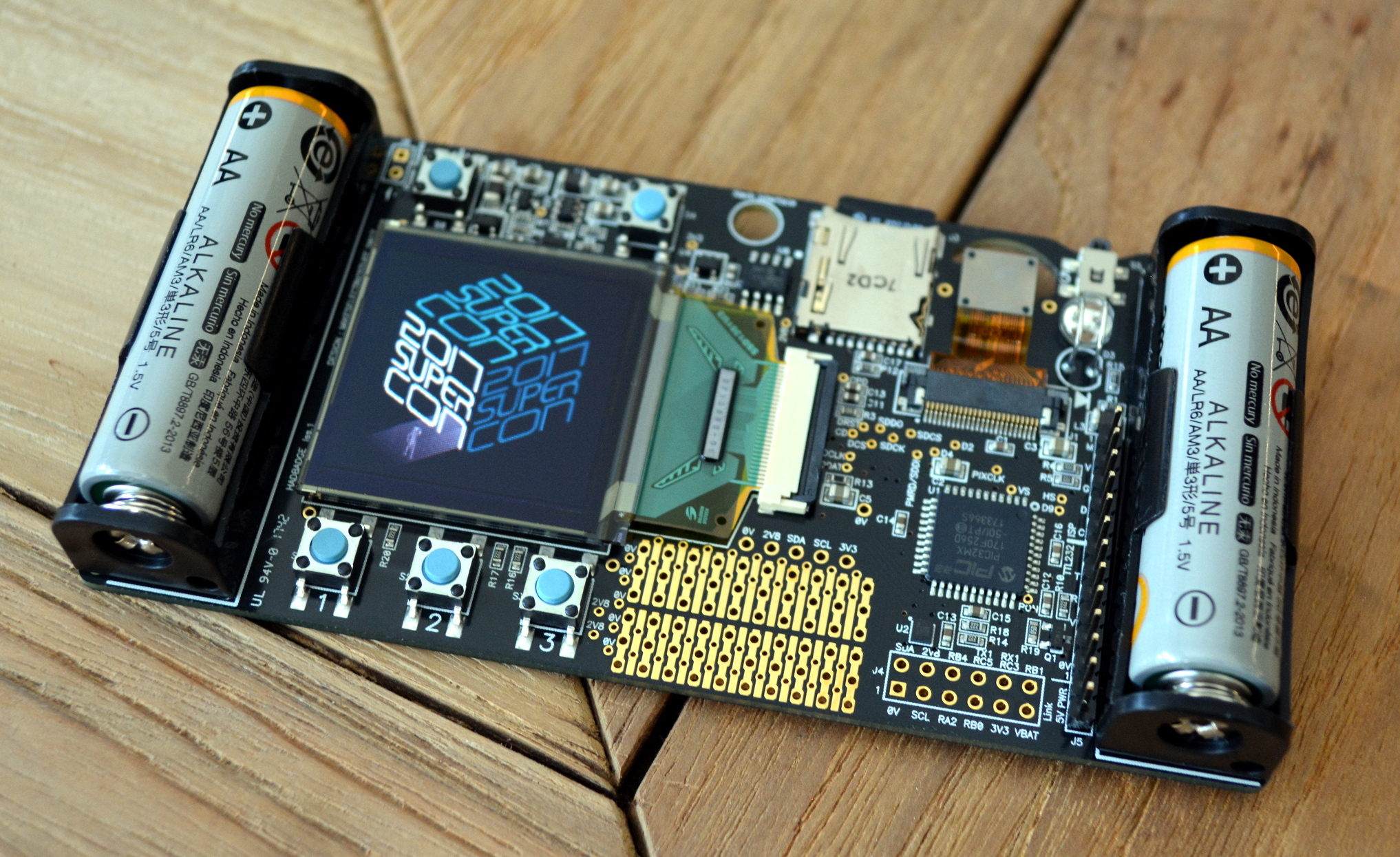
We just got the shipment of hot Hackaday Superconference badges in our hands yesterday, and they’re frankly awesome. Due to great manufacturing partners and a fantastic design by [Mike Harrison], we ended up with too few manufacturing defects and too many badges. How’s that for a nice problem to have?

But our gain is your gain! We have enough badges for everyone who’s coming to the con, and we’re selling the rest on Tindie.
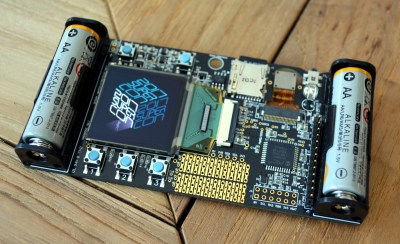
In case you missed it, the badge is a digital video camera, or at least that’s how it’s going to start out its life. It’s got a camera sensor, enough processing power on-board to handle the image data, a screen, and SD card storage. It’s also got a good assortment of buttons, and more importantly, prototyping space and an abundance of pins broken out for you to play with. For the nitty-gritty, see the badge’s Hackaday.io project page. We’ve coded up the obvious applications, added in some challenging puzzles, and now we’re handing them off to you.

Hackaday Badge History

What will you do with them? That remains to be seen. The first time we put on a Supercon, we made the best badge you’ve ever seen — a blank protoboard, and a big pile of parts. Add in an enthusiastic and creative crowd, and out pops magic. Last year, [Voja] produced a badge with finesse and more resources, adding blinkies, IR, and an accelerometer, and we saw hacks making use of each of the features. This year, we’ve pushed it even further. Now it’s your turn.

The Superconference is this weekend, and a few hundred Hackaday hackers will get their hands on this lump of open hardware. Something fantastic is certainly going to happen. If you couldn’t make it but still want to play along, now’s your chance!

Conference badges are a fantastic playground for hardware hackers: they’re a small enough project to get done, but large enough to do something interesting. Some badges, like [Brian Benchoff]’s badge for Tindie, are minimalistic. Others, like this unofficial badge for DEFCON, are quadcopters. In between, there’s room for artistry and aesthetics and just plain cleverness. And don’t forget utility. The 2017 Layer One conference badge (here on Hackaday.io) is easily converted into an OBD II CAN bus sniffer or a video game machine — your pick.

Hackaday loves custom hardware and badges like this are more than just a PCB full of components. They’re a piece of the culture from the event where they made their debut. We’re happy we can share that with some of the hackers who couldn’t make it to Supercon this year.


Robotic Arm Rivals Industrial Counterparts

We’ve seen industrial robotic arms in real life. We’ve seen them in classrooms and factories. Before today, we’ve never mistaken a homemade robotic arm for one of the price-of-a-new-home robotic arms. Today, [Chris Annin] made us look twice when we watched the video of his six-axis robotic arm. Most of the DIY arms have a personal flare from their creator so we have to assume [Chris Annin] is either a robot himself or he intended to build a very clean-looking arm when he started.

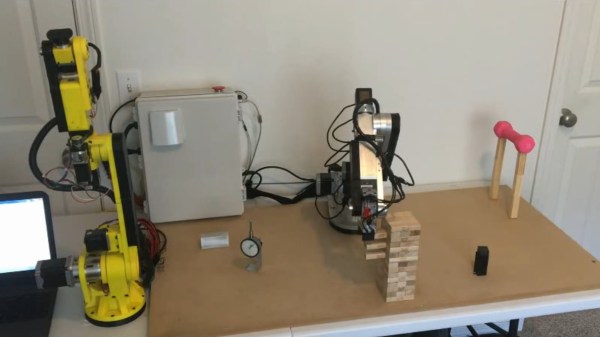
He puts it through its paces in the video, available after the break, by starting with some stretches, weight-lifting, then following it up and a game of Jenga. After a hard day, we see the arm helping in the kitchen and even cracking open a cold one. At the ten-minute mark, [Chris Annin] walks us through the major components and talks about where to find many, many more details about the arm.

Many of the robotic arms on Hackaday are here by virtue of resourcefulness, creativity or unusual implementation but this one is here because of its similarity to the big boys.

Continue reading “Robotic Arm Rivals Industrial Counterparts”

Why You Shouldn’t Quite Forget The Moving Coil Multimeter

Did any of you have an AWS multimeter? Was it the best? Radio-electronics magazine, August 1981.
Did any of you have an AWS multimeter? Was it the best? Radio-Electronics magazine, August 1981.

If you were to ask a random Hackaday reader what their most fundamental piece of electronic test equipment was, it’s likely that they would respond with “multimeter”. If you asked them to produce it, out would come a familiar item, a handheld brick with a 7-segment LCD at the top, a chunky rotary selector switch, and a pair of test probes. They can be had with varying quality and features for anything from a few dollars to a few hundred dollars, though they will nearly all share the same basic set of capabilities. Voltage in both AC and DC, DC current, resistance from ohms to mega ohms, and maybe a continuity tester. More expensive models have more features, may be autoranging, and will certainly have better electrical safety than the cheaper ones, but by and large they are a pretty standard item.

If Hackaday had been around forty years ago and you’d asked the same question, you’d have had a completely different set of multimeters pulled out for your inspection. Probably still a handheld brick with the big selector switch, but instead of that LCD you’d have seen a large moving-coil meter with a selection of scales for the different ranges. It would have done substantially the same job as the digital equivalent from today, but in those intervening decades it’s a piece of equipment that’s largely gone. So today I’m going to investigate moving coil multimeters, why you see them a lot less these days than you used to, and why you should still consider having one in your armoury. Continue reading “Why You Shouldn’t Quite Forget The Moving Coil Multimeter”

Colette Biometric Security Purse Screams When Stolen

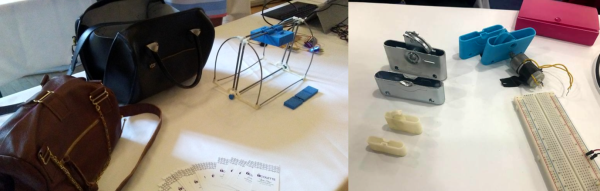
A team of college hackers was disappointed with the selection of secure purses available. Nearly every purse on the market is attractive, secure, or neither so they are designing their own security purse with some style. Instead of just brass or leather clasps keeping unwanted hands out, they are upgrading to automation and steel.

Everything starts with a fingerprint reader connected to an Arduino. Once an acceptable finger is recognized, a motor opens a coffin lock, also known as a butt-joint fastener, which can be completely hidden inside the purse and provides a lot of holding force. That is enough to keep quick fingers from reaching into an unattended purse.

In the case of a mugging, a sound grenade will trigger which should convince most thieves to quickly abandon it. Then, the internal GPS tells the owner where the purse can be found.

We can’t imagine a real-life purse thief prepared to tackle this kind of hardware. Hackaday loves knowing the ins and out of security from purses to cars and of course IoT.

Laser Levitation With Scrap Parts

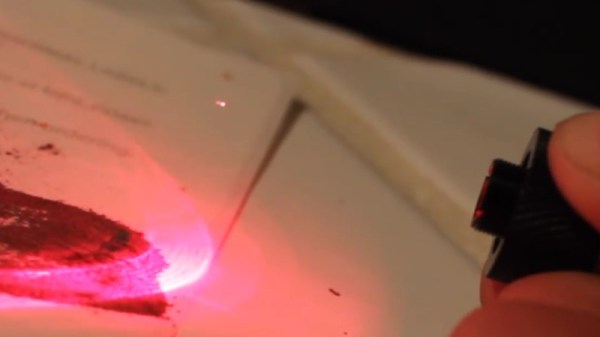
After a year away from YouTube, the ever-energetic [Styropyro] has returned with whiteboard in hand to remind us just how little we actually know about lasers. In the last month he’s really hit the ground running with plenty of new content, but one video of his particularly stands out: a practical demonstration of laser levitation. Even better, unlike most of his projects, it looks like we can replicate this one without killing ourselves or burning our house down!

For those unaware, laser levitation is probably as close as we’ll get to Star Trek-style tractor beams in our lifetimes. In fact, the NASA Innovative Advanced Concepts program has been examining using the technology for capturing small particles in space, since it would allow sample collection without the risk of physical contamination. While the demonstration [Styropyro] performs lacks the “tractor” part of the equation (in other word’s, there’s no way to move the particle along the length of the beam) it does make us hopeful that this type of technology is not completely outside the reach of our home labs.

The trick seems to be with the focus of the laser beam itself. Your average laser pointer just doesn’t have the appropriate beam for this kind of work, but with a diode pulled from a DVD burner and a driver circuit made from parts out of the junk bin, the effect can be demonstrated very easily as long as you can keep the air in the room extremely still. Of course, what you’re trying to pick up is also very important, [Styropyro] has found that synthetic diamond powder works exceptionally well for this experiment. At about $1.60 a gram, it won’t break the bank either.

So how does it work? With a few trips to the aforementioned white board, Professor Pyro explains that the effect we’re seeing is actually electromagnetic. If the particle you want to levitate is small enough it will become polarized by the light, which is in itself an electromagnetic wave. Once you’ve got your mind wrapped around that, it logically follows that the levitating particle will experience the Lorentz force. Long story short, the particle is suspended in the air for the same reason that a projectile is ejected from a rail gun: if you’ve got enough power and the mass of the object is low enough, there will be an observable force.

We’ve been covering the work of [Styropyro] for years now, and are glad to see him back on YouTube creating new content and terrifying a new generation of viewers. Between this and the return of [Jeri Ellsworth], it’s like we’re experiencing a YouTube hacker Renaissance.

Continue reading “Laser Levitation With Scrap Parts”

Romanian Cobra clone

Romania’s 1980s Illicit DIY Computer Movement

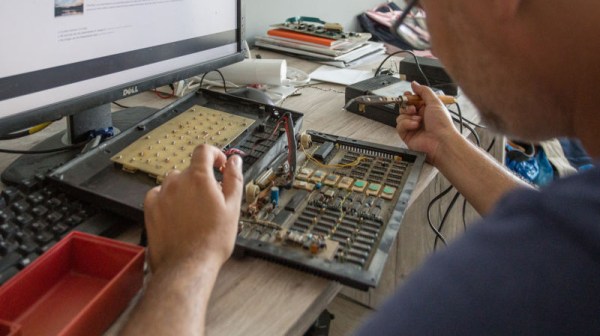
In Western countries in the early 1980s, there was plenty of choice if you wanted an affordable computer: Apple, Atari, TRS-80, Commodore and Sinclair to name a few. But in communist-ruled Romania, mainly you’d find clones of the British Sinclair ZX Spectrum, an 8-bit computer built around the Zilog Z80A, using a CRT TV as display and a BASIC interpreter as UI. The Cobra was one such Romanian Sinclair clone. However, most people couldn’t afford even that, which lead to hackers building their own versions of the Cobra.

Making these clones was highly illegal. But that didn’t stop students at the Politehnica University of Bucharest. They made them for themselves, family and friends, and even sold them at well under market price. To keep people from building radio transmitters, the Communist government kept electronics prices high. So instead, parts smuggled from factories could be paid for with a pack of cigarettes.

Look inside an old Apple II and you’ll see a sea of chips accomplishing what can be done with only a few today. The Cobra clones looked much the same, but with even more chips. Using whatever they could get their hands on, the students would make 30 chips do the job of an elusive $10 chip. No two computers were necessarily alike. Even the keyboards were hacked together, sometimes using keys designed for mainframe computers but with faults from the molding process. These were cleaned up and new letters put on. The results are awesome hacks which fit right in here on Hackaday.

Sadly though, it often takes harsh necessity to make a culture where these inspiring hacks thrive in the mainstream. Another such country which we’ve reported on this happening in is Cuba, which found the necessity first when the U.S. left Cuba in the 60s and again when the Soviet Union collapsed in the 90s, reducing the availability of many factory produced items needed for daily life, and creating a DIY society.