Etch-A-Snap Will Sketch Your Selfies

The Etch-a-Sketch was a hugely popular toy in the days before video games and the Internet became ubiquitous. These days, they’re a fun amusement, but can still be difficult to master. Rather than learn the necessary skills himself, [Martin Fitzpatrick] decided to build a machine to draw for him. Enter the Etch-a-Snap.

The build starts with a Raspberry Pi Zero, equipped with the requisite camera. Images taken are processed into a 100×60 pixel image with 1-bit color. At this stage, a network graph representation is built of the image and used to generate commands for the plotting mechanism to draw the scene. Plotting is achieved with stepper motors that turn the knobs through 3D-printed gears. Plotting is slow, with images taking 15 minutes to an hour to “develop”. The system can also be used to draw manually processed images, which can improve results when images are chosen carefully.

It’s a project that combines modern hardware with a classic toy for some interactive fun. We could imagine a large-scale version of this being a great installation at a science museum or MakerFaire. We’ve seen others tackle a computer-controlled Etch-A-Sketch, too. Video after the break.

Continue reading “Etch-A-Snap Will Sketch Your Selfies”

Building An RC Air Boat From Garbage

What do you get when you combine an old optical drive, some empty soda bottles, and a microcontroller? Well…nothing, really. That’s still just a pile of rubbish. But if you add in a battery, an RC receiver, and some motors, you’re getting dangerously close to a fun little toy to kick around the pond as [Antonio Rizzo] recently demonstrated.

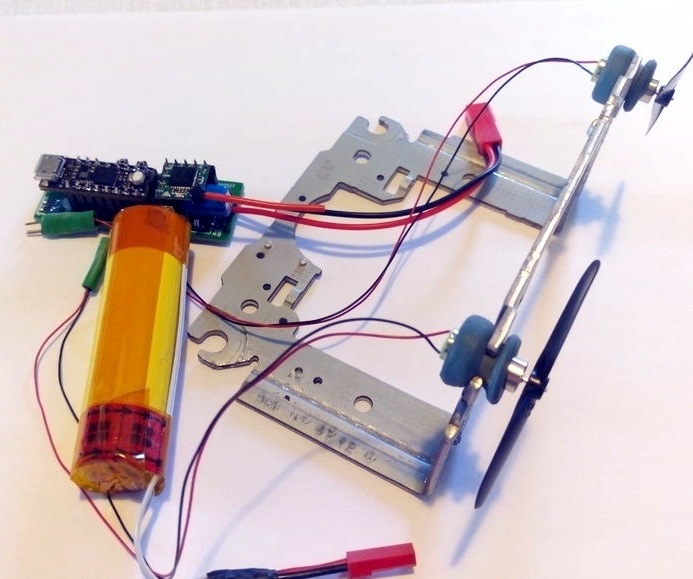
A couple of plastic bottles lashed together make up the hull of the boat, and [Antonio] has used the internal frame of an old optical drive bent at a 90 degree angle to hold the two small DC motors. In a particularly nice touch, the drive’s rubber anti-vibration bushings are reused as motor mounts, though he does admit it was just dumb luck that the motors were a perfect fit.

For the electronics, [Antonio] has paired a custom motor controller up with the uChip, a diminutive Arduino-compatible microcontroller in a narrow DIP-16 package. Wireless communication is provided by an off-the-shelf cPPM receiver such as you might see used in a small plane or quadcopter.

The whole build is powered by a common 18650 lithium-ion battery, which could also be easy enough to recover from the trash given how common they are in laptop batteries; though if you threw a new cell into this build we wouldn’t hold it against you. Everything is put into a high-tech plastic sandwich bag to provide minimum of waterproofing with the minimum of effort.

If using a commercial RC receiver and transmitter is a bit too mainstream for your tastes, you could always roll your own radio.

Continue reading “Building An RC Air Boat From Garbage”

Build Your Own Vacuum Chamber For Degassing And More

A vacuum chamber can be a useful thing to have around the shop. It can be used for all manner of purposes, from science experiments to degassing paints and epoxies. They’re not something you’d find in every workshop, but never fear – you can always build one from scrap you’ve got lying around! (YouTube video, embedded below.)

[VegOilGuy] begins the build with a simple plywood box, which gets screwed together and then tarted up with bodyfiller and paint. This helps to make the box airtight, as well as improving the aesthetics. A slot is then cut in the lid, and then filled with an excessive amount of silicone sealant. A flat plate covered in aluminium foil is placed on top, and the silicone is left to cure for several days.This is used to create a flat sealing surface for the lid to be placed on later.

Once the seal is complete, it’s a simple plumbing job to finish the chamber. [VegOilGuy] does a great job of demonstrating copper soldering and the proper way to install the necessary taps and check valves. Combined with an electric pump, the vacuum chamber passes its tests with flying colors, completely ruining some marshmallows in the process.

With a few dollars spent online for the special bits, it’s a build that any handy maker could throw together in a weekend. You can always go another route, though – like using an old fridge compressor to get the job done.

[Thanks to Keith O for the tip!]

Continue reading “Build Your Own Vacuum Chamber For Degassing And More”

Ask Hackaday: Experiences With Capacitor Failure

Regular readers of Hackaday are intimately knowledgeable about old electronics, and whether it’s about that old oscilloscope sitting in the pile of other oscilloscopes, or the very rare vintage computer made in a Soviet bloc country, someone somewhere knows how to fix it. One of the biggest problems with these old electronics are capacitors. If it isn’t the battery that’s gone dead and leaked all over, it’s the caps that are either out of spec or have already exploded.

These machines can be brought back from the dead, and in recent months and years we’ve seen an uptick in the number of restomods hitting the Hackaday tip line. If you have a soldering iron and the patience to do so, any machine can be brought back from the grave.

Continue reading “Ask Hackaday: Experiences With Capacitor Failure”

Hackaday Podcast 014: Keeping Raspberry’s SD Card Alive, We Love MRRF, And How Hot Are Flip Chips?

Elliot Williams and Mike Szczys take a look at advances in photogrammetry (building 3D models out of many photographs from a regular camera), a delay pedal that’s both aesthetically and aurally pleasing, and the power of AI to identify garden slugs. Mike interviews Scotty Allen while walking the streets and stores of the Shenzhen Electronics markets. We delve into SD card problems with Raspberry Pi, putting industrial controls on your desk, building a Geiger counter for WiFi, and the sad truth about metal 3D printing.

Take a look at the links below if you want to follow along, and as always, tell us what you think about this episode in the comments!

Take a look at the links below if you want to follow along, and as always, tell us what you think about this episode in the comments!

Direct download (60 MB or so.)

Continue reading “Hackaday Podcast 014: Keeping Raspberry’s SD Card Alive, We Love MRRF, And How Hot Are Flip Chips?”

WiFi Controlled Plane Is Cheap Flying Fun

The world of radio controlled aircraft used to be an expensive and exclusive hobby, limited to those with the time and money to invest in difficult builds and pricey radio gear. More recently, the hobby has become more accessible, with cheap ready to fly planes available that can be flown in smaller spaces like suburban parks. [Ravi Butani] has built just such a plane, and you can even fly it with your smartphone!

An ESP8266 does double duty here as both the brains and the communication system. A custom smartphone app communicates with the plane over WiFi. Touching the screen increases the throttle, while steering is achieved through tilting the phone. There’s also monitoring of signal strength and battery level, with the phone vibrating if the plane is getting out of range or low on battery.

Flight control is via differential thrust, with power coming courtesy of two small DC motors controlled by tiny SMD MOSFETs. The plane flies remarkably well in still conditions, and the WiFi connection is stable in an open park environment. [Ravi] reports that control is possible at a range of around 70 meters using a Motorola G5S smartphone.

Despite the simplicity of the build and the low cost of the components, the final product performs admirably. It would be a great weekend project, and at the end of it, you get to go and fly your new plane! If you’re worried about keeping your batteries charged, don’t worry – there’s a solution for that. Video after the break.

Continue reading “WiFi Controlled Plane Is Cheap Flying Fun”

Televox: The Past’s Robot Of The Future

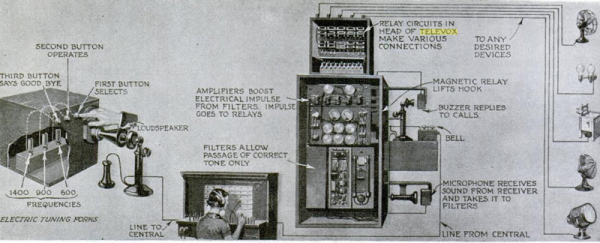
When I read old books, I like to look for predictions of the future. Since we are living in that future, it is fun to see how they did. Case in point: I have a copy of “The New Wonder Book of Knowledge”, an anthology from 1941. This was the kind of book you wanted before there was a Wikipedia to read in your spare time. There are articles about how coal is mined, how phonographs work, and the inner workings of a beehive. Not the kind of book you’d grab to look up something specific, but a great book to read if you just want to learn something interesting. In it there are a few articles about technology that seemed ready to take us to the future. One of those is the Televox — a robot from Westinghouse poised to usher in an age of home and industrial mechanical servants. Robots in 1941? Actually, Televox came into being in 1927.

If you were writing about the future in 2001, you might have pictured city sidewalks congested with commuters riding Segways. After all, in 2001, we were told that something was about to hit the market that would “change everything.” It had a known inventor, Dean Kamen, and a significant venture capitalist behind it. While it has found a few niche markets, it isn’t the billion dollar personal transportation juggernaut that was predicted.

But technology is like that. Sometimes things seem poised for greatness and disappear — bubble memory comes to mind. Sometimes things have a few years of success and get replaced by something better. Fax machines or floppy drives, for example. The Televox was a glimpse of what was to come, but not in any way that people imagined in 1941. Continue reading “Televox: The Past’s Robot Of The Future”