Nightmare Robot Only Moves When You Look Away

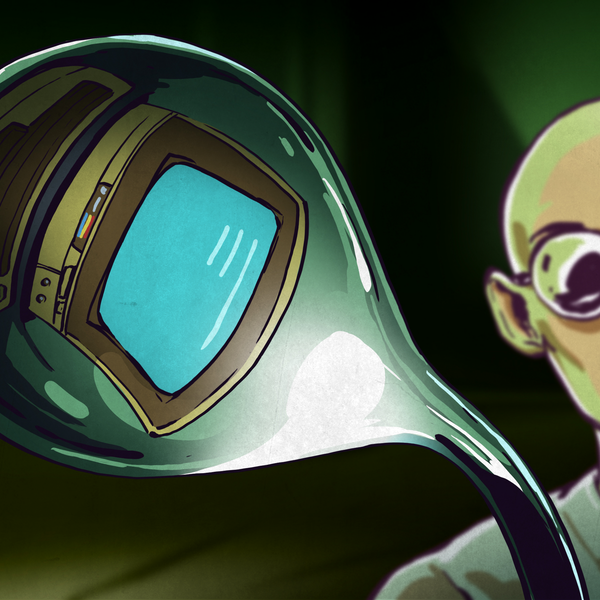
What could be more terrifying than ghosts, goblins, or clowns? How about a shapeless pile of fright on your bedroom floor that only moves when you’re not looking at it? That’s the idea behind [Sciencish]’s nightmare robot, which is lurking after the break. The Minecraft spider outfit is just a Halloween costume.

In this case, “looking at it” equates to you shining a flashlight on it, trying to figure out what’s under the pile of clothes. But here’s the thing — it never moves when light is shining on it. It quickly figures out the direction of the light source and lies in wait. After you give up and turn out the flashlight, it spins around to where the light was and starts moving in that direction.

The brains of this operation is an Arduino Uno, four light-dependent resistors, and a little bit of trigonometry to find the direction of the light source. The robot itself uses two steppers and printed herringbone gears for locomotion. Its chassis has holes in it that accept filament or wire to make a cage that serves two purposes — it makes the robot into more of an amorphous blob under the clothes, and it helps keep clothes from getting twisted up in the wheels. Check out the demo and build video after the break, because this thing is freaky fast and completely creepy.

While we usually see a candy-dispensing machine or two every Halloween, this year has been more about remote delivery systems. Don’t just leave sandwich bags full of fun size candy bars all over your porch, build a candy cannon or a spooky slide instead.

Continue reading “Nightmare Robot Only Moves When You Look Away”
A Clock From An Electricity Meter

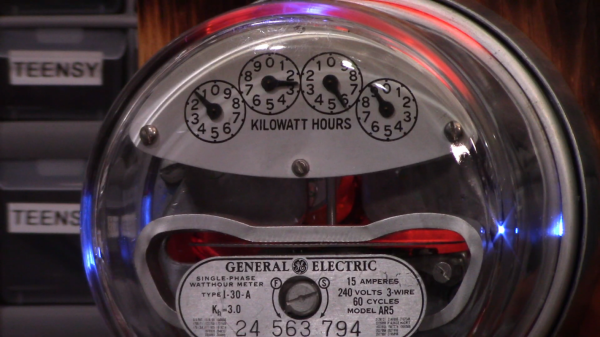
Electric utilities across the world have been transitioning their meters from the induction analog style with a distinctive spinning disc to digital “smart” meters which aren’t as aesthetically pleasing but do have a lot of benefits for utilities and customers alike. For one, meter readers don’t need to visit each meter every month because they are all networked together and can download usage data remotely. For another, it means a lot of analog meters are now available for projects such as this clock from [Monta].

The analog meters worked by passing any electricity used through a small induction motor which spun at a rate proportional to the amount of energy passing through it. This small motor spun a set of dials via gearing in order to keep track of the energy usage in the home or business. To run the clock, [Monta] connected a stepper motor with a custom transmission to those dials for the clock face because it wasn’t possible to spin the induction motor fast enough to drive the dials. An Arduino controls that stepper motor, but can’t simply drive the system in a linear fashion because it needs to skip a large portion of the “minutes” dials every hour. A similar problem arises for the “hours” dials, but a little bit of extra code solves this problem as well.

Once the actual clock is finished, [Monta] put some finishing touches on it such as backlighting in the glass cover and a second motor to spin the induction motor wheel to make the meter look like it’s running. It’s a well-polished build that makes excellent use of some antique hardware, much like one of his other builds we’ve seen which draws its power from a Stirling engine.

Continue reading “A Clock From An Electricity Meter”

Five-Axis Pumpkin Carving

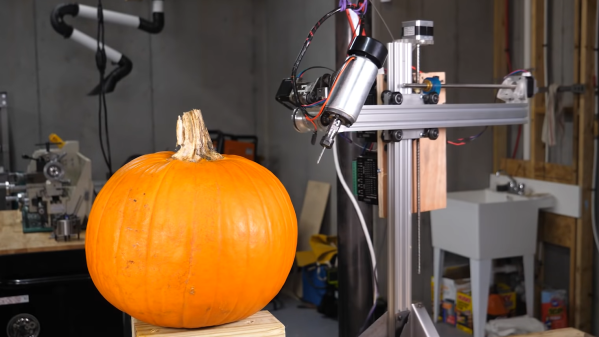
The day of carved pumpkins is near, and instead of doing manually like a mere mortal, [Shane] of [Stuff Made Here] built a five-axis CNC machine to take over carving duties. (Video, embedded below.)

[Shane] initially intended to modify his barber robot, but ended up with a complete redesign, reusing only the electronics and the large ring bearing in the base. The swiveling spindle is a rotating gantry with two sets of aluminum extrusions for vertical and horizontal motion. The gantry isn’t very rigid, but it’s good enough for pumpkin carving. Software is the most challenging part of the endeavor due to the complexity of five-axis motion and mapping 2D images onto a roughly spherical surface. Cartographers have dealt with this for a long time, so [Shane] turned to Mercator projection to solve the problem. We’re also relieved to hear that we aren’t the only ones who sometimes struggle with equation-heavy Wikipedia pages.

Since there are no perfectly spherical pumpkins, [Shane] wrote a script to probe the surface of the pumpkin with a microswitch before cutting, appropriately named “TSA.exe”. The machine is capable of carving both profiles and variable depth lithophanes, mostly of [Shane]’s long-suffering wife. She seriously deserves an award for holding onto her sense of humor.

With projects like explosive baseball bats and CNC basketball hoop, the [Stuff Made Here] YouTube Channel is worth keeping an eye on.

Tracking Satellites With A Commodore PET

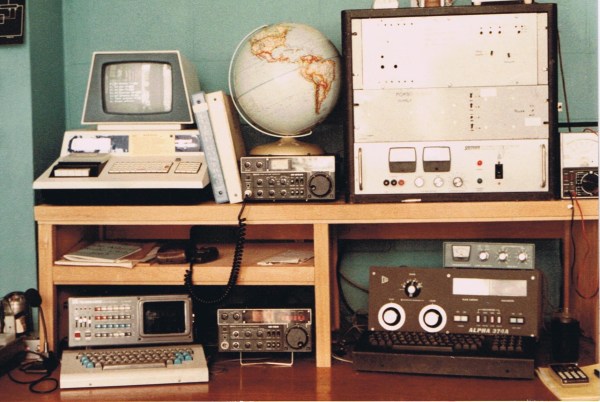
A recent writeup by Tom Nardi about using the 6502-based NES to track satellites brought back memories of my senior project at Georgia Tech back in the early 80s.  At our club station W4AQL, I had become interested in Amateur Radio satellites.  It was quite a thrill to hear your signal returning from space, adjusting for Doppler as it speeds overhead, keeping the antennas pointed, all while carrying on a brief conversation with other Earth stations or copying spacecraft telemetry, usually in Morse code.

Continue reading “Tracking Satellites With A Commodore PET”

Alfred Jones And Kipp Bradford To Deliver Keynotes At Remoticon Next Week

There’s just one week left until Hackaday Remoticon, our online gathering in place of our traditional in-person conference during this time of social distancing. Joining the more than 20 hands-on workshops that make up the bulk of Remoticon, we’re excited to announce the two keynote speakers who will be taking the virtual stage: Alfred Jones and Kipp Bradford.

Tickets to see these keynote talks, to watch the SMD Challenge, to see hardware demos, and to take part in the show and tell are free, so get yours today!


Alfred Jones

Alfred Jones

Head of Mechanical Engineering at Lyft’s Self-Driving Division

Alfred Jones is the Head of Mechanical Engineering at Lyft’s level 5 self-driving division. Level 5 means there are no humans involved in operating the vehicle and it is still capable of driving anywhere a human could have. What goes into modifying a vehicle for this level of self-driving? What processes does his team use to deliver safe automation? And will cars in the near future completely get rid of the driver’s seat? Alfred knows and we’ll be hanging on his every word!

Kipp BradfordKipp Bradford

CTO fo Treau

Kipp Bradford is the CTO of Treau, a company bringing heating, ventilation, and air conditioning (HVAC) into the information age. These systems contribute as much as 20% of global emissions each year, so even small efficiency gains stand to have a huge impact. The industry has remained nearly unchanged for decades, and Kipp is at the forefront of evolving the hidden systems found in nearly every building. Will the air conditioner of tomorrow make the one we have today look like a rotary telephone? We look forward to hearing what Kipp has to say about it.

We’re so excited to have these two phenomenal speakers who have also both been involved as expert judges in the Hackaday Prize (Alfred in 2020, Kipp in 2017 and 2018). Help us show our appreciation by packing the virtual lecture halls for their talks on Saturday, November 7th! Get your free ticket now.

Rockin’ Out In LTSpice: Simulating Classic Guitar Pedals

Musicians have a fantastic language to describe signals. A sound can be fat, dark, crunchy, punchy — the list goes on. These aren’t very technical terms, but they get the job done. After all, it’s much easier to ask to guitarist for a crisper sound than to ask them to sharpen the edges of the waveform, while amplifying the high-frequency components and attenuating the low-frequency components. Of course, it’s fun to look at signals this way as well, especially when you can correlate shifts in sound quality to changes in the waveform and, ideally, the circuit that produces it.

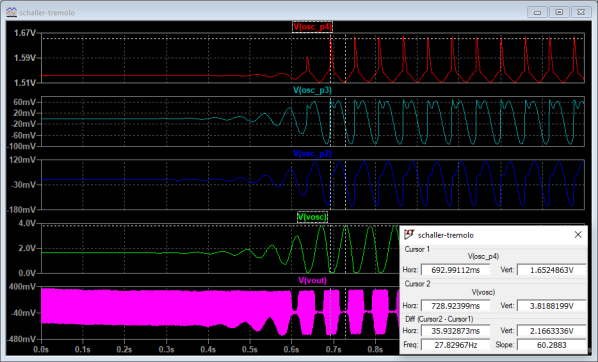
To undergo such an investigation, [Nash Reilly] has been simulating guitar effects pedals in LTSpice. Able to find most of the schematics he needs online, [Nash] breaks down the function of each part of the circuit and builds a simulation of the entire system. His write-up clearly explains, and often demonstrates, what’s going on inside the box. On the surface, it’s an interesting tour of the inner workings of your favorite effects pedals. Beyond that, it’s an excellent survey of analog design that is well-worth the read for anybody interested in audio, electronics, or audio electronics.

For those interested in taking the physical route rather than the simulated one, we’ve taken a look at pedal design before. Anybody who wants to try their hand at creating simulations can grab a copy of LTSpice, or check out a package called LiveSpice, which lets you simulate circuits in realtime and use them to process live audio — pretty useful for prototyping guitar effects.

DSL Is Barely Hanging On The Line As Telcos Stop Selling New Service

Are you reading this over AT&T DSL right now? If so, you might have to upgrade or go shopping for a new ISP soon. AT&T quietly stopped selling new traditional DSLs on October 1st, though they will continue to sell their upgraded fiber-to-the-node version. This leaves a gigantic digital divide, as only 28% of AT&T’s 21-state territory has been built out with full fiber to the home, and the company says they have done almost all of the fiber expansion that they intend to do. AT&T’s upgraded DSL offering is a fiber and copper hybrid, where fiber ends at the network node closest to the subscriber’s home, and the local loop is still over copper or coax.

At about the same time, a report came out written jointly by members of the Communications Workers of America union and a digital inclusion advocacy group. The report alleges that AT&T targets wealthy and non-rural areas for full fiber upgrades, leaving the rest of the country in the dark.

As the internet has been the glue holding these unprecedented times together, this news comes as a slap in the face to many rural customers who are trying to work, attend school, and see doctors over various videoconferencing services.

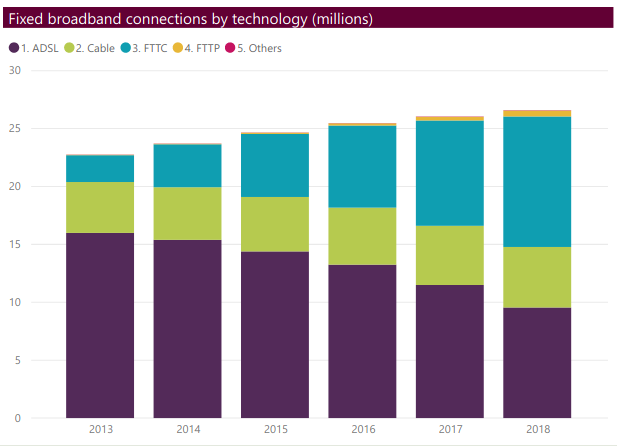
If you live in a big enough city, chances are you haven’t thought of DSL for about twenty years, if ever. It may surprise you to learn of the popularity of ADSL in the United Kindom. ADSL the main source of broadband in the UK until 2017, having been offset by the rise of fibre-to-the-cabinet (FTTC) connections. However, this Ofcom report shows that in 2018 ADSL still made up more than a third of all UK broadband connections.

Why do people still have it, and what are they supposed to do in the States when it dries up?

Continue reading “DSL Is Barely Hanging On The Line As Telcos Stop Selling New Service”