With a seemingly endless list of shortages of basic items trotted across newsfeeds on a daily basis, you’d be pardoned for not noticing any one shortage in particular. But in among the shortages of everything from eggs to fertilizers to sriracha sauce has been a growing realization that we may actually be running out of something so fundamental that it could have repercussions that will be felt across all aspects of our technological society: helium.
The degree to which helium is central to almost every aspect of daily life is hard to overstate. Helium’s unique properties, like the fact that it remains liquid at just a few degrees above absolute zero, contribute to its use in countless industrial processes. From leak detection and welding to silicon wafer production and cooling the superconducting magnets that make magnetic resonance imaging possible, helium has become entrenched in technology in a way that belies its relative scarcity.
But where does helium come from? As we’ll see, the second lightest element on the periodic table is not easy to come by, and considerable effort goes into extracting and purifying it enough for industrial use. While great strides are being made toward improved methods of extraction and the discovery of new deposits, for all practical purposes helium is a non-renewable resource for which there are no substitutes. So it pays to know a thing or two about how we get our hands on it.



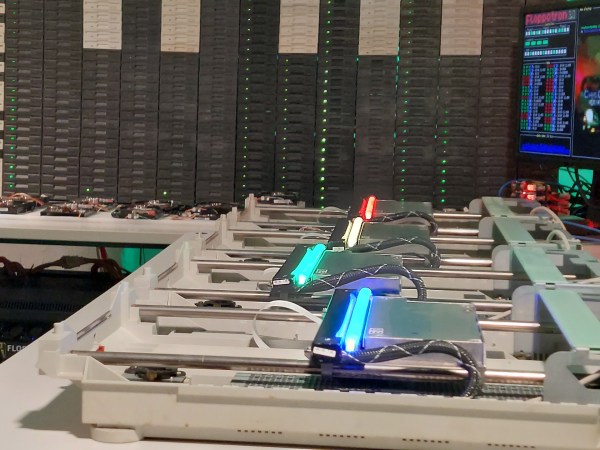
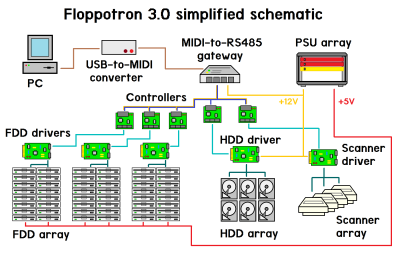 the collection of instrument controllers. These controllers are generic enough to take RS485 input and control a dedicated driver for either an array of floppy drives (up to 192), an array of hard drives or the handful of scanners. The way the floppy drives are grouped is quite neat. Rather than using each drive to generate a specific tone, the software uses the whole column for each note. By varying the number of drives moving simultaneously over time, the sound volume varies, simulating the note envelope and giving a richer sound. Multiple columns driving in parallel give the system a 16-note polyphony. The floppies cover the low notes, with the four flatbed scanners covering the higher notes. MIDI drum sounds are mapped to the hard disks, operating in a, well, percussive manner, with different case shapes giving unique sounds. Even the firmware can be updated over MIDI! So, checkout the demo video after the break for a sweet rendition of the very familiar “Entry of the gladiators” by